
Thread Transfer
Best practices for AI context management
Frameworks, templates, and checklists we use with customers to tame context sprawl without losing essential nuance.
Thread Transfer
AI Systems for Builders
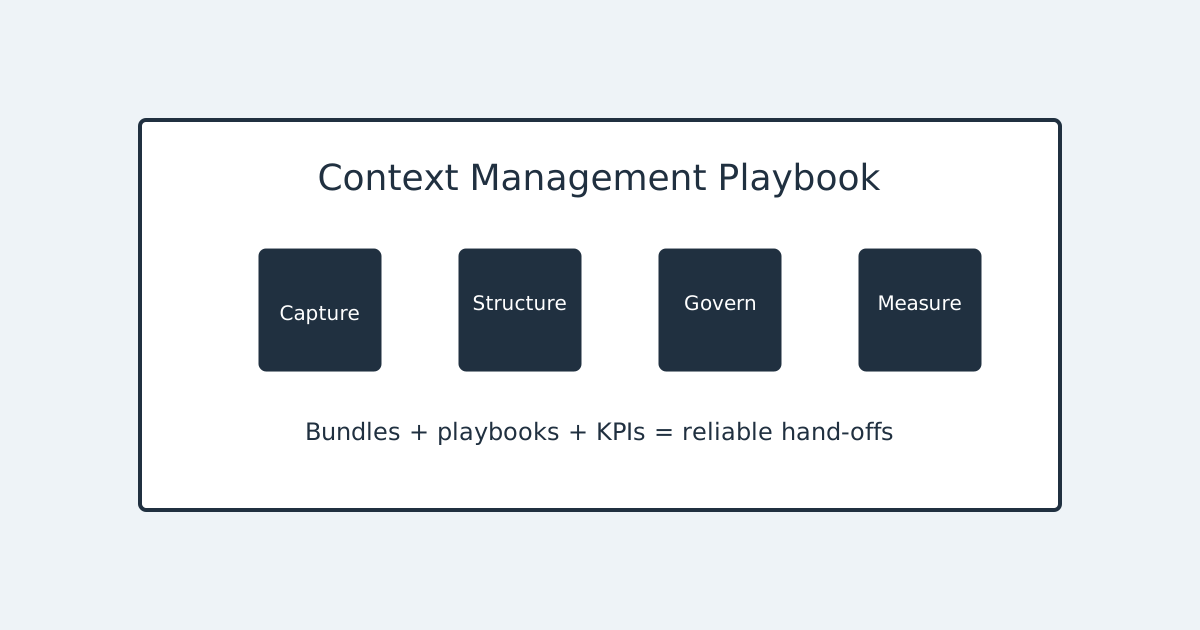
Every team we onboard shares the same anxiety: “We finally centralised our conversations, but no one can find anything when it matters.” Context management is no longer a side project for ops—it is a core capability for anyone shipping AI into production. This field guide distills the playbook we run with support, research, and operations teams when we implement Thread-Transfer. The goal: preserve nuance, reduce noise, and make every conversation reusable without hours of manual curation.
Start with a context inventory
Before you automate anything, map the conversation types that drive outcomes. Sit with stakeholders and ask which threads resurface during audits, hand-offs, or escalation calls. We tag them into four buckets:
- Critical incidents. Outages, security reviews, or compliance escalations that must be preserved with an audit trail.
- Revenue moments. Renewals, deal desk discussions, or enterprise QBRs with high commercial stakes.
- Product decisions. Threads where roadmap choices or scope trade-offs were made.
- Knowledge transfers. Onboarding flows, research debriefs, or internal tool walkthroughs.
Give each bucket an owner and a service-level expectation for how quickly the conversation hits its home.
Operationalise capture, not curation
The easiest way to lose context is to rely on someone remembering to tidy things up. Instead, embed capture in the workflow:
- Hotkeys and slash commands. Make it trivial for agents to flag a thread for distillation without leaving the conversation.
- Lifecycle hooks. Trigger exports when a ticket moves to “Resolved,” when an incident channel is archived, or when a Salesforce opportunity hits a stage.
- Consent banners. Let participants know the conversation will be captured. Trust is easier to maintain when people aren’t surprised later.
Standardise the format once
Context only travels if the receiving tool knows what to do with it. We align on a single bundle schema that includes:
- Facts. Verified statements with source message IDs.
- Decisions. Owners, timestamps, next steps, and blockers.
- References. Links to attachments, dashboards, or CRM records.
- Metadata. Distillation recipe version, participants, and integrity hashes.
Once the bundle schema is enforced, you can push the same file into a knowledge base, analytics pipeline, or LLM prompt without brittle transformations.
Layer your guardrails
Context is only useful if it is trustworthy. Our favourite safeguards include:
- Immutable storage. Save the original bundle in an append-only bucket or Git repo so it becomes part of the operational record.
- Automated diffing. When a bundle updates, generate a diff that shows what changed and why. Legal and compliance teams love this.
- Access tiers. Use tagged blocks (public, internal, restricted) so the same conversation can power multiple surfaces without oversharing.
Teach the organisation how to read bundles
Tools are useless if no one knows how to interpret them. Run a 30-minute enablement session covering:
- Where bundles live and how to search for them.
- How to verify a block by jumping back to the source message.
- How to add clarifications without mutating the original bundle.
- Where to escalate if a bundle is missing or looks wrong.
Record the session and make it part of onboarding for managers and new hires across operations, success, and engineering.
Measure what matters
We instrument context programmes with three KPIs:
- Reuse rate. How often bundles are opened or referenced within 30 days.
- Hand-off efficiency. Time between “conversation ended” and “context available in the target tool.”
- Escalation clarity. The percentage of follow-up tickets citing missing context—we aim for under 5%.
Example weekly checklist
Assign this to the operations lead or programme manager:
| Task | Owner | Why it matters |
|---|---|---|
| Review failed bundle generations | On-call engineer | Catch schema drift or upstream API changes before they snowball. |
| Spot-check three random bundles | Ops manager | Validate that decisions map to the source thread and metadata is complete. |
| Update knowledge base playbooks | Customer education | Keep the rest of the organisation informed about bundle best practices. |
| Report KPIs to leadership | Programme owner | Make momentum visible so the initiative stays funded. |
Close the loop every quarter
Schedule a quarterly retro with stakeholders. Bring fresh metrics, bundle samples, and any escalations. Decide whether to adjust the schema, tighten access controls, or add new capture hooks. Momentum comes from treating context management like a product, not a checklist.
Need help tailoring this playbook to your organisation? Email me at info@thread-transfer.com and we’ll run the first workshop with you.
Learn more: How it works · Why bundles beat raw thread history