
Thread Transfer
Understanding token economics in AI development
A practical walkthrough of forecasting token spend, scenario planning for new model launches, and aligning finance with engineering.
Thread Transfer
AI Systems for Builders
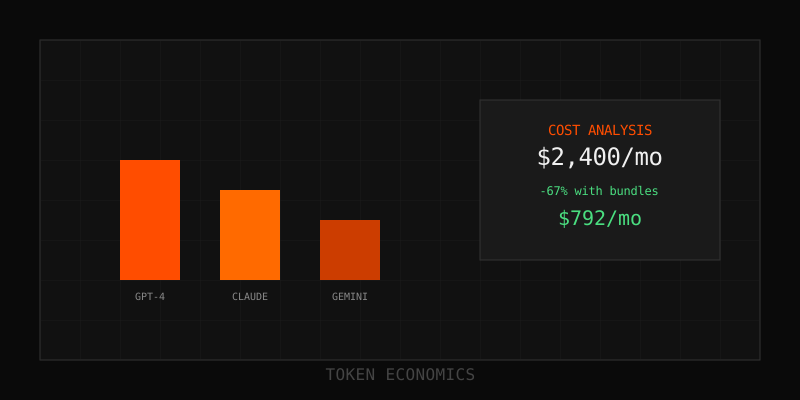
Tokens are the new cloud bill. Every product leader we talk to can recite their AWS spend, yet token invoices still arrive like surprise packages. Understanding token economics is now a prerequisite for responsible AI development. This article breaks down how we model token spend, what variables matter most, and the frameworks finance and engineering leaders use to stay aligned.
The three layers of token spend
- Acquisition. How many tokens you ingest to gather context—chat transcripts, CRM notes, support history. These costs grow with customer volume.
- Transformation. Tokens burned by cleaning, distilling, or augmenting the data before it hits a model. This is where Thread-Transfer bundles shine by trimming redundant context.
- Inference. The tokens consumed by the downstream model during prompts and completions. Inference spend scales with usage and context window size.
Forecasting model
Build a simple forecasting dashboard in your warehouse and track the following per workload:
- Volume. Number of conversations, prompts, or documents processed.
- Average tokens per unit. Both before and after distillation or preprocessing.
- Model mix. Which vendors and model families you hit each month.
- Unit cost. Maintain a price book with current rates for each model.
Feed this data into a monthly planning model that projects spend under conservative, expected, and aggressive growth scenarios. Finance will love you for it, and product can make resourcing decisions with evidence instead of anecdotes.
Scenario planning for new features
Before green-lighting an AI-powered feature, run three questions:
- What if usage doubles overnight? Ensure model choices and prompting strategies can handle spikes without wrecking budgets.
- How sensitive is the experience to latency? Larger models burn more tokens and add delay. Sometimes a smaller model plus a high-quality bundle wins.
- Can we defer context? Instead of shipping the entire conversation, store a bundle and retrieve only the blocks you need at runtime.
Token cost levers you control
- Prompt architecture. Long prompt templates that repeat instructions multiply your spend. Parameterise what you can and audit prompts quarterly.
- Retrieval quality. Sending the top 20 matches from a vector store because “why not?” is the fastest way to burn money. Tune retrievers for precision.
- Context retention policies. Decide how long expanded context stays live. Many teams cache bundle IDs but delete expanded prompts after a week.
Negotiating with vendors
Walk into vendor conversations prepared with:
- Historical spend by model family and use case.
- Forecasted volume for the next two quarters.
- Evidence of optimisation (distillation, prompt trimming) so discounts are justified.
Vendors are more flexible when you can show you’re an intentional, growing customer rather than a team guessing at usage.
Framework for cross-functional alignment
Build a monthly “token council” with product, engineering, finance, and operations. Review actuals vs. plan, upcoming experiments, and any large transcripts that need special handling. This prevents surprise invoices and keeps everyone accountable for the impact of the features they ship.
Case study: Platform team rollout
A fintech platform customer discovered 38% of their inference bill came from agents pasting entire client histories into prompts. After moving to Thread-Transfer bundles, they trimmed the context window by 62% and reallocated the savings to dedicated red-team exercises. Finance now receives a weekly CSV mapping token spend to business outcomes, so there are no off-cycle budget conversations.
Closing thoughts
Treat token spend like any other utility bill. Model it, monitor it, and optimise continuously. Bundles enforce discipline at the context layer, but it still takes a cross-functional mindset to keep costs in check. Want a copy of our spreadsheet templates or API scripts? Get in touch.
Learn more: How it works · Why bundles beat raw thread history