
Thread Transfer
Context engineering vs prompt engineering: What changed in 2025
Prompt engineering got you started. Context engineering gets you to production. Here's what changed and why it matters for your AI stack.
Thread Transfer
AI Systems for Builders
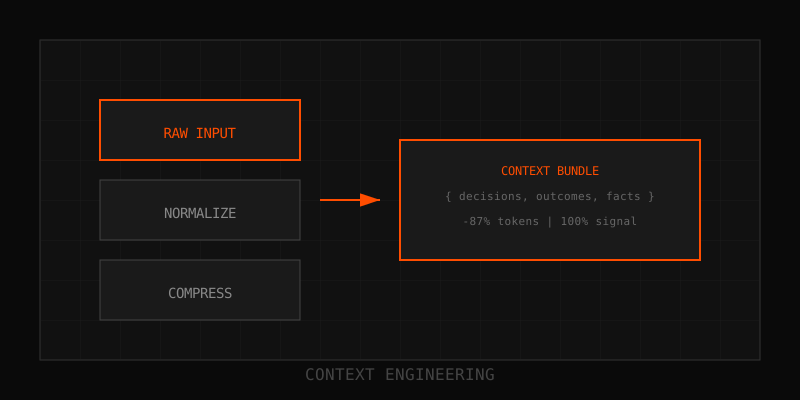
In 2023, "prompt engineering" was the hottest skill in AI. By 2025, the conversation shifted. Teams realized that crafting better prompts couldn't solve the real problem: context architecture. Enter context engineering—the discipline of designing entire systems that prepare, structure, and deliver context to AI models.
What is context engineering?
Context engineering treats context as infrastructure. Instead of hand-tuning a single prompt, you architect how information flows into your AI system: how it's sourced, filtered, compressed, indexed, retrieved, and delivered. It's the difference between writing one great SQL query and designing a database schema.
Prompt engineering asks: "What should I say to the model?"
Context engineering asks: "What does the model need to know, and how do I get it there efficiently?"
Why the shift happened
Three forces pushed the industry from prompts to context:
- Context windows exploded. GPT-3 had 4k tokens. GPT-4 Turbo has 128k. Claude 3 has 200k. Gemini 1.5 Pro hit 1 million. The bottleneck moved from "how much context can I give?" to "how do I manage it all?"
- RAG went mainstream. Retrieval-Augmented Generation proved you don't need to fit everything in a prompt. You can fetch what you need on-demand. But now you need vector stores, chunking strategies, reranking, and query augmentation—none of which are "prompting."
- Agents demand structure. Autonomous agents need more than clever wording. They need tools, memory, verification loops, and guardrails. That's infrastructure, not copy.
Key components of context engineering
A mature context architecture includes:
- Ingestion pipelines: How raw data (Slack threads, support tickets, docs) enters the system.
- Normalization layers: Cleaning, deduplication, entity extraction.
- Storage strategies: Vector databases, graph stores, relational DBs for metadata.
- Retrieval logic: Semantic search, hybrid search, query rewriting.
- Compression: Techniques like summarization, LLMLingua, or structured distillation to fit more meaning in fewer tokens.
- Delivery contracts: How context is packaged and handed to the model (JSON, markdown, bundles).
How Thread-Transfer fits
Thread-Transfer is a context engineering tool. It takes long, messy AI conversations and distills them into structured bundles that preserve decisions, outcomes, and key facts while stripping noise. Instead of dumping 50 messages into a new chat and hoping the model picks up the thread, you pass a compact bundle that's been engineered for reuse.
That's the shift: from "writing better prompts" to "building better context infrastructure." Prompt engineering got you started. Context engineering gets you to production.
Implementation tips
- Start with observability. Log every context payload. Track token counts, retrieval latency, and model performance. You can't optimize what you don't measure.
- Design for compression. Assume you'll need to shrink context later. Use structured formats (JSON, markdown tables) instead of free-form prose.
- Version your context. As schemas evolve, tag each context payload with a version so you can safely roll forward or back.
- Build handoff contracts. If context moves between systems (Slack to Linear, support chat to CRM), define what must travel with it.
The best AI teams in 2025 aren't hiring "prompt engineers." They're hiring context architects. If you're still thinking one prompt at a time, you're already behind.
Learn more: How it works · Why bundles beat raw thread history