
Thread Transfer
LLM API pricing 2025: Complete cost breakdown and optimization guide
We analyzed 15+ LLM providers so you don't have to. Here's the definitive 2025 pricing guide with optimization strategies.
Thread Transfer
AI Systems for Builders
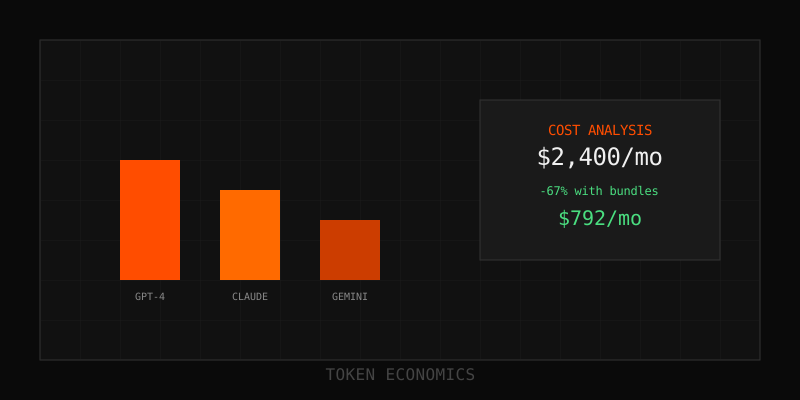
LLM pricing in 2025 has stabilized into a clear hierarchy: ultra-fast frontier models at premium rates, mid-tier models balancing speed and cost, and budget options for high-volume workloads. Understanding the full pricing landscape—including hidden fees, volume discounts, and caching strategies—can cut your AI bill by 40-70%. This guide breaks down every major provider's pricing and shows you where to optimize.
GPT-4o and GPT-4 Turbo pricing
OpenAI's flagship models remain the industry benchmark. GPT-4o costs $2.50 per million input tokens and $10.00 per million output tokens. GPT-4 Turbo runs $10 input / $30 output. For comparison, the original GPT-4 was $30 input / $60 output—prices have dropped 66% in 18 months.
OpenAI offers cached input tokens at 50% off ($1.25/M for GPT-4o). If you're sending the same system prompt or document prefix repeatedly, this alone can cut costs in half.
Claude 4 and Claude 3.5 Sonnet
Anthropic's Claude 4 Opus (their most capable model) prices at $15 input / $75 output per million tokens. Claude 3.5 Sonnet is the sweet spot: $3 input / $15 output with performance rivaling GPT-4o.
Anthropic's prompt caching is aggressive: cache writes cost $3.75/M, cache reads $0.30/M. For applications with large static context (legal docs, code repositories), this achieves 90% cost reduction on cached portions.
Google Gemini: Flash vs Pro
Gemini 1.5 Flash is the budget champion: $0.075 input / $0.30 output per million tokens—40x cheaper than GPT-4o for input. It handles 1M token context windows and is perfect for high-volume summarization, classification, and extraction tasks.
Gemini 1.5 Pro ($1.25 input / $5 output) competes with GPT-4o on quality while undercutting it by 50% on price. Both models support 2M token context in preview, making them attractive for long-document workflows.
Hidden costs you need to track
- Data transfer fees. Egress charges from cloud providers can add 5-15% to your bill if you're moving large datasets between regions.
- Failed requests. Rate limits and errors still burn tokens on partial completions. Add retry logic with exponential backoff to minimize waste.
- Tokenization overhead. Some providers count special tokens (delimiters, role markers) differently. Test with the official tokenizer libraries to avoid surprises.
- Minimum batch sizes. Batch APIs often require minimum request counts. Small teams may pay for unused capacity.
Optimization strategies that work
1. Model routing. Route simple queries to cheaper models. Use GPT-4o for complex reasoning, Gemini Flash for extraction. One team cut costs 70% by classifying requests first.
2. Prompt compression. Tools like LLMLingua compress prompts by 5-20x without losing fidelity. Works best for repeated context like product catalogs or policy documents.
3. Structured outputs. Force models to return JSON instead of verbose prose. Cuts output tokens by 30-50% and makes parsing deterministic.
4. Context bundling. Thread-Transfer bundles distill long conversations into compact, structured blocks—reducing context windows by 40-80% while preserving decisions and outcomes.
Cost calculator tips
Build a simple spreadsheet model: average input tokens, average output tokens, requests per day, model mix percentages. Plug in provider pricing and compare scenarios. Add sliders for cache hit rate and routing percentages to see how optimization strategies impact spend.
Track actual vs. forecast weekly. Variance over 15% signals a prompt change, usage spike, or model shift that needs investigation.
Volume discounts and enterprise contracts
Most providers offer tiered discounts starting at $50k/month spend. Typical structure: 10% off at $50k, 15% at $100k, 20% at $500k. If you're forecasting consistent volume, negotiate upfront. Bring historical usage data and growth projections—vendors reward customers who can prove they're optimizing, not just burning tokens.
When to lock in rates vs. stay flexible
If your workload is stable and you're confident in your model choice, annual contracts lock in predictable costs. But if you're experimenting or expect to shift models as new releases drop, stay on pay-as-you-go and invest in routing infrastructure instead.
Closing thoughts
LLM pricing is now competitive enough that optimization matters more than vendor selection. A well-architected system with routing, caching, and compression will outperform a naive single-model approach by 3-5x. Want help modeling your specific workload? Reach out—we share our cost models with customers.
Learn more: How it works · Why bundles beat raw thread history