
Thread Transfer
Token budgeting for enterprise AI: A CFO's guide
Engineering speaks tokens. Finance speaks dollars. This guide bridges the gap with practical budgeting frameworks.
Thread Transfer
AI Systems for Builders
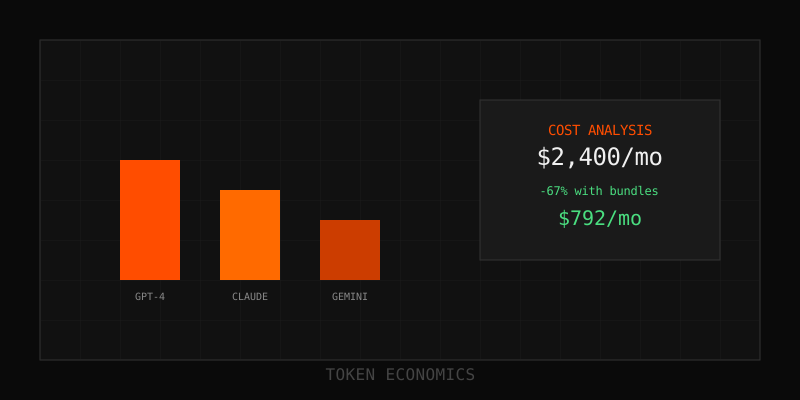
Engineering teams speak tokens per request. Finance teams speak dollars per quarter. The disconnect between these languages derails AI budgets and causes friction between departments. CFOs need frameworks that translate technical metrics into financial forecasts—and engineering needs to understand how their optimization decisions impact P&L. This guide bridges the gap with practical budgeting models, guardrails, and alignment rituals that work.
Why token budgeting matters now
LLM costs are variable, high-volume, and tied directly to user behavior. Unlike SaaS seats or cloud instances, you can't predict spend with simple headcount formulas. One viral feature can 10x your token burn overnight. Without budgeting discipline, AI projects blow through allocations, trigger emergency cost reviews, and lose executive trust.
Best-in-class teams treat tokens like compute credits in cloud cost management: forecasted, monitored, and optimized continuously. They align engineering and finance on shared metrics and run monthly reviews to course-correct before variance spirals.
Forecasting framework: Unit economics
Start with unit economics. Define your "unit" (user session, support ticket, document processed) and calculate:
- Tokens per unit. Average input + output tokens consumed per interaction. Segment by feature and model tier.
- Cost per token. Blended rate across all models, accounting for routing and caching. Example: 70% Gemini Flash ($0.10/M), 30% GPT-4o ($6/M) = $1.87/M blended.
- Units per period. Monthly volume based on user growth, feature adoption curves, and seasonality.
Formula: Monthly token spend = (units/month) × (tokens/unit) × (cost/token)
Example: 100k support tickets/month × 5000 tokens/ticket × $0.000002/token = $1000/month. Adjust for growth: if tickets grow 15% monthly, project $1150, $1322, $1520 for Q1.
Building a three-scenario forecast
Finance wants scenarios, not point estimates. Build three:
- Conservative. Baseline growth (10% monthly), no new features, current model mix. This is your floor—what you'll spend if everything stays flat.
- Expected. Planned growth (20% monthly), one major feature launch, moderate optimization (caching, routing). This is your budget target.
- Aggressive. Viral growth (50% monthly), multiple features, delayed optimization. This is your ceiling—what you'll spend if everything goes right (or wrong).
Share all three scenarios with finance. Give them confidence intervals: "We're 90% confident spend will land between conservative and aggressive." This prevents the "surprise invoice" conversation.
Setting guardrails and alerts
Guardrails prevent runaway spend. Common patterns:
- Per-user rate limits. Cap tokens per user per day. Prevents abuse and bot traffic from spiking costs.
- Feature flags with budget gates. Expensive features (GPT-4o reasoning, large context windows) stay behind flags tied to budget thresholds. Auto-disable if spend exceeds target.
- Model fallback tiers. If daily spend hits 80% of budget, automatically route more traffic to cheaper models. Degrades experience slightly but prevents overages.
- Quota allocations. Pre-allocate token budgets by team or feature. Once a team hits their quota, requests queue or defer to next period.
Set alerts at 50%, 75%, and 90% of monthly budget. Alert the engineering team at 50%, finance at 75%, and trigger automated mitigation at 90%.
Cross-functional alignment: The token council
Run a monthly "token council" meeting with engineering, product, finance, and operations. Agenda:
- Review actuals vs. forecast for prior month. Investigate >10% variance.
- Discuss upcoming experiments and feature launches. Forecast incremental spend.
- Prioritize optimization projects. Model ROI: if caching saves $5k/month and costs 1 week of eng time, ROI is 10:1.
- Align on guardrail adjustments. Should we tighten rate limits? Expand quotas for high-value features?
This ritual keeps everyone accountable and surfaces issues before they become crises. Finance sees engineering taking costs seriously. Engineering gets budget predictability and support for optimization work.
Dashboard metrics CFOs care about
Build an executive dashboard that shows:
- Total monthly spend with trend line and forecast envelope (conservative/expected/aggressive).
- Cost per unit (session, ticket, document) over time. Declining means optimization is working.
- Model mix (% spend by model tier). Shift toward cheaper models = cost efficiency improving.
- Cache hit rate and routing efficiency. Technical metrics tied to cost impact.
- Spend by feature or team. Identifies high-burn areas for targeted optimization.
Update weekly. Share in Slack or email. Finance appreciates transparency—even if spend is above plan, showing you're tracking and acting builds trust.
ROI framework for optimization projects
CFOs greenlight optimization projects when the ROI is clear. Calculate:
- Current monthly waste. Example: retries cost $4k/month due to rate limit errors.
- Savings after optimization. Smarter backoff reduces retries by 70% → $2.8k/month saved.
- Implementation cost. 1 week of eng time = $3k fully-loaded.
- Payback period. $3k / $2.8k/month = 1.1 months. Annualized ROI: 11x.
Present projects with this structure. CFOs love seeing engineering think in financial terms—it signals maturity and partnership.
Handling budget overruns
If spend exceeds forecast:
- Root cause analysis. Was it usage growth? Model mix shift? Unexpected feature adoption? Inefficient prompts?
- Immediate mitigation. Activate guardrails (rate limits, model fallbacks). Defer non-critical features.
- Revised forecast. Update scenarios based on new data. Communicate new baseline to finance.
- Optimization roadmap. Prioritize high-ROI projects to bring costs back in line. Share timeline with finance.
Transparency is key. Finance hates surprises but respects teams that surface issues early and have a remediation plan.
Case study: SaaS platform hitting scale
A B2B SaaS platform launched an AI co-pilot feature. Initial forecast: $20k/month. Actual: $38k in month two due to higher-than-expected usage and users triggering expensive GPT-4o calls.
Response: Engineering implemented smart routing (70% of queries handled by Gemini Flash) and context caching (90% hit rate on knowledge base prefixes). Finance approved a temporary $10k/month overage while optimizations rolled out. By month four, spend stabilized at $22k—10% over original plan but with 3x the user volume.
Outcome: Feature stayed live, users loved it, and finance trusted engineering to course-correct. The token council kept everyone aligned throughout.
Closing thoughts
Token budgeting isn't just a finance exercise—it's a forcing function for engineering discipline and cross-functional collaboration. CFOs need forecasts they can trust. Engineers need budgets that don't choke innovation. The frameworks in this guide bridge that gap. Start with unit economics, build scenarios, set guardrails, and run monthly reviews. Do this, and AI spend becomes predictable instead of chaotic.
Want a token budgeting spreadsheet template or help modeling your workload? Reach out.
Learn more: How it works · Why bundles beat raw thread history