
Thread Transfer
Agentic AI in 2025: From pilot to production at scale
Gartner says 40% of agentic projects will fail. We analyze why—and share patterns from teams that ship agents that work.
Thread Transfer
AI Systems for Builders
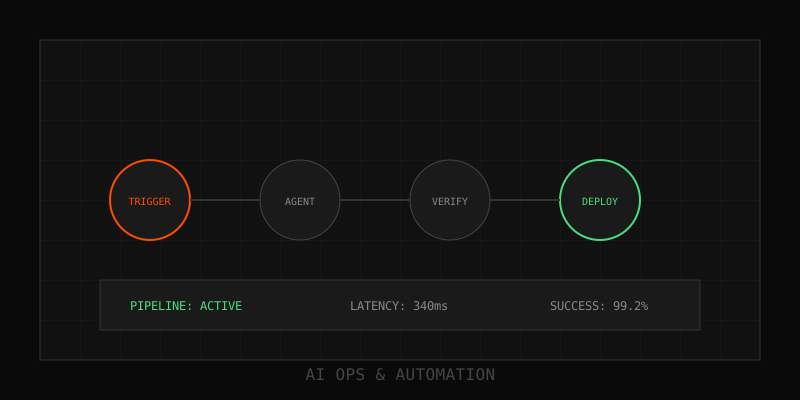
Gartner reports 61% of organizations have already started agentic AI pilots. The same research predicts 40% of those deployments will fail or be canceled by the end of 2027. The gap between pilot and production is where most teams fall into the pit—underfunding observability, overestimating model autonomy, and shipping agents that break silently in edge cases.
State of agentic AI in 2025
Agentic AI means models that plan, decide, and execute multi-step workflows without constant human intervention. They coordinate tool use, loop on feedback, and recover from failures. Early adopters are deploying agents for customer support triage, data analysis pipelines, internal IT automation, and content generation workflows.
The economics are compelling: one Fortune 500 company cut support ticket resolution time from 32 hours to 32 minutes using an agent that orchestrates Zendesk, Jira, and Slack. Another reduced manual data entry by 78% with an agent that reads emails, validates schemas, and updates CRM records.
Why agentic projects fail
The pattern is consistent across failed deployments:
- Scope creep. Teams try to automate everything at once instead of picking narrow, high-value workflows.
- Brittle integration. Agents break when APIs change or return unexpected payloads. No retry logic, no graceful degradation.
- Missing guardrails. Agents make destructive changes without approval gates or rollback mechanisms.
- Observability gaps. When an agent fails, teams can't reconstruct what happened or why.
- Hallucination risk. Agents confidently execute on fabricated data when context is incomplete.
Success patterns from teams that ship
The 60% that succeed follow a different playbook:
- Start narrow. Pick one workflow. Automate 70% of it. Measure impact. Expand only after proving value.
- Design for failure. Assume every API call can fail. Implement retries, timeouts, circuit breakers, and human escalation paths.
- Structure context tightly. Give agents clean, validated input. Use schemas, not raw text. Bundle conversation history into structured blocks.
- Log everything. Trace IDs, input payloads, tool calls, reasoning steps, and final outputs. Make every decision auditable.
- Gate risky actions. Agents can suggest. Humans approve destructive writes, money movement, and policy changes.
Production readiness checklist
Before you ship an agentic workflow, verify:
- Input validation with schema enforcement and rejection logic for malformed data.
- Idempotency on all mutations so retries don't duplicate effects.
- Observability with trace IDs, structured logs, and latency/cost/quality dashboards.
- Human-in-the-loop gates for high-risk actions with clear escalation criteria and approval workflows.
- Graceful degradation when upstream services fail or timeout.
- Rollback mechanisms for any state changes the agent makes.
- Regular accuracy audits to catch drift in tool behavior or model performance.
The future is layered autonomy
The winning pattern isn't "full automation or nothing." It's layered autonomy: agents handle routine cases end-to-end, escalate ambiguous cases to humans with full context, and collaborate with humans on complex decisions. Context continuity is what makes handoffs work—agents that lose conversation history force humans to start from scratch.
Thread-Transfer bundles give agents portable, structured context that survives handoffs. When an agent escalates to Slack or Linear, the full conversation travels with it. No repeated context. No missing decisions.
Need help designing your first production agent? info@thread-transfer.com
Learn more: How it works · Why bundles beat raw thread history