
Thread Transfer
Hyperautomation meets LLMs: The new enterprise stack
Hyperautomation is no longer just RPA. Here's how LLMs slot into the stack and what it means for your automation strategy.
Thread Transfer
AI Systems for Builders
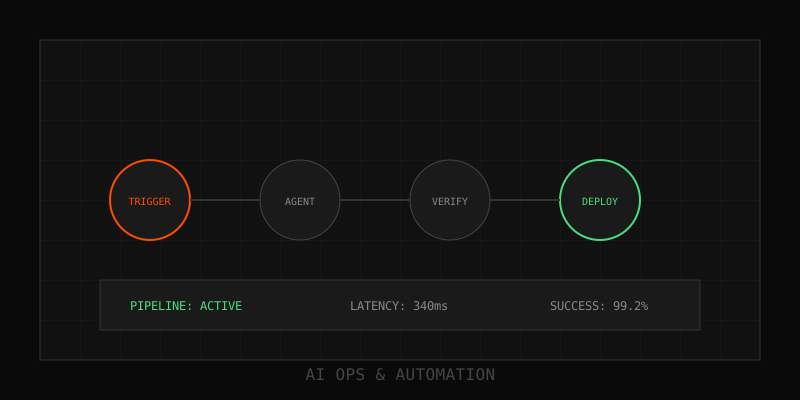
Hyperautomation used to mean RPA bots clicking through enterprise apps plus process mining to find inefficiencies. In 2025, LLMs changed the stack. Now hyperautomation means orchestrating RPA, APIs, decision engines, and language models into unified workflows that adapt to unstructured input and reason through exceptions.
What is hyperautomation today
Gartner defines hyperautomation as the disciplined approach to rapidly identify, vet, and automate as many business and IT processes as possible. The original stack combined RPA (UI automation), business process management platforms, process mining, and integration tools. Teams automated repetitive tasks but struggled with anything requiring judgment, language understanding, or adaptation to novel inputs.
LLMs fill that gap. They parse unstructured emails, extract entities from PDFs, reason about policy exceptions, and generate responses that sound human. The new hyperautomation stack layers LLMs on top of traditional automation primitives.
How LLMs fit into the stack
Modern hyperautomation architectures use LLMs in five key roles:
- Intent classification. Route incoming requests to the right workflow based on natural language analysis.
- Entity extraction. Pull structured data from invoices, contracts, support tickets, and emails without brittle regex.
- Exception handling. When rule-based automation hits an edge case, escalate to an LLM for reasoning and decision support.
- Response generation. Draft emails, summarize outcomes, update tickets with human-quality language.
- Orchestration. Agentic LLMs coordinate multi-step workflows, calling APIs and RPA bots as needed.
Reference architecture for LLM-powered hyperautomation
The production stack has four layers:
- Trigger layer. Webhooks, scheduled jobs, message queues that initiate workflows.
- Orchestration layer. Workflow engine (Temporal, Step Functions, Prefect) that coordinates LLM calls, API integrations, and RPA bots.
- Execution layer. LLM API, database writes, RPA scripts, third-party API calls.
- Observability layer. Structured logs, trace IDs, cost tracking, quality metrics.
Context management sits between layers. When a workflow hands off from LLM to RPA to human approval, context must flow intact—no lost decisions, no missing conversation history.
Implementation strategy that works
Teams that succeed follow this sequence:
- Map your process landscape. Use process mining to find high-volume, high-variance workflows where humans spend time on judgment calls.
- Identify LLM insertion points. Where do humans read unstructured input, make decisions, or draft responses? That's where LLMs add value.
- Pilot with one workflow. Automate intake classification or exception routing. Measure accuracy and latency.
- Build the observability stack first. You need logs and traces before you scale. Instrument everything.
- Expand incrementally. Add one automation per sprint. Validate quality before moving to the next.
ROI potential and cost realities
One healthcare org automated prior authorization workflows and cut processing time from 4 days to 6 hours—78% reduction in cycle time. A logistics company used LLMs to classify and route 80% of inbound support requests, reducing human intervention by 65%.
But LLMs add cost. API spend for high-volume workflows can hit $10k–$50k monthly. Optimize with smart model routing (GPT-4 for edge cases, smaller models for routine tasks), context caching to reuse prompt prefixes, and aggressive input compression. One team dropped their monthly bill from $42k to $29k by routing 70% of requests to Gemini Flash instead of GPT-4.
The ecosystem integration challenge
Hyperautomation means orchestrating dozens of tools: Salesforce, ServiceNow, SAP, legacy mainframes, internal APIs, and third-party data providers. LLMs don't magically integrate with those systems. You still need connectors, authentication, retry logic, and error handling.
Portable context formats help. When conversation history, decisions, and metadata are bundled into structured blocks, they flow cleanly across tool boundaries. Thread-Transfer bundles travel from Slack to Linear to Zendesk without losing fidelity.
Building a hyperautomation stack? Let's talk architecture.
Learn more: How it works · Why bundles beat raw thread history