
Thread Transfer
Service orchestration platforms (SOAPs): The future of IT automation
SOAPs orchestrate your entire IT stack from a single control point. Learn what they are and why they're replacing legacy tools.
Thread Transfer
AI Systems for Builders
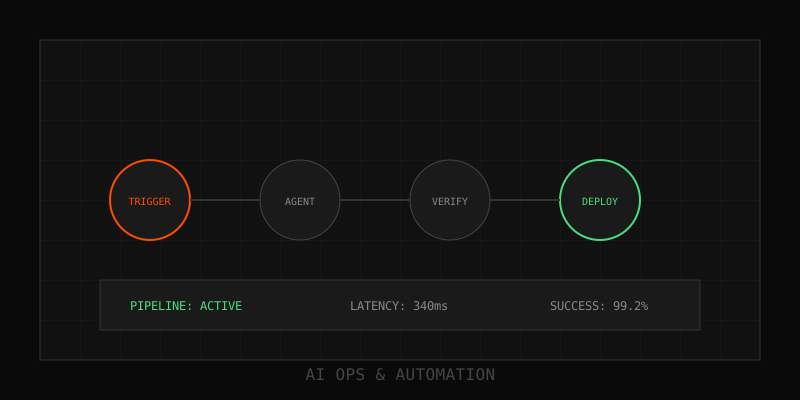
Gartner predicts 80% of workload automation teams will switch from traditional job schedulers to service orchestration and automation platforms (SOAPs) by the end of 2025. The shift is already happening: teams are tired of brittle cron jobs, fragmented tooling, and zero visibility across their automation stack.
What are service orchestration platforms
SOAPs unify scheduling, orchestration, monitoring, and governance into a single control plane. Instead of managing separate tools for batch jobs, API workflows, RPA scripts, and LLM agents, you define everything in one platform with shared observability, retry logic, and approval gates.
Traditional workload automation relied on job schedulers (Autosys, Control-M, cron) that execute tasks on a fixed schedule. They lack native support for APIs, event-driven triggers, or intelligent retry policies. SOAPs treat every automation as a service: REST-callable, observable, and composable.
Why the shift is happening
Legacy job schedulers can't handle modern automation requirements:
- Event-driven workflows. Automations trigger on webhooks, message queues, or file uploads, not just time-based schedules.
- API-first integrations. Modern apps expose REST/GraphQL APIs, not batch files or SFTP endpoints.
- Dynamic orchestration. Workflows branch based on runtime data, not static DAGs defined weeks in advance.
- Observability gaps. Legacy schedulers log job status but don't trace distributed workflows or measure business impact.
- Governance requirements. Regulated industries need approval gates, audit trails, and rollback mechanisms that old schedulers don't provide.
Key capabilities that define a SOAP
Modern service orchestration platforms deliver:
- Unified workflow engine. One orchestrator for batch jobs, API calls, RPA scripts, LLM agents, and human tasks.
- Event-driven triggers. Start workflows on webhooks, message queues, database changes, or file system events.
- Built-in observability. Trace IDs, structured logs, latency dashboards, and cost tracking across every workflow.
- Declarative workflow definitions. Define workflows as code (YAML, Python, DSL) with version control and CI/CD integration.
- Retry and error handling. Exponential backoff, circuit breakers, dead-letter queues, and escalation paths built in.
- Human-in-the-loop gates. Pause workflows for approval, inject manual decisions, and resume execution.
- Multi-cloud support. Run workflows on-prem, AWS, Azure, GCP without refactoring.
Leading platforms in 2025
Temporal dominates for developer-first teams. Define workflows in Python, Go, Java, or TypeScript. Temporal guarantees exactly-once execution even across failures. Strong observability via built-in UI and OpenTelemetry support.
Prefect targets data engineering teams. Python-native with first-class support for data pipelines, retries, and caching. Managed cloud offering simplifies deployment.
AWS Step Functions is the go-to for AWS-heavy shops. Integrates natively with Lambda, SQS, DynamoDB, and EventBridge. Pay-per-transition pricing makes it cost-effective for low-volume workflows.
ServiceNow Orchestration serves enterprise IT teams already invested in ServiceNow. Tight integration with ITSM workflows, approval gates, and CMDB. Less developer-friendly than Temporal or Prefect.
Camunda fits process-heavy industries (finance, insurance, logistics). BPMN modeling for business analysts, strong audit trails, and compliance features.
Migration guide: moving from legacy schedulers
- Inventory your jobs. Catalog every scheduled task, dependency, and downstream consumer. Identify high-risk workflows that require zero downtime.
- Pick a pilot workflow. Choose a non-critical batch job with clear inputs/outputs. Migrate it to the SOAP and validate behavior in parallel with the legacy scheduler.
- Refactor for idempotency. SOAPs retry failed steps. Ensure workflows tolerate retries without duplicating effects.
- Build observability first. Instrument workflows with trace IDs and structured logs before cutting over production traffic.
- Migrate incrementally. Move one workflow per sprint. Run old and new systems in parallel until confidence is high.
- Deprecate legacy jobs gradually. Monitor for unexpected dependencies. Communicate deprecation timelines to stakeholders early.
Context continuity in orchestrated workflows
SOAPs excel at coordinating tasks, but they don't solve context loss. When a workflow hands off from API call to LLM agent to human approval, conversation history and decisions must flow intact. Losing context forces humans to reconstruct what happened, killing productivity.
Portable context bundles bridge the gap. Thread-Transfer bundles carry conversation history, metadata, and decisions across workflow stages. When Temporal calls an LLM agent that escalates to Slack, the bundle ensures full context travels with the handoff.
Planning a migration? We've guided three teams through SOAP adoption—let's talk.
Learn more: How it works · Why bundles beat raw thread history