
Thread Transfer
AI governance frameworks compared: NIST, Databricks, and beyond
70% of AI-using companies plan to increase governance investment. Here's how to choose the right framework.
Thread Transfer
AI Systems for Builders
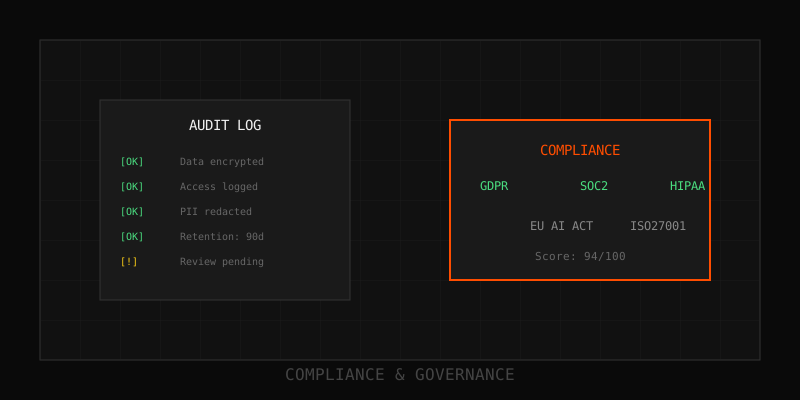
70% of organizations using AI plan to increase governance investment in 2025. The challenge: choosing a framework that fits your risk profile, industry, and maturity level. This guide compares the leading frameworks and helps you select the right starting point.
Why AI governance matters now
Governance isn't about compliance theater—it's about operationalizing trust. Without clear policies, teams ship models that hallucinate in production, leak PII, or reinforce bias. Governance frameworks provide structure: who approves what, which risks require mitigation, and how to audit decisions months later. The EU AI Act and state-level regulations make formal governance mandatory for regulated industries.
NIST AI Risk Management Framework (AI RMF)
The U.S. National Institute of Standards and Technology released the AI RMF in January 2023. It's voluntary, flexible, and widely adopted by federal agencies and contractors. The framework organizes around four functions:
- Govern—Establish accountability, policies, and culture.
- Map—Identify context, stakeholders, and potential impacts.
- Measure—Assess risks using quantitative and qualitative metrics.
- Manage—Prioritize and mitigate identified risks.
NIST AI RMF is ideal for organizations with regulatory exposure, government contracts, or a need for audit-friendly documentation. It pairs well with ISO standards and integrates into existing risk management programs.
Databricks Data and AI Governance Framework (DAGF)
Databricks published DAGF for data-intensive AI workflows. It emphasizes technical controls: lineage tracking, access management, quality gates, and monitoring. DAGF assumes you're already running a lakehouse or data platform and need governance built into the pipeline.
Key pillars include data cataloging, federated access control, metadata-driven quality checks, and observability dashboards. DAGF works best for engineering-led organizations shipping models from centralized data platforms.
ISO/IEC 42001 AI Management System
ISO 42001, published in December 2023, provides a certifiable standard for AI management systems. It mirrors ISO 27001's structure, covering risk assessment, documentation, continuous improvement, and third-party audits. If your customers require certifications or you operate in finance, healthcare, or defense, ISO 42001 delivers audit credibility.
Google AI Principles and Model Cards
Google's internal framework centers on ethical principles: social benefit, bias avoidance, safety testing, accountability, privacy, and scientific excellence. Model Cards translate principles into practice by documenting intended use, performance across demographics, and known limitations. This lightweight approach suits teams prioritizing transparency and stakeholder communication over formal compliance.
Comparison and selection guide
Choose based on your primary driver:
- Regulatory compliance—Start with NIST AI RMF or ISO 42001.
- Technical rigor and data platform integration—Use Databricks DAGF.
- Stakeholder transparency and ethical alignment—Adopt Model Cards and principle-driven governance.
- Hybrid needs—Combine frameworks. Many teams use NIST for policy and DAGF for technical implementation.
Implementation tips
Don't adopt a framework wholesale. Start with one function or pillar, prove value, then expand. For example, begin with NIST's "Map" function: inventory AI systems, classify risk, document stakeholders. Once leadership sees the audit benefits, add "Measure" and "Manage."
Assign a governance owner with cross-functional authority. Governance fails when it's an afterthought owned by a single team. Successful programs embed governance champions in product, engineering, legal, and security.
Automate where possible. Policy documents gather dust; technical guardrails enforce behavior. Use CI/CD gates for bias testing, lineage tracking in your data platform, and observability dashboards for drift detection.
Want to see how other teams operationalize these frameworks? Email info@thread-transfer.com for case studies and templates.
Learn more: How it works · Why bundles beat raw thread history