
Thread Transfer
Audit-ready AI: Building evidence trails for regulated industries
95% of execs report negative consequences from AI deployments. Many trace back to missing audit trails. Here's the fix.
Thread Transfer
AI Systems for Builders
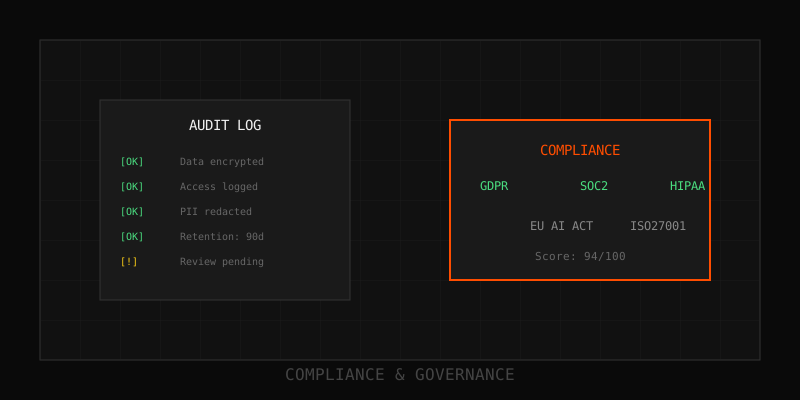
95% of executives report negative consequences from AI deployments, and many trace back to missing audit trails. When regulators, customers, or internal teams ask "why did the AI decide that?" the answer can't be "we don't know." Audit-ready AI systems log decisions, preserve context, and enable replay months or years later.
Why audit trails matter
Audit trails serve three audiences. Regulators need evidence of compliance with frameworks like the EU AI Act or sector-specific rules. Customers demand transparency when AI affects hiring, lending, or healthcare. Internal teams use trails to debug model drift, investigate incidents, and improve performance over time.
Without trails, you're flying blind. When an AI denies a loan application or flags a transaction as fraudulent, the decision must be explainable and verifiable. Audit trails make that possible.
What to log
Effective audit trails capture five elements:
- Input data—The exact prompt, user query, or structured payload sent to the model. Hash or fingerprint large inputs.
- Model metadata—Model version, provider, endpoint, temperature, and all inference parameters.
- Output—The model's response, including any intermediate reasoning or chain-of-thought steps.
- Context—User ID, session ID, timestamp, geographic location, and any retrieved documents or RAG context.
- Decision metadata—Was the output accepted, rejected, or escalated? Did a human override the AI?
Store logs in an append-only, immutable format. We recommend DynamoDB with point-in-time recovery enabled, or S3 with object lock and versioning. Never allow deletion or in-place updates.
Architecture for audit-ready systems
Build logging into the inference path, not as an afterthought. Every model call should flow through a logging middleware that captures inputs, outputs, and metadata synchronously. Async logging risks data loss on failures.
Use structured logging formats like JSON. Include trace IDs that link logs across services. For example, if a user query triggers RAG retrieval, LLM inference, and a downstream API call, the same trace ID should appear in all three log streams.
Separate operational logs from compliance logs. Operational logs can be pruned after 90 days; compliance logs must persist for years. Tag each log entry with a retention policy so automated cleanup never touches audit data.
Implementation patterns
For OpenAI or Anthropic API calls, wrap the client in a logging decorator:
- Before the API call, log the full request payload and generate a trace ID.
- After the response, log the output, token counts, and latency.
- On error, log the exception and any partial response.
For RAG systems, log retrieval results alongside the final LLM response. Include document IDs, relevance scores, and retrieval timestamps. This allows auditors to verify which sources informed the decision.
For agentic systems with multiple tool calls, log each step in the chain. If the agent calls a calculator, web search, and database query before answering, all three should appear in the audit trail with inputs and outputs.
Testing your compliance setup
Run quarterly "audit fire drills." Pick a random decision from 90 days ago and attempt to reconstruct it from logs alone. Can you identify the model version, input prompt, retrieved context, and final output? If not, your logging is incomplete.
Test retention policies by verifying old logs remain accessible. Simulate a regulator request: "Show us all AI decisions affecting user X between January and March." Your query should return complete, immutable records in under 60 seconds.
Validate log integrity by comparing hashes. If you fingerprinted inputs, rehash them and confirm the digests match. Any discrepancy indicates tampering or data corruption.
Common pitfalls
Don't log PII without encryption or anonymization. Audit trails must preserve context without violating privacy. Hash user IDs or use pseudonymous identifiers with a secure mapping table.
Don't skip intermediate steps. Logging only the final output hides critical reasoning. If the AI rejected a claim because it flagged a missing document, that flag must appear in the trail.
Don't assume logs will always be available. Replicate across regions and back up to cold storage. One team lost audit trails when their primary database failed; they couldn't reconstruct decisions and faced regulatory fines.
Building audit-ready AI into an existing system? We've helped teams retrofit logging without breaking production. Reach out at info@thread-transfer.com for implementation workshops.
Learn more: How it works · Why bundles beat raw thread history