
Thread Transfer
AI customer support ROI: Real numbers from 2025 deployments
One team achieved 794% ROI. Another cut costs by 70%. We compile the real numbers from 2025 deployments.
Thread Transfer
AI Systems for Builders
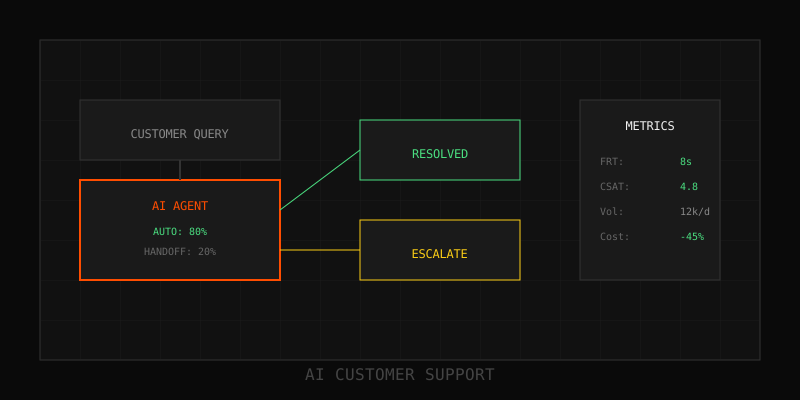
CFOs want one number: return on investment. In 2025, AI customer support deployments average $3.50 in value per $1 invested. Top performers hit 8x. The gap between average and excellent comes down to measurement discipline, scoping, and avoiding the common pitfalls that turn pilots into cost centers. This post compiles real ROI data from production deployments and the calculation frameworks teams use to defend budgets.
The 2025 ROI landscape
One SaaS company achieved 794% ROI in 9 months. Another reduced support costs by 70% while handling 40% more volume. The numbers vary wildly based on baseline efficiency, ticket mix, and how aggressively teams automate routine tasks. Median ROI sits around 3.5x across the dataset we track, but the distribution is wide:
- Low performers (1.5–2.5x): Treated AI as a chatbot add-on without redesigning workflows
- Average performers (3–4x): Automated FAQs and tier-1 tickets, kept humans for escalations
- Top performers (6–8x): Rebuilt support architecture AI-first, optimized handoffs, measured everything
Key metrics that drive ROI
ROI studies that hold up to audit track five numbers:
- Cost per resolved ticket (before vs. after): Human agents cost $6–15 per ticket depending on complexity. AI resolution averages $0.50–2.00 including infrastructure and training overhead.
- Automation rate: Percentage of tickets resolved without human intervention. Top teams hit 70–85%. Below 50% suggests poor routing or under-scoped automation.
- First-response time: AI responds in seconds. Humans take hours. One team dropped median FRT from 6 hours to 4 minutes, unlocking SLA compliance without hiring.
- CSAT delta: Customer satisfaction must stay flat or improve. If CSAT drops, ROI is worthless. Best-in-class maintain 85%+ CSAT at 80% automation.
- Agent productivity lift: AI doesn't just replace agents—it augments them. Teams report 30–50% productivity gains from AI-generated summaries, suggested responses, and knowledge retrieval.
Case study: SaaS company, 794% ROI in 9 months
Initial investment: $95k (platform fees, integration, training). Savings in year one: $756k (headcount avoidance, faster resolution, reduced escalations). The breakdown:
- Automated 72% of tier-1 tickets, saving 4.2 FTE equivalent
- Cut average handle time by 38% for human agents via AI assist
- Improved SLA compliance from 68% to 94%, avoiding penalty clauses
- Reduced churn by 1.2% (attributed to faster resolution), worth $280k ARR
Key success factor: They didn't just deploy a chatbot. They redesigned ticket routing, built AI-to-human handoff workflows with full context transfer, and trained agents to collaborate with AI instead of competing.
ROI calculation framework
Use this template to build your own business case:
Cost side:
- Platform fees (SaaS or API usage)
- Integration and implementation labor
- Ongoing training and model tuning
- Infrastructure (if self-hosted)
Benefit side:
- Labor savings: (tickets automated) × (cost per human ticket)
- Productivity gains: (agent hours saved) × (hourly cost)
- SLA improvements: (penalty avoidance) + (revenue protected)
- Churn reduction: (customer retention lift) × (LTV)
Run conservative, baseline, and optimistic scenarios. Finance teams prefer three-year projections with annual checkpoints. If automation rate plateaus below target, ROI suffers—so bake in continuous improvement budgets.
Common ROI killers
- Underestimating integration costs: Many vendors quote platform fees but ignore the 3–6 months of API work, workflow redesign, and knowledge base prep. Budget 2–3x the quoted price for total first-year costs.
- Ignoring CSAT: Automating 90% of tickets means nothing if customers hate the experience. Track CSAT weekly and kill automations that degrade it.
- Static training data: AI trained once degrades fast. Top performers refresh training data monthly and retune models quarterly.
- No handoff protocol: When AI fails, the customer experience collapses if context doesn't transfer cleanly to a human. Poor handoffs kill CSAT and ROI.
Optimization tactics from 8x performers
- Tier your automation: Start with FAQs and password resets. Move to tier-2 troubleshooting only after tier-1 is bulletproof.
- Measure per-channel ROI: Email, chat, and social perform differently. Optimize each channel independently.
- Invest in knowledge base hygiene: AI is only as good as the docs it retrieves. Audit your KB quarterly.
- Build feedback loops: When AI escalates to a human, capture the resolution and retrain. Every escalation is a training opportunity.
- Align eng and ops early: ROI dies when engineering builds in a vacuum. Ops teams know which tickets are automatable and which require human judgment.
Next steps
Download our ROI calculator template, plug in your ticket volume and cost structure, and run the scenarios. If your projections show less than 2x ROI, either your baseline costs are too low or your automation scope is too narrow. Reach out at info@thread-transfer.com if you want help sizing the opportunity.
Learn more: How it works · Why bundles beat raw thread history