
Thread Transfer
The Hidden Cost of Audience Overlap: When Your Ad Sets Bid Against Each Other
Your ad sets are bidding against each other in the same auction. This self-competition inflates CPM by 20-40%. Here's how to find and fix it.
Thread Transfer
Founder, Meta Ads Audit
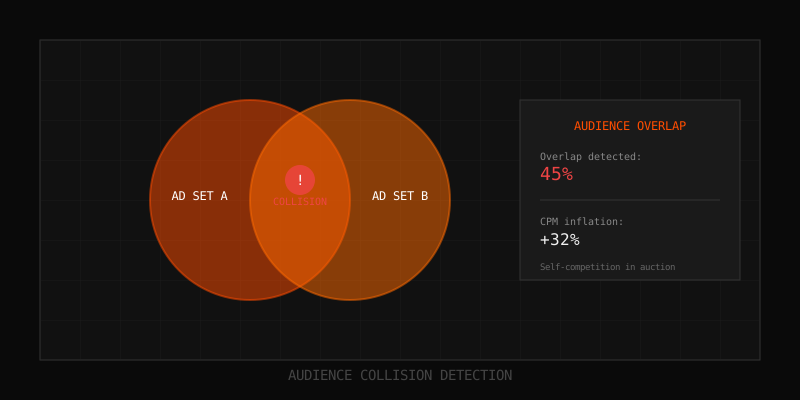
You launch three ad sets targeting slightly different interests. Performance looks decent—until you realize all three are showing ads to the same people. Your ad sets are competing against each other in Meta's auction, driving up your own CPMs. This is audience overlap, and it's one of the most expensive mistakes in Meta advertising.
Audience overlap occurs when two or more ad sets target users who belong to multiple audiences. When those ad sets enter the same auction, you're essentially bidding against yourself. Meta's auction system doesn't care that both bids come from the same advertiser—it treats them as competitors. The result: inflated CPMs, wasted budget, and a false sense of which targeting actually works.
How Audience Overlap Costs You Money
To understand the financial impact, you need to understand how Meta's auction works. When a user becomes eligible to see an ad, Meta runs an auction among all advertisers targeting that user. Your bid, estimated action rate, and ad quality determine your "total value" score. The highest total value wins the impression.
When you have overlapping audiences, your ad sets compete in the same auction. Here's what happens:
Self-Competition Inflates CPMs
In a normal auction, you might win an impression for $8 CPM. But when two of your ad sets are in the same auction, Meta sees two bidders willing to pay for that user. Even though both bidders are you, the auction dynamics push the clearing price higher. We consistently see 20-40% CPM inflation in accounts with significant audience overlap.
Budget Cannibalization
Overlapping ad sets don't just raise prices—they steal impressions from each other. An ad set that should deliver 10,000 impressions might only get 6,000 because a sibling ad set won the other 4,000 auctions. Both ad sets underperform their potential, and you can't tell which targeting strategy actually works better.
Polluted Performance Data
When the same users see multiple ad sets, attribution becomes unreliable. Did that conversion come from ad set A or ad set B? If the user saw both, Meta attributes it to whichever ad set delivered most recently—but that's arbitrary. Your performance data stops reflecting targeting quality and starts reflecting which ad set happened to win more auctions.
Types of Audience Overlap
Audience overlap isn't always obvious. Here are the common patterns:
Identical Saved Audiences
The most obvious overlap: two ad sets using the exact same saved audience. This happens when advertisers duplicate ad sets for creative testing but forget to differentiate targeting. In our audits, this is the easiest pattern to catch—same saved_audience_id across multiple active ad sets.
Interest Stack Overlap
You create one ad set targeting "Running" and another targeting "Marathon." The problem: most marathon enthusiasts are also interested in running. Your audiences overlap substantially even though the targeting looks different on paper.
Lookalike Overlap
A 1% lookalike and a 3% lookalike based on the same source audience have 100% overlap at the 1% level. The 3% lookalike contains everyone in the 1% lookalike, plus additional users. Running both simultaneously guarantees collision.
Retargeting Overlap
Website visitors (last 30 days) and website visitors (last 180 days) overlap completely—the 30-day audience is a subset of the 180-day audience. Same problem with cart abandoners vs. all visitors, or engaged vs. all video viewers.
Geographic Overlap
One ad set targets California, another targets the United States. Every California user is also a US user. Less common, but we've seen accounts accidentally create nested geographic targeting that causes constant auction collision.
How to Detect Audience Overlap
Method 1: Meta's Audience Overlap Tool
Meta provides a built-in tool to check overlap between saved audiences. Navigate to Audiences in Ads Manager, select multiple audiences, and click "Show Audience Overlap." This shows the percentage of users who belong to both audiences.
Limitation: This only works for saved audiences. It won't detect overlap between ad sets using dynamic targeting, lookalikes created on the fly, or interest-based targeting.
Method 2: Delivery Insights Analysis
In Ads Manager, enable Delivery Insights for your ad sets. Look for "Auction Overlap" in the metrics. High auction overlap (above 30%) indicates your ad sets are frequently competing against each other.
Method 3: CSV Export Pattern Matching
Export your ad set settings as CSV and look for duplicate saved_audience_id values across active ad sets. This catches the most obvious overlap pattern. For interest-based targeting, compare the targeting_json field for similarity.
Our Meta Ads Audit tool automatically detects ad sets sharing the same saved audience or identical targeting configuration. We flag collisions with exact CSV row references so you can verify and fix them immediately.
Method 4: Manual Audience Mapping
Create a spreadsheet mapping each ad set to its targeting criteria. Visually identify overlap by looking for nested audiences (e.g., lookalike 1% contained within lookalike 5%) or related interests that likely share users.
Overlap Thresholds: When to Worry
Some overlap is inevitable and acceptable. Here's how to interpret overlap percentages:
| Overlap % | Risk Level | Action |
|---|---|---|
| 0-20% | Low | Acceptable for most accounts |
| 20-40% | Moderate | Monitor CPM inflation; consider exclusions |
| 40-60% | High | Add exclusions or consolidate ad sets |
| 60%+ | Critical | Consolidate immediately; significant waste |
Note: Even 30% overlap can be problematic at scale. If you're spending $50k/month and 30% of auctions involve self-competition, you're leaving $5-10k on the table.
How to Fix Audience Overlap
Fix 1: Consolidate Duplicate Ad Sets
The simplest fix for identical audiences: merge duplicate ad sets into one. If you're testing creatives, put all creatives in a single ad set using Dynamic Creative or separate ads within the same ad set. This eliminates overlap entirely for that audience.
Fix 2: Add Audience Exclusions
For partially overlapping audiences, add exclusions to create clean separation. Examples:
- Lookalike 3-5%: Exclude Lookalike 0-3%
- Website visitors (180 days): Exclude website visitors (30 days)
- Interest "Running": Exclude saved audience "Marathon Enthusiasts"
This creates mutually exclusive audience segments that won't compete in the same auction.
Fix 3: Use Audience Segments Instead of Overlap
Instead of running overlapping lookalikes (1%, 3%, 5%), run segmented lookalikes (0-1%, 1-3%, 3-5%). Each segment is mutually exclusive. Meta allows you to create these directly when building lookalike audiences.
Fix 4: Implement Proper Test Structure
If you're testing targeting strategies, don't run parallel ad sets with overlapping audiences. Instead:
- Use Meta's native A/B testing tool (creates clean holdout groups)
- Run tests sequentially rather than simultaneously
- Use Advantage Campaign Budget with tight audience controls
Fix 5: Move to Advantage+ or Broad Targeting
One way to eliminate overlap is to consolidate into a single Advantage+ campaign or broad targeting ad set. Let Meta's algorithm find your best users rather than trying to manually segment audiences. This approach trades control for simplicity—no overlap possible when there's only one ad set.
Preventing Future Overlap
Fixing existing overlap is reactive. Here's how to prevent it proactively:
Audience Naming Conventions
Adopt naming conventions that make overlap obvious. Include the audience type, source, and date range in the name. For example: "LAL_Purchasers_1pct_US" or "RET_Cart_30d_ExclPurchase". When two ad sets have similar names, you'll immediately notice the potential conflict.
Audience Library Documentation
Maintain a living document that maps all your saved audiences, their definitions, and which campaigns use them. Before creating a new ad set, consult the document to check for overlap with existing targeting.
Regular Overlap Audits
Schedule monthly or bi-weekly overlap audits. Export your ad set settings, run them through an audit tool, and address any new collisions before they accumulate significant waste.
Campaign Structure Discipline
Establish rules for campaign structure that minimize overlap risk. For example: one campaign per audience type (prospecting vs. retargeting), no more than 3 ad sets per campaign, mandatory exclusions for all retargeting ad sets.
The Larger Picture: Audience Strategy
Audience overlap is a symptom of fragmented audience strategy. Advertisers create ad sets reactively— "let's try this interest," "let's test that lookalike"—without considering how they fit together. The result is a messy account with dozens of overlapping ad sets, none performing optimally.
The fix isn't just technical (add exclusions). It's strategic: design your audience architecture intentionally. Map out your full-funnel audiences, decide where each ad set fits, and ensure clean boundaries before launching anything. Overlap problems are architecture problems.
Key Takeaways
- Audience overlap causes your ad sets to compete in the same auction
- Self-competition typically inflates CPM by 20-40%
- Common culprits: duplicate saved audiences, nested lookalikes, overlapping retargeting windows
- Use Meta's Overlap Tool, Delivery Insights, or CSV audits to detect collisions
- Fix by consolidating ad sets, adding exclusions, or using segmented audiences
- Prevent future overlap with naming conventions and regular audits
FAQ
Does Advantage Campaign Budget prevent audience overlap?
No. Advantage Campaign Budget (CBO) shifts budget between ad sets based on performance, but it doesn't prevent those ad sets from competing in the same auction. You can still have overlap-driven CPM inflation with CBO—the algorithm just allocates more budget to whichever ad set "wins" more auctions.
Should I ever intentionally have overlapping audiences?
Rarely. The only legitimate case is when you're deliberately testing which audience performs better and you've accepted the testing cost (inflated CPMs during the test). Even then, Meta's native A/B testing tool is a better option because it creates true holdout groups.
How much overlap is acceptable for different budget levels?
Lower budgets can tolerate more overlap because the absolute dollar waste is smaller. At $1k/month, 30% overlap might waste $50-100. At $100k/month, that same overlap wastes $5k-10k. Set overlap tolerance based on your spend scale.
Does audience overlap affect learning phase?
Indirectly. When overlapping ad sets compete, neither accumulates conversions as efficiently. This can extend learning phase duration for both ad sets. Clean audience separation helps each ad set exit learning faster with more reliable data.
Learn more: How it works · Why bundles beat raw thread history