
Thread Transfer
Idle Budget Syndrome: Money Sitting While Your Best Campaigns Starve
One ad set spends 23% of its budget while its sibling is capped at 97%. That idle budget is wasted opportunity. Here's how to find and fix it.
Thread Transfer
Founder, Meta Ads Audit
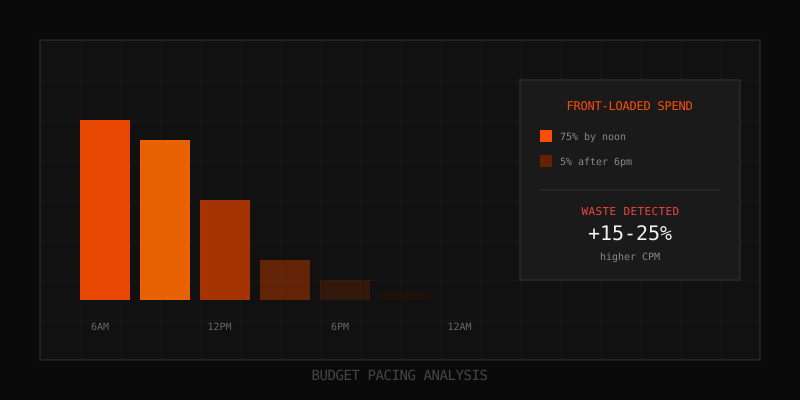
You have two ad sets in the same campaign. Ad set A spent 23% of its daily budget. Ad set B hit its cap at 97% utilization by 6pm. That's not optimization—that's missed opportunity. While ad set A sits on unused budget, ad set B is turning away potential customers because it ran out of money.
This pattern—idle budgets in some ad sets while others are starved—is one of the most common forms of budget waste in Meta advertising. It's particularly frustrating because the money isn't technically "lost." It just sits there, accomplishing nothing, while your best-performing campaigns beg for more runway.
What Is Idle Budget Syndrome?
Idle budget syndrome occurs when an ad set consistently spends significantly less than its allocated daily budget. We define "idle" as spending less than 30% of budget for 3 or more consecutive days. The problem compounds when sibling ad sets (in the same campaign) are simultaneously hitting 90%+ budget utilization.
Here's a typical scenario:
| Ad Set | Daily Budget | Actual Spend | Utilization | Status |
|---|---|---|---|---|
| Ad Set A | $100 | $23 | 23% | Idle |
| Ad Set B | $100 | $97 | 97% | Capped |
| Ad Set C | $100 | $85 | 85% | Healthy |
In this scenario, you have $77 of daily budget sitting idle in Ad Set A. Meanwhile, Ad Set B could profitably spend $150 if given the chance, but it's locked at $100. The $77 isn't wasted in the traditional sense—it doesn't get charged—but it represents $77 of opportunity cost every single day.
Why Idle Budgets Form
Understanding the causes helps you prevent idle budgets from forming in the first place:
1. Audience Size Too Small
The most common cause. If your audience is 50,000 people and you set a $500 daily budget, Meta simply can't find enough impressions to spend that money without destroying frequency. The algorithm throttles delivery to avoid showing ads 10+ times per day to the same users.
2. Bid Caps Too Restrictive
If you're using Cost Cap or Bid Cap with aggressive targets, Meta may not find enough auctions where it can win at your price. The ad set sits idle not because there's no audience, but because you've priced yourself out of the market.
3. Poor Ad Quality or Relevance
Low relevance scores reduce your "total value" in auctions, making it harder to win impressions. If your ads aren't resonating, Meta deprioritizes delivery regardless of budget. The ad set underdelivers because it can't compete.
4. High Frequency Limits
If you've set frequency caps (e.g., max 3 impressions per user per week), you limit the total impressions Meta can deliver. Small audiences combined with tight frequency caps guarantee underdelivery.
5. Seasonal or Time-Based Patterns
Some audiences are only active at certain times. A B2B audience targeting office workers will underdeliver on weekends and evenings. If your budget assumes 24/7 delivery but your audience is 9-5 only, you'll see idle budget during off-hours.
6. Learning Phase Stall
Ad sets stuck in learning phase may underdeliver while the algorithm tries to figure out optimal targeting. If the ad set never exits learning (due to low conversion volume or frequent edits), it can remain in a perpetual underdelivery state.
The True Cost of Idle Budgets
Opportunity Cost
Every dollar sitting idle is a dollar not working. If Ad Set B can produce $4 ROAS but is capped, and Ad Set A is sitting on $77, you're losing $308 in potential revenue every day. Over a month, that's $9,240 in missed revenue—not from budget waste, but from budget misallocation.
Distorted Performance Data
Idle ad sets pollute your account-level metrics. If you're measuring average CPA across all ad sets, the idle ones drag the numbers in unpredictable ways. Some advertisers mistakenly conclude their overall strategy isn't working when the reality is that one high-performer is starved while underperformers hog budget.
Learning Phase Disruption
Ad sets need consistent delivery to exit learning phase. An idle ad set that delivers sporadically never accumulates enough data to optimize properly. It stays in learning limbo, wasting whatever budget it does spend on suboptimal targeting.
CBO Misallocation
If you're using Advantage Campaign Budget (CBO), Meta might allocate budget to the idle ad set anyway, trying to "give it a fair chance." This pulls budget away from proven performers. The algorithm doesn't know your idle ad set has a structural problem—it just keeps testing.
How to Detect Idle Budgets
Method 1: Budget Utilization Report
In Ads Manager, add a custom column for "Amount Spent" and compare it to "Daily Budget" or "Lifetime Budget" divided by campaign duration. Calculate utilization percentage manually or export to spreadsheet. Flag any ad set below 50% utilization for 3+ consecutive days.
Method 2: Delivery Insights
Check Delivery Insights for each ad set. Look for "Limited" delivery status and the reason provided (audience too small, bid too low, etc.). Meta tells you why delivery is constrained—use this diagnostic data.
Method 3: CSV Export Analysis
Export daily performance data as CSV. Calculate the ratio of actual spend to budget for each ad set. Sort by utilization to quickly identify the worst offenders. Look for ad sets with utilization below 30% while siblings are above 90%.
Our Meta Ads Audit tool automatically flags idle budget patterns. We detect ad sets with sustained underdelivery (less than 30% utilization for 3+ days) and highlight when siblings in the same campaign are hitting capacity. The audit shows exactly which days triggered the detection, with row-level evidence.
Method 4: Sibling Analysis
Group ad sets by campaign. For each campaign, compare utilization across all ad sets. If any ad set is below 30% while another is above 90%, you have a reallocation opportunity. This pattern is the clearest signal of idle budget syndrome.
How to Fix Idle Budgets
Fix 1: Reallocate to High Performers
The simplest fix: move budget from idle ad sets to those hitting capacity. If Ad Set A is at 23% utilization and Ad Set B is at 97%, reduce A's budget by 50% and give it to B. Monitor for a week to confirm B can scale without efficiency loss.
Fix 2: Expand Targeting
If the idle ad set has a valid targeting hypothesis but the audience is too small, expand it. Add related interests, increase lookalike percentage (1% → 3%), or broaden geographic targeting. More audience = more delivery capacity.
Fix 3: Reduce Budget to Match Delivery Capacity
Sometimes the ad set is fine—you just over-budgeted. If an ad set can only spend $30/day efficiently, don't give it $100. Right-size the budget to actual delivery capacity. Unused budget sitting idle helps no one.
Fix 4: Loosen Bid Constraints
If you're using Cost Cap or Bid Cap, try raising the cap or switching to Lowest Cost temporarily. See if delivery increases. If it does, the ad set was constrained by bid settings, not audience size. Find the right balance between cost efficiency and delivery volume.
Fix 5: Improve Ad Quality
Check relevance diagnostics. If Quality Ranking or Engagement Ranking is below average, the ad is the problem, not the budget. Test new creative, refine the offer, or rewrite copy. Better ads win more auctions and improve delivery.
Fix 6: Remove Frequency Caps
Temporarily remove or loosen frequency caps to see if delivery increases. If it does, your caps were limiting total addressable impressions. Decide whether the caps are necessary for your goals or if they're artificially constraining delivery.
Fix 7: Pause the Idle Ad Set
If nothing else works, pause the ad set entirely. An idle ad set that can't deliver isn't contributing to your goals. Free up the mental overhead of managing it and redirect focus to ad sets that actually spend.
Preventing Future Idle Budgets
Budget Sizing Framework
Before launching an ad set, estimate deliverable impressions based on audience size and historical CPM. A rough formula: Daily Budget = (Audience Size × Target Frequency × CPM) / 1000. If your budget exceeds this estimate, you're setting up for underdelivery.
Start Conservative, Scale Up
Launch new ad sets with conservative budgets that you're confident can be spent. Once delivery proves consistent, scale up in 20-30% increments. It's better to raise budgets on proven performers than to front-load budget on unproven ad sets.
Weekly Budget Reviews
Schedule weekly reviews of budget utilization across all active ad sets. Create a simple dashboard or spreadsheet that flags any ad set below 50% utilization. Address issues before they become chronic.
Use CBO Strategically
Advantage Campaign Budget can help prevent idle budgets by automatically shifting spend to ad sets that can use it. However, CBO works best when all ad sets in the campaign have similar audiences and can realistically compete. Don't mix wildly different targeting in the same CBO campaign.
The Bigger Picture: Budget Efficiency
Idle budgets are one symptom of broader budget inefficiency. Other patterns to watch:
- Over-concentration: 80% of spend in one ad set, others starved
- Even split with uneven performance: All ad sets get same budget despite different ROAS
- Budget churn: Constantly moving budget without allowing ad sets to optimize
The goal is dynamic budget allocation that matches spend to opportunity. Idle budgets represent the opposite: static allocation that ignores reality. Regular audits and proactive reallocation are the fix.
Key Takeaways
- Idle budgets occur when ad sets spend less than 30% of allocated budget for 3+ days
- The problem compounds when sibling ad sets are simultaneously hitting capacity
- Root causes include small audiences, restrictive bids, poor ad quality, and tight frequency caps
- The true cost is opportunity cost—dollars not working while high performers are starved
- Fix by reallocating budget, expanding targeting, or right-sizing budgets to delivery capacity
- Prevent with conservative initial budgets and weekly utilization reviews
FAQ
Is some underdelivery normal?
Yes. Utilization in the 70-90% range is healthy—it means the ad set has room to capture additional opportunity if competition decreases or new users enter the audience. Underdelivery becomes problematic below 50% utilization, and idle below 30%.
Should I use CBO to fix idle budgets?
CBO can help by automatically shifting budget to ad sets that can use it. However, CBO won't fix structural problems (audience too small, bid too restrictive). Use CBO as part of the solution, not the entire fix.
How quickly should I act on idle budget detection?
Wait 3+ days to confirm the pattern is consistent, not a one-off. After that, act quickly. Every day of idle budget is a day of missed opportunity. One week of diagnosis followed by immediate action is a good cadence.
Does idle budget affect account health or reputation?
Not directly. Meta doesn't penalize accounts for underdelivery. However, chronically underdelivering ad sets may accumulate low engagement signals that hurt their competitiveness in auction over time.
Learn more: How it works · Why bundles beat raw thread history