
Thread Transfer
Learning Phase Hell: Why Edits Keep Resetting Your Meta Ads Progress
You tweaked the budget. CPA spiked 35%. The algorithm is relearning from scratch. Here's how to stop resetting your progress.
Thread Transfer
Founder, Meta Ads Audit
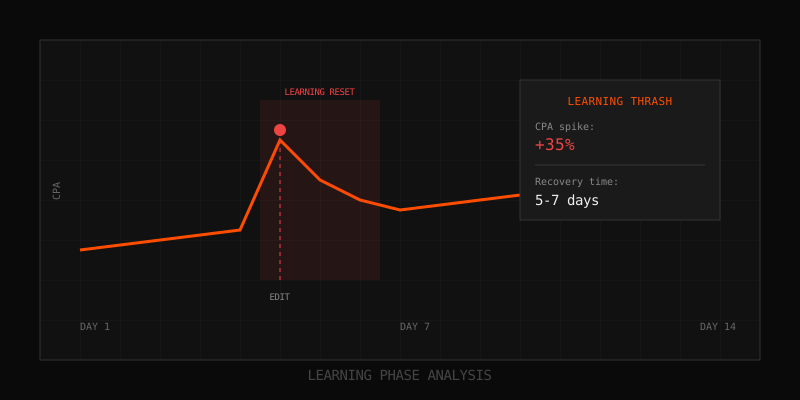
You made a small budget adjustment on Tuesday. By Thursday, your CPA had spiked 35%. You changed it back, hoping to recover. By Saturday, CPA spiked again. Welcome to learning phase hell—where well-intentioned optimizations trigger a cascade of algorithmic confusion that costs you more than the original problem.
Learning phase thrash occurs when frequent edits to an ad set repeatedly reset Meta's optimization algorithm, preventing it from ever stabilizing. Each reset forces the algorithm to relearn what works, and that relearning process is expensive. Our analysis shows CPA typically increases 20-50% during learning phase, and accounts stuck in thrash cycles often see sustained efficiency losses.
What Is Learning Phase?
When you create or significantly edit an ad set, Meta enters "learning phase"—a period where the algorithm experiments to find the best people to show your ad to. During this phase, performance is volatile. CPA fluctuates as the algorithm tests different audiences, placements, and delivery patterns.
Meta considers learning phase complete when your ad set achieves approximately 50 optimization events (usually conversions) within a 7-day window. Once exited, the algorithm has enough data to deliver efficiently and predictably.
The problem: certain changes reset learning phase entirely, forcing the algorithm to start over. If you make these changes frequently, your ad set never exits learning—it thrashes between reset states, perpetually underperforming.
Which Edits Trigger Learning Phase Reset?
Not all changes are equal. Here's what triggers a full learning phase reset:
High-Impact Changes (Always Reset)
| Change Type | Threshold | Impact |
|---|---|---|
| Budget change | More than 20% | Full reset |
| Bid cap/cost cap change | Any significant change | Full reset |
| Targeting change | New audience, interests, or exclusions | Full reset |
| Optimization event change | Any change | Full reset |
| New creative added | Adding ads to the ad set | Partial reset |
| 7-day pause | Paused for 7+ days | Full reset |
Low-Impact Changes (Usually Safe)
- Budget changes under 20%
- Changing ad creative text or images within existing ads
- Adjusting ad scheduling (within reason)
- Renaming the ad set or campaign
- Pausing for less than 7 days
The Thrash Cycle
Learning phase thrash follows a predictable pattern:
- Day 1: You make an edit (budget increase, targeting tweak)
- Days 2-3: CPA spikes as the algorithm experiments
- Day 4: You panic and make another edit to "fix" it
- Days 5-6: CPA spikes again from the second reset
- Day 7: You make a third edit, convinced something is broken
- Repeat indefinitely
Each edit resets the 50-conversion counter. If you're getting 5-10 conversions per day, you need 5-10 days without edits to exit learning. But most advertisers can't resist tweaking for that long, especially when CPA is elevated. The impatience creates a self-reinforcing cycle.
How to Detect Learning Phase Thrash
Method 1: Check Learning Status in Ads Manager
The "Delivery" column shows current status. "Learning" means the ad set is in learning phase. "Learning Limited" means it's in learning but not getting enough events to exit (under 50/week). If you see these statuses persisting for 2+ weeks, you're likely thrashing.
Method 2: Audit Edit History
View the ad set's Activity History (click "..." → "View History"). Count significant edits in the past 14 days. More than 2-3 reset-triggering edits in that window indicates thrash. Pay attention to budget changes over 20% and any targeting modifications.
Method 3: CPA Trend Analysis
Export daily performance data and plot CPA over time. Look for a sawtooth pattern: spike, partial recovery, spike, partial recovery. This pattern indicates repeated resets. A healthy ad set shows stable CPA after an initial learning period.
Our Meta Ads Audit tool automatically detects learning thrash by analyzing the relationship between edit timestamps and CPA spikes. We flag ad sets where edits made 48-72 hours prior correlate with 20%+ CPA increases, with row-level evidence from your CSV exports.
The Cost of Learning Phase Thrash
Direct CPA Premium
During learning phase, CPA typically runs 20-50% higher than post-learning. If your stable CPA is $25 and you're perpetually in learning at $35, you're paying a $10 premium per conversion. At 100 conversions/month, that's $1,000 in waste—every month.
Opportunity Cost
Learning phase isn't just inefficient—it's unpredictable. You can't reliably scale an ad set that's thrashing because you don't know what its true performance floor is. You miss scaling opportunities because you're constantly fighting fires.
Data Pollution
Performance data from learning phase doesn't reflect true potential. If you're using this data to make targeting decisions, you're optimizing based on noise, not signal. Bad data leads to bad decisions.
How to Fix Learning Phase Thrash
Fix 1: Stop Editing
The most effective fix is the hardest: stop making changes. Set a rule for yourself—no edits for 7 days minimum, ideally 14. Let the algorithm stabilize. Accept that short-term CPA elevation is the price of long-term efficiency.
Fix 2: Batch Your Edits
If you must make changes, batch them into a single editing session. Make all budget, targeting, and creative changes at once, then hands off. One reset is better than five. Schedule a weekly "edit window" and resist making changes outside it.
Fix 3: Duplicate Instead of Edit
Instead of editing a performing ad set, duplicate it with your desired changes. Let the original continue running while the duplicate enters learning. If the duplicate outperforms after learning, pause the original. If not, kill the duplicate. This preserves your baseline while testing changes.
Fix 4: Use Smaller Budget Changes
Stay under the 20% threshold for budget adjustments. If you need to scale from $100 to $200, do it in steps: $100 → $120 → $145 → $175 → $200, with at least 3-4 days between each step. Each step stays under 20%, so no reset triggers.
Fix 5: Increase Conversion Volume
More conversions = faster learning exit. Consider optimizing for a higher-volume event temporarily (e.g., Add to Cart instead of Purchase) to get through learning faster, then switch back. Or increase budget (in one big step, accepting the reset) to generate more conversion data faster.
Preventing Future Thrash
Edit Calendar
Create a calendar that blocks out "no edit" periods for each ad set. After any significant change, mark 7-14 days as off-limits. Having a visual reminder helps resist the urge to tweak.
Performance Thresholds
Define specific thresholds that trigger edits. For example: "Only adjust budget if CPA exceeds $40 for 5 consecutive days." This prevents knee-jerk reactions to normal learning phase volatility.
Staging Environment
Test significant changes in a separate ad set first. Run a small-budget "staging" ad set with new targeting or creative. If it performs well after learning, roll the changes to your main ad set. If not, you haven't disrupted your primary performer.
Automation Rules
Use Meta's automated rules carefully. Rules that trigger frequent budget changes can cause thrash. If using automated scaling, set wide thresholds and long lookback windows to avoid triggering resets from daily fluctuations.
When Edits Are Necessary
Sometimes you must edit despite the learning phase cost:
- Emergency stop: Ad is violating policy or brand guidelines
- Major underperformance: CPA is 3x+ target with no improvement after 2 weeks
- External event: Product out of stock, promotion ended, landing page changed
- Budget exhaustion: Campaign is running out of money and needs emergency increase
In these cases, make the change, accept the reset, and commit to a hands-off period afterward. The key is intention—edit because you must, not because you're impatient.
Key Takeaways
- Learning phase requires ~50 conversions in 7 days to exit
- Budget changes over 20%, targeting changes, and bid changes trigger full resets
- Thrash cycles occur when frequent edits prevent the algorithm from ever stabilizing
- CPA premium during learning is typically 20-50% above stable performance
- Fix by stopping edits, batching changes, or duplicating instead of editing
- Prevent with edit calendars and defined performance thresholds
FAQ
How long does learning phase actually last?
It depends on conversion volume. If you get 10 conversions/day, you'll exit in about 5 days. If you get 2 conversions/day, it takes 3-4 weeks. Low-volume ad sets are most vulnerable to thrash because even one edit sets them back significantly.
Is "Learning Limited" the same as thrash?
Not exactly. "Learning Limited" means the ad set isn't getting enough conversions to exit learning, but it might be due to audience size or budget constraints—not necessarily edits. Thrash specifically refers to repeated edit-induced resets.
Should I ignore learning phase for testing purposes?
For creative tests within the same ad set, minor learning disruptions are acceptable. But for targeting or audience tests, run them as separate ad sets to avoid contaminating your baseline. Never test and optimize simultaneously in the same ad set.
Does Advantage+ (CBO) help prevent thrash?
CBO doesn't prevent learning phase resets within individual ad sets. However, it can help by shifting budget away from ad sets in learning toward those already optimized. It's a partial mitigation, not a solution.
Learn more: How it works · Why bundles beat raw thread history