
Thread Transfer
When Advantage+ Works Against You: Detecting Automation Drift
Advantage+ enabled, CPA 30% above target. Meta's automation is optimizing for volume, not efficiency. Here's how to detect and fix automation drift.
Thread Transfer
Founder, Meta Ads Audit
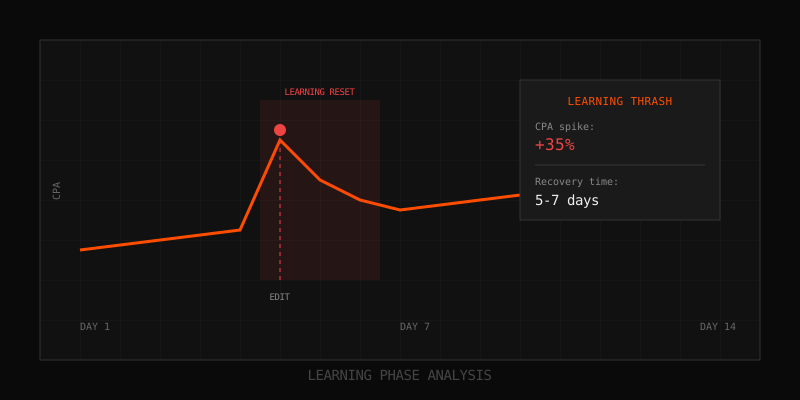
You enabled Advantage+ Audience because Meta promised better performance through AI optimization. Three weeks later, your CPA is 30% above target. The automation didn't fail—it optimized for exactly what Meta told it to. The problem is that Meta's objective and your objective aren't the same thing.
Automation drift occurs when Meta's Advantage+ features optimize for volume or engagement metrics that don't align with your actual business goals. The AI finds more conversions—but at a higher cost than manual targeting would achieve. This is particularly insidious because the ad set looks healthy by some metrics while quietly draining your efficiency.
What Is Advantage+ and Why Does It Drift?
Advantage+ is Meta's umbrella term for AI-powered automation features. The main ones affecting targeting and creative are:
Advantage+ Audience
Replaces manual targeting with AI-driven audience expansion. You provide audience suggestions, but Meta can go beyond them if it finds "better" opportunities. The problem: "better" means more conversions, not necessarily cheaper conversions.
Advantage+ Creative
Automatically generates creative variations—different text, images, aspect ratios—to test what performs best. The risk: Meta may favor variations that get clicks but not conversions, or that convert low-value customers.
Advantage+ Placements
Automatically distributes budget across all available placements (Feed, Stories, Reels, Audience Network, etc.). The risk: budget flows to cheap placements with poor conversion rates because they have lower CPM.
Why Drift Happens
Meta's optimization objective is "maximize conversions within your budget." But the algorithm doesn't care about CPA—it cares about total conversions. If expanding to a lower-quality audience segment produces more conversions (even at higher CPA), the algorithm will do it. Your efficiency tanks while Meta's conversion count looks great.
Signs of Automation Drift
Drift doesn't announce itself. Look for these warning signs:
CPA Creeping Above Target
The clearest signal. If your target CPA is $15 and you're consistently at $18-20 with Advantage+ enabled, the automation is drifting. Compare to manual targeting baseline—if manual achieves $15 and Advantage+ sits at $20, the AI is costing you money.
Volume Up, Efficiency Down
You're getting more conversions than before, but ROAS has dropped. The algorithm found more customers, but they cost more to acquire. This is the classic drift pattern—quantity over quality.
High Spend in Low-Quality Placements
Check placement breakdown. If Audience Network or Facebook Right Column is consuming 30%+ of budget but converting at 50% lower rates than Feed, Advantage+ Placements is drifting toward cheap inventory.
Creative Variants Underperforming Original
With Advantage+ Creative, check which variants are spending. If AI-generated variations have worse conversion rates than your original creative but are still getting budget, the automation is optimizing for the wrong signals.
Audience Expansion Beyond Intent
With Advantage+ Audience, check Audience Insights. If you suggested "online shoppers aged 25-34" but the algorithm is spending heavily on 45-54 year-olds who rarely convert, expansion has gone too far.
How to Detect Automation Drift
Method 1: CPA vs Target Analysis
Calculate the ratio of actual CPA to target CPA. If this ratio exceeds 1.2 (20% above target) consistently for ad sets with Advantage+ enabled, flag for review. Compare to ad sets without Advantage+ features as a control.
Method 2: A/B Test Against Manual
Run a controlled test: one ad set with Advantage+ enabled, one with manual targeting, same creative and budget. After 2 weeks and 100+ conversions each, compare CPA. If manual wins by more than 10%, Advantage+ is drifting.
Method 3: CSV Export Analysis
Export daily performance data. For each ad set with Advantage+ features, calculate average CPA and compare to your stated target. Flag any ad set where actual CPA exceeds target by 20%+ with 7+ days of data.
Our Meta Ads Audit tool automatically detects automation drift by comparing Advantage+ ad set performance against target CPA thresholds. We flag ad sets where the automation is consistently underperforming efficiency targets, with exact evidence from your CSV exports.
How to Fix Automation Drift
Fix 1: Disable Advantage+ and Compare
The simplest test: turn off Advantage+ features for 2 weeks and compare. If CPA improves, the automation was hurting you. You might sacrifice some volume, but if efficiency matters more than scale, manual wins.
Fix 2: Add Audience Guardrails
With Advantage+ Audience, you can still set demographic limits (age, location, language). Tighten these constraints to prevent the algorithm from drifting too far from your core audience. You're not fully manual, but you're bounded.
Fix 3: Use Cost Cap Bidding
Pair Advantage+ with Cost Cap bidding to enforce CPA limits. This tells the algorithm: "Find conversions, but only if they cost less than $X." If Advantage+ can't find efficient conversions within your cap, it simply won't spend—which is better than spending inefficiently.
Fix 4: Exclude Low-Performing Placements
With Advantage+ Placements, manually exclude placements that historically underperform. Check your placement breakdown, identify the bottom performers, and remove them. The automation still optimizes across remaining placements but can't waste budget on Audience Network if you've excluded it.
Fix 5: Limit Creative Variations
With Advantage+ Creative, you can disable specific enhancements (text variations, image optimizations, etc.). If certain variation types underperform, turn them off. Keep the AI assistance you find valuable, cut what hurts.
Fix 6: Hybrid Approach
Run some ad sets with Advantage+ for scale and others with manual targeting for efficiency. Allocate budget based on goals: Advantage+ when you need volume, manual when you need precision. Don't put all eggs in one basket.
When Advantage+ Actually Helps
Advantage+ isn't universally bad. It tends to work well when:
- High volume targets: If you need scale above all else, Advantage+ can find incremental conversions that manual targeting misses
- New accounts: Without historical data, Advantage+ can explore more efficiently than manual guesses
- Broad products: If your product appeals to almost everyone, letting AI find the best prospects makes sense
- Creative testing: Advantage+ Creative can surface winning variations faster than manual A/B tests
The key is monitoring. Advantage+ requires more vigilance, not less. The automation handles execution, but you must still validate that execution serves your goals.
The Bigger Picture: Automation vs Control
Meta is pushing advertisers toward more automation. Every platform update makes manual controls harder to find and Advantage+ features more prominent. This isn't inherently bad—AI can find patterns humans miss.
But automation serves Meta's interests first. Meta wants advertisers to spend more, and AI that maximizes conversions (regardless of cost) achieves that. Your job is to validate that automation actually improves your outcomes, not just Meta's revenue.
Regular drift audits are essential. Don't set Advantage+ and forget it. Monitor weekly, compare to baselines, and intervene when the AI drifts from your goals.
Key Takeaways
- Automation drift occurs when Advantage+ optimizes for volume over efficiency
- Common signs: CPA above target, declining ROAS, budget in low-quality placements
- Compare Advantage+ performance to manual targeting as a control
- Fix with Cost Cap bidding, placement exclusions, or hybrid approaches
- Advantage+ works well for scale, less well for efficiency-focused campaigns
- Monitor weekly—automation requires more vigilance, not less
FAQ
Should I avoid Advantage+ entirely?
No. Advantage+ can deliver value, especially for scale-focused campaigns or new accounts. But you must monitor actively and intervene when it drifts. Treat it as a tool that requires supervision, not a set-and-forget solution.
How long should I test before concluding Advantage+ isn't working?
At least 2 weeks with 100+ conversions. Automation needs time to learn. But if after 4 weeks and 200+ conversions CPA is still 20%+ above target, the drift is real and intervention is warranted.
Does Advantage+ Shopping work differently?
Advantage+ Shopping Campaigns (ASC) are fully automated and harder to control. Drift is more common because you have fewer levers. Consider running ASC alongside manual campaigns and comparing. Many advertisers find a hybrid allocation works best.
Will Meta reduce Advantage+ drift over time?
Meta improves its algorithms continuously, but remember: their incentive is to maximize spend, yours is to maximize efficiency. These don't always align. Stay vigilant regardless of algorithm updates.
Learn more: How it works · Why bundles beat raw thread history