
Thread Transfer
Seasonal Budget Strategy: Preparing for Q4 Without Overspending
CPMs spike 40% in Q4 but so do conversion rates. The advertisers who win are those who plan budgets months in advance. Here's the complete seasonal playbook.
Thread Transfer
Founder, Meta Ads Audit
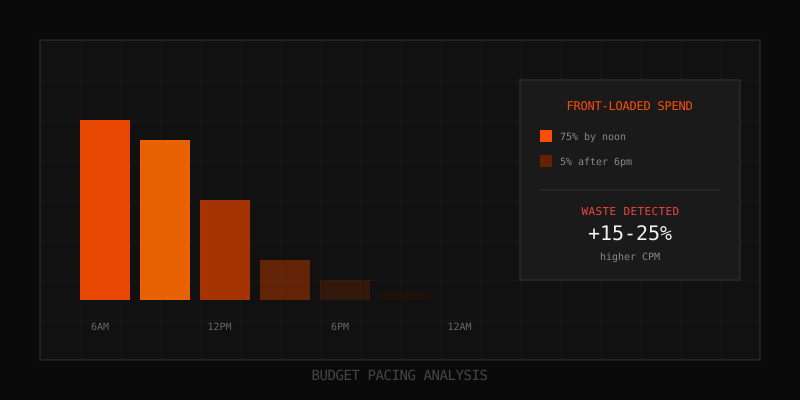
Q4 is a paradox. CPMs spike 30-50% as every advertiser floods the auction. But conversion rates climb too, sometimes dramatically. Black Friday weekend alone can represent 20% of an e-commerce brand's annual revenue. The advertisers who win aren't those with the biggest budgets—they're those who planned their budgets months in advance.
This guide gives you the complete seasonal budget strategy. We'll cover when to start planning, how to calculate the right budget increases, which tactics preserve efficiency during high-CPM periods, and how to avoid the most common seasonal mistakes.
The Seasonal Reality: What Actually Happens to Costs
Before planning your budget, you need to understand what you're planning for. Here's what Meta Ads costs look like across a typical year for e-commerce advertisers:
| Period | CPM Index | Conversion Rate Index | Net Efficiency |
|---|---|---|---|
| January | 70 | 80 | Below average |
| February-March | 80 | 90 | Slightly below average |
| April-June | 90 | 100 | Average |
| July-August | 85 | 95 | Slightly below average |
| September | 100 | 105 | Average |
| October | 110 | 115 | Average |
| November 1-20 | 130 | 120 | Below average |
| Black Friday Week | 180 | 200 | Above average |
| December 1-15 | 150 | 160 | Average to above average |
| December 16-24 | 140 | 180 | Above average |
| December 25-31 | 90 | 110 | Average |
The key insight: CPM spikes don't automatically mean worse ROAS. During peak buying periods, conversion rates often increase faster than costs. The weeks right before Black Friday (November 1-20) are actually the most challenging—CPMs rise in anticipation, but buyers are waiting for deals.
The Four-Phase Seasonal Budget Framework
Break your annual budget into four phases, each with different goals and strategies:
Phase 1: Pre-Season Build (August-September)
Goal: Build audience pools and test creative before CPMs rise.
- Budget allocation: 15-20% of Q4 total, spread evenly
- Focus on prospecting to grow remarketing audiences
- Test 3-5x more creative variations than normal
- Identify winning audience-creative combinations for scaling
- Build email/SMS lists through lead generation campaigns
Why it matters: By building audiences now, you'll have larger remarketing pools when CPMs spike. Testing creative now means you're not wasting expensive Q4 impressions on unproven ads.
Phase 2: Pre-Peak (October-November 15)
Goal: Scale proven winners and warm up the algorithm before peak.
- Budget allocation: 20-25% of Q4 total, front-loaded
- Scale winning ad sets from Phase 1 by 30-50%
- Shift mix toward remarketing (60% remarketing, 40% prospecting)
- Pause all testing; run only proven performers
- Implement BFCM teaser campaigns to build anticipation
Critical warning: The period November 1-15 often has the worst efficiency—CPMs rise but buyers wait for sales. Consider reducing spend here and reallocating to peak week.
Phase 3: Peak (November 16-December 15)
Goal: Maximize revenue during highest-conversion period.
- Budget allocation: 50-60% of Q4 total, heavily concentrated
- Black Friday week: 20-30% of Q4 budget in 7 days
- Aggressive remarketing to all engaged audiences
- Dynamic product ads with sale pricing
- Hourly bid adjustments during key sale periods
Black Friday week math: If your Q4 budget is $100,000, plan to spend $20,000-$30,000 in the 7 days around Black Friday. This isn't overspending—it's capturing your best ROAS window of the year.
Phase 4: Post-Peak (December 16-31)
Goal: Capture last-minute shoppers and gift card buyers.
- Budget allocation: 10-15% of Q4 total, tapering down
- Focus on "last chance" and "arrives by Christmas" messaging
- Heavy gift card promotion after shipping cutoffs
- Remarketing to cart abandoners from peak period
- Taper spending after December 22 unless you sell gift cards or digital products
Calculating Your Q4 Budget Increase
How much should you increase spending in Q4? Use this framework:
Method 1: Historical Revenue Share
If Q4 typically represents X% of your annual revenue, Q4 should represent at least X% of your annual ad spend, adjusted upward by 10-20% for CPM inflation.
- Example: Q4 is 35% of annual revenue
- Baseline Q4 spend: 35% of annual budget
- Adjusted for CPM inflation: 35% x 1.15 = 40% of annual budget
Method 2: ROAS Threshold Calculation
Calculate how much you can spend while maintaining minimum acceptable ROAS.
- Determine minimum acceptable ROAS (e.g., 3.0x)
- Estimate peak period conversion rate increase (e.g., +50%)
- Estimate peak period CPM increase (e.g., +40%)
- Calculate effective efficiency: (1.50 / 1.40) = 1.07x normal
- If normal ROAS is 4.0x, peak ROAS estimate: 4.0 x 1.07 = 4.3x
- This exceeds 3.0x floor, so aggressive spending is justified
Method 3: Marginal ROAS Analysis
For more sophisticated accounts, calculate marginal ROAS at different spend levels.
| Daily Spend | Expected Revenue | ROAS | Marginal ROAS |
|---|---|---|---|
| $1,000 | $4,500 | 4.5x | - |
| $2,000 | $8,200 | 4.1x | 3.7x |
| $3,000 | $11,400 | 3.8x | 3.2x |
| $4,000 | $14,000 | 3.5x | 2.6x |
| $5,000 | $15,500 | 3.1x | 1.5x |
If your minimum acceptable ROAS is 2.5x, you can profitably scale to $4,000/day in this example. Beyond that, marginal returns drop below your threshold.
Timing Your Budget Ramps
Don't wait until November to increase budgets. The algorithm needs time to adjust, and sudden budget increases trigger learning phase.
The Gradual Ramp Strategy
| Week | Budget vs Baseline | Notes |
|---|---|---|
| October Week 1 | +10% | Begin gradual increase |
| October Week 2 | +20% | Continue scaling |
| October Week 3 | +30% | Monitor for efficiency drops |
| October Week 4 | +40% | Pre-peak level reached |
| November Week 1 | +50% | Hold steady |
| November Week 2 | +50% | Pre-BFCM steadiness |
| BFCM Week | +150-200% | Peak spend |
| December Week 1 | +100% | Step down from peak |
| December Week 2 | +80% | Continue tapering |
| December Week 3 | +50% | Last-minute shoppers |
| December Week 4 | 0% | Return to baseline |
High-CPM Survival Tactics
When CPMs spike, efficiency tactics become critical. Here's how to maintain ROAS during peak periods:
Tactic 1: Shift to Remarketing
During high-CPM periods, remarketing audiences typically maintain efficiency better than prospecting. These audiences already know your brand and convert at higher rates.
- Normal mix: 50% remarketing, 50% prospecting
- Peak period mix: 70-80% remarketing, 20-30% prospecting
- Focus remarketing on: cart abandoners, past purchasers, engaged website visitors
Tactic 2: Narrow to High-Intent Audiences
When impressions are expensive, make each one count. Narrow targeting to highest-converting segments:
- Shorten lookalike percentages (3% to 1%)
- Add purchase intent signals (engaged shoppers, purchase behavior)
- Exclude low-value segments (bounced visitors, single-page viewers)
- Layer exclusions to prevent audience overlap
Tactic 3: Use Catalog/DPA Campaigns
Dynamic Product Ads automatically show relevant products to interested users. They typically outperform static ads during high-intent periods because they personalize at scale.
- Retargeting: show products users viewed or added to cart
- Cross-sell: show complementary products to past purchasers
- Broad audience: let the algorithm match products to interests
Tactic 4: Bid Strategy Adjustments
Different bid strategies work better in different competitive environments:
- Normal periods: Lowest Cost for volume
- Peak periods: Cost Cap to maintain efficiency floor
- BFCM specifically: Bid Cap for premium placement during critical hours
Tactic 5: Dayparting During Peak Days
On Black Friday and Cyber Monday specifically, consider hourly budget adjustments:
- 5-8 AM: Light spend (deal hunters checking options)
- 8 AM-12 PM: Heavy spend (morning shopping peak)
- 12-2 PM: Moderate spend (lunch lull)
- 2-6 PM: Heavy spend (afternoon shopping peak)
- 6-10 PM: Maximum spend (prime buying window)
- 10 PM-12 AM: Heavy spend (late-night deals)
Common Seasonal Budget Mistakes
Mistake 1: Waiting Until November to Scale
If you suddenly double your budget on November 1, you'll spend peak dollars during learning phase—the worst possible timing. Start scaling in October.
Mistake 2: Testing Creative During Peak
Creative testing during Q4 wastes expensive impressions on unproven ads. Do all testing in September and early October. By November, run only proven winners.
Mistake 3: Maintaining Normal Prospecting Mix
Prospecting is more expensive during peak because everyone is doing it. Shift mix heavily toward remarketing where you have a conversion rate advantage.
Mistake 4: Same Budget Every Day
Black Friday spending should be 3-5x a normal day. Treating peak days the same as regular days leaves revenue on the table.
Mistake 5: Not Accounting for CPM Inflation
A $10,000 budget in June buys different reach than $10,000 in November. Plan for 30-50% fewer impressions per dollar during peak.
Mistake 6: Cutting Budget During the CPM Surge
When you see CPMs spike 40%, the instinct is to cut budget. But if conversion rates are up 50%, you're actually more efficient. Look at ROAS, not CPM, when making budget decisions.
Post-Season Analysis Framework
After Q4, analyze performance to improve next year's strategy:
- CPM patterns: When exactly did CPMs spike and return to normal?
- Conversion rate patterns: When were conversion rates highest?
- Best ROAS windows: Which specific days/weeks had the best efficiency?
- Audience performance: Which audiences held up best during high-CPM periods?
- Creative performance: Which creative themes resonated during holiday messaging?
- Budget accuracy: Did you over or underspend vs. plan? Why?
Key Takeaways
- Q4 CPMs spike 30-50%, but conversion rates often rise faster—net efficiency can improve
- Use a four-phase framework: Pre-Season Build, Pre-Peak, Peak, Post-Peak
- Allocate 50-60% of Q4 budget to peak period (November 16-December 15)
- Black Friday week alone should get 20-30% of Q4 budget
- Start budget ramps in October; sudden increases in November trigger learning phase
- Shift mix toward remarketing (70-80%) during high-CPM periods
- Complete all creative testing before November; run only proven winners during peak
FAQ
Should I run ads on Black Friday if I'm not offering discounts?
Consider reducing spend. Buyers expect deals on Black Friday, and non-discounted offers compete against doorbuster sales. Instead, save budget for the week after when deal fatigue sets in and buyers return to normal shopping patterns.
How do I budget for a product launch in Q4?
If possible, delay the launch to January when CPMs are 30-40% lower. If you must launch in Q4, allocate significantly more budget than normal launches—expect to pay 1.5x for the same reach—and front-load spending in September-October for testing.
My brand doesn't benefit from holiday shopping. Should I reduce Q4 spend?
Yes. If your product isn't gift-worthy or holiday-relevant, reallocate Q4 budget to January-February when CPMs are at their lowest. You'll get 40% more impressions for the same money.
How do I handle a tight cash flow during Q4?
Concentrate spending on the highest-ROAS windows: Black Friday weekend and December 16-24. Skip the inefficient pre-Black Friday period (November 1-20) entirely. This captures peak revenue potential with minimal budget.
Should I use Advantage+ for Q4 campaigns?
Yes, especially for remarketing and catalog campaigns. Advantage+ Shopping campaigns often outperform manual setups during high-competition periods because the algorithm optimizes in real-time. Just ensure you've "trained" the campaign before peak by running it through September-October.
Learn more: How it works · Why bundles beat raw thread history