
Thread Transfer
Saved Audiences vs Dynamic Targeting: When to Use Each
Saved audiences give you control. Dynamic targeting gives Meta control. Neither is universally better. Here's when to use each.
Thread Transfer
Founder, Meta Ads Audit
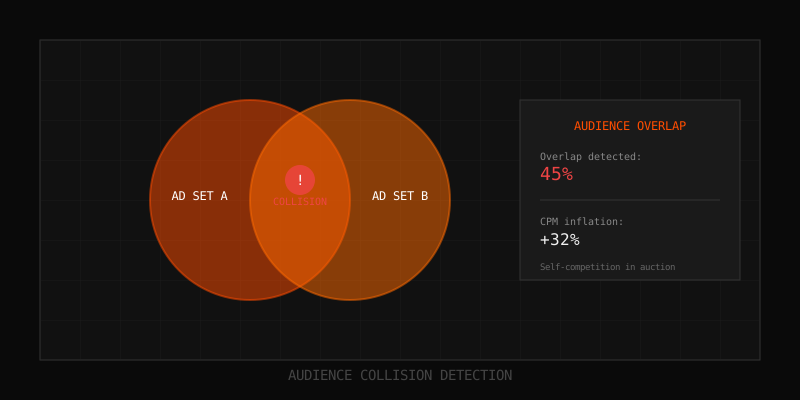
Meta offers two fundamentally different approaches to audience targeting. Saved audiences give you precise control—you define exactly who sees your ads based on demographics, interests, behaviors, and custom audiences. Dynamic targeting (Advantage+ Audience and broad targeting) hands control to Meta's algorithm, which finds converters across a wider pool.
The industry has been shifting toward dynamic targeting. Meta pushes it heavily. Many advertisers have abandoned saved audiences entirely. But this binary thinking misses the point. Both approaches have optimal use cases. Understanding when each wins—and how to combine them—creates better results than choosing one exclusively.
Understanding the Two Approaches
Saved Audiences: Precision Control
Saved audiences are targeting definitions you create and save in Ads Manager. They can include:
- Demographics: Age, gender, location, language
- Interests: Topics users have engaged with (fitness, cooking, technology)
- Behaviors: Purchase history, device usage, travel patterns
- Custom audiences: Your own data (customer lists, website visitors, engagers)
- Lookalikes: Users similar to your custom audiences
Key characteristic: You control exactly who's included. Meta shows ads only to users matching your criteria.
Dynamic Targeting: Algorithm Optimization
Dynamic targeting lets Meta's algorithm decide who sees your ads. The main forms:
- Advantage+ Audience: You provide targeting suggestions, but Meta can expand beyond them to find converters
- Broad targeting: No targeting restrictions—Meta shows ads to anyone it predicts will convert
- Advantage+ Shopping Campaigns: Fully automated targeting for e-commerce
Key characteristic: Meta controls targeting. Your inputs are suggestions, not restrictions. The algorithm optimizes for your stated objective.
When Saved Audiences Win
1. Niche Markets and Small Audiences
If your target market is highly specific, saved audiences outperform. Meta's algorithm needs signal volume to learn. With a niche audience (B2B software for dental practices, luxury goods for collectors), the algorithm may never see enough conversions to optimize effectively.
Example: A company selling equipment to commercial fishermen. Broad targeting would show ads to millions of irrelevant users. A saved audience targeting specific job titles, industry behaviors, and relevant interests dramatically improves efficiency.
2. Limited Budget
Dynamic targeting needs budget to learn. Meta recommends 50+ conversions per week per ad set for optimal learning. At $20 CPA, that's $1,000/week minimum per ad set. If your budget is $500/week total, broad targeting won't accumulate enough signal.
Saved audiences perform better at low budgets because you're pre-filtering to relevant users rather than paying for the algorithm to learn who's relevant.
3. Strict Geographic or Demographic Requirements
Some businesses have hard targeting requirements:
- Local businesses that can only serve specific zip codes
- Age-restricted products (alcohol, gambling)
- Services limited by licensing (insurance, real estate by state)
- B2B targeting specific company sizes or industries
Dynamic targeting may expand into users you can't legally or practically serve. Saved audiences enforce these boundaries.
4. Retargeting Campaigns
Retargeting requires showing ads to specific people who've already interacted with you. Saved audiences (built from custom audiences) are the tool for this. You can't retarget with broad targeting—by definition, you need to target users who completed specific actions.
5. Testing Audience Hypotheses
When you want to test whether a specific audience segment performs well, saved audiences provide clean data. "Do marathon runners convert better than general fitness enthusiasts?" requires targeting each segment separately. Dynamic targeting blends audiences, making such tests impossible.
When Dynamic Targeting Wins
1. Scale-Focused Campaigns
When the goal is maximum conversions rather than maximum efficiency, dynamic targeting often wins. Meta's algorithm can find converters in unexpected segments that you'd never think to target manually.
Example: An e-commerce brand finds that dynamic targeting delivers 20% more conversions than saved audiences, at 10% higher CPA. If volume matters more than efficiency, dynamic wins.
2. Sufficient Budget and Signal
With adequate budget ($5k+/week per campaign) and conversion volume (50+/week), dynamic targeting typically outperforms. The algorithm has enough data to learn and optimize continuously. Manual targeting can't adapt as quickly to changing user behavior.
3. Broad Product Appeal
If your product appeals to almost anyone (consumer goods, general apps, mass-market services), dynamic targeting makes sense. Why limit to specific interests when the algorithm might find better converters in segments you never considered?
4. Creative-Led Strategy
When strong creative does the targeting (specific hooks, pain points, or use cases), let the audience be broad. Your video about back pain naturally attracts people with back pain. You don't need interest targeting for "back pain sufferers"—the creative self-selects.
5. Algorithm Trust and Iteration Speed
Dynamic targeting adapts daily based on conversion data. Saved audiences are static until you manually update them. For fast-moving products, seasonal offers, or rapidly evolving markets, dynamic targeting's automatic optimization is valuable.
Performance Comparison: Real Data
Here's what we typically see when comparing approaches across different scenarios:
E-commerce: $50K/Month Spend
| Targeting Approach | CPA | ROAS | Conversions |
|---|---|---|---|
| Interest-based saved audiences | $22 | 3.8x | 1,450 |
| Lookalike saved audiences | $19 | 4.2x | 1,680 |
| Advantage+ Audience | $24 | 3.5x | 1,330 |
| Advantage+ Shopping | $21 | 4.0x | 1,900 |
Finding: Advantage+ Shopping delivered the most conversions, but lookalikes had the best efficiency. The optimal approach was hybrid: ASC for scale, lookalikes for efficiency-focused acquisition.
B2B Lead Gen: $15K/Month Spend
| Targeting Approach | CPL | Lead Quality | SQL Rate |
|---|---|---|---|
| Job title + industry targeting | $85 | 7.8/10 | 22% |
| Customer list lookalike | $72 | 7.2/10 | 18% |
| Advantage+ Audience | $48 | 4.1/10 | 8% |
| Broad targeting | $38 | 3.2/10 | 5% |
Finding: Broad targeting had the cheapest leads but terrible quality. Job title targeting had the best SQL rate. For B2B, saved audiences dominated despite higher CPL because lead quality matters more than lead cost.
Consumer App: $100K/Month Spend
| Targeting Approach | CPI | Day-7 Retention | Day-30 LTV |
|---|---|---|---|
| Interest saved audiences | $2.40 | 28% | $3.20 |
| High-value user lookalike | $2.80 | 35% | $4.50 |
| Advantage+ Audience | $1.80 | 22% | $2.80 |
| Broad targeting | $1.50 | 18% | $2.20 |
Finding: Broad targeting had cheapest installs but worst retention and LTV. Lookalikes had best LTV/CPI ratio. At scale, a hybrid approach worked best: broad for volume, lookalikes for quality.
Hybrid Strategies: Best of Both
The either/or framing is limiting. Smart advertisers combine approaches:
Strategy 1: Saved for Retargeting, Dynamic for Prospecting
Use saved audiences for retargeting (website visitors, cart abandoners, engagers). Use dynamic targeting for cold prospecting where the algorithm can explore.
Rationale: Retargeting requires targeting specific users by definition. Prospecting benefits from algorithm optimization when you have sufficient budget.
Strategy 2: Advantage+ with Audience Suggestions
Use Advantage+ Audience but provide strong audience suggestions (your best-performing saved audiences or lookalikes). Meta uses these as starting points but can expand beyond them.
Rationale: You get algorithm flexibility while seeding it with known good audiences. Performance often exceeds both pure approaches.
Strategy 3: Budget Split Testing
Allocate budget to both approaches: 60% to whichever performs better historically, 40% to the other for continued testing. Adjust monthly based on results.
Rationale: Performance varies by season, creative, and competitive dynamics. Maintaining both approaches lets you shift when conditions change.
Strategy 4: Funnel-Based Allocation
Top of funnel (awareness): Dynamic targeting for reach Middle of funnel (consideration): Saved audiences (engagers, video viewers) Bottom of funnel (conversion): Saved audiences (retargeting, high-intent)
Rationale: Each funnel stage has different optimal targeting. Broad works for awareness; precision works for conversion.
Making the Decision: A Framework
Use this decision framework to choose your approach:
Choose Saved Audiences If:
- Budget is under $5,000/month per campaign
- Target audience is niche or B2B
- You have strict geographic/demographic requirements
- You need to test specific audience hypotheses
- You're running retargeting campaigns
- Lead quality matters more than lead volume
Choose Dynamic Targeting If:
- Budget exceeds $10,000/month per campaign
- You achieve 50+ conversions/week consistently
- Product has broad market appeal
- Creative does the targeting (specific hooks/pain points)
- You're focused on scale over efficiency
- You trust Meta's optimization and want faster iteration
Choose Hybrid If:
- You have moderate budget ($5-15K/month)
- You run both prospecting and retargeting
- Results are mixed between approaches
- You want the benefits of both
Implementation Tips
For Saved Audiences
- Name audiences clearly: include targeting criteria, date created, and purpose
- Review and update saved audiences quarterly—interests shift, behaviors change
- Test audience exclusions to prevent overlap between saved audiences
- Create variations (interest A vs interest B) to test which performs better
For Dynamic Targeting
- Always provide audience suggestions—even if Meta can ignore them
- Ensure pixel/CAPI is properly implemented—dynamic targeting needs good signal
- Give campaigns time to learn (2-4 weeks minimum)
- Monitor for audience drift—check who Meta is actually reaching
For Hybrid Approaches
- Keep saved and dynamic campaigns in separate ad sets for clean comparison
- Use consistent creative across approaches to isolate targeting effects
- Review performance weekly and reallocate budget monthly
- Document what works for your specific business and product
Key Takeaways
- Saved audiences offer control; dynamic targeting offers algorithm optimization
- Neither is universally better—optimal choice depends on budget, audience, and goals
- B2B and niche markets typically favor saved audiences for quality
- High-budget, broad-appeal products typically favor dynamic targeting for scale
- Hybrid approaches often outperform either pure approach
- Retargeting requires saved audiences; prospecting can use either
- Test both, measure true business outcomes (not just CPA), and adapt
FAQ
Is Meta phasing out saved audiences?
Meta is pushing dynamic targeting but hasn't eliminated saved audiences. Interest targeting options have been reduced, but custom audiences, lookalikes, and demographic targeting remain. Expect continued pressure toward automation, but saved audiences will likely remain available for specific use cases.
Can I use exclusions with dynamic targeting?
Yes. Advantage+ Audience and Advantage+ Shopping both support exclusions. Always exclude recent purchasers, employees, and any other audiences you don't want reached—even when using dynamic targeting.
How do I know if dynamic targeting is reaching the right people?
Check Audience Insights in Ads Manager. Review the demographics, locations, and interests of people your campaigns are reaching. If they don't match your customer profile, consider adding audience suggestions or switching to saved audiences.
Should I start with saved audiences and switch to dynamic later?
A reasonable approach for new advertisers. Saved audiences help you understand what works. Once you have conversion data and proven creative, dynamic targeting can scale those learnings. Think of it as training wheels—useful early, optional later.
What's the minimum budget for dynamic targeting to work?
Meta recommends 50+ conversions per week per ad set for optimal learning. Divide your weekly budget by your CPA to estimate conversions. If you can't hit 50/week, saved audiences may perform better until you can scale budget.
Learn more: How it works · Why bundles beat raw thread history