
Thread Transfer
Is Interest Targeting Dead in 2025? The Data Says...
Interest targeting used to be the workhorse of Meta Ads. Now advertisers are abandoning it. But the data tells a more nuanced story.
Thread Transfer
Founder, Meta Ads Audit
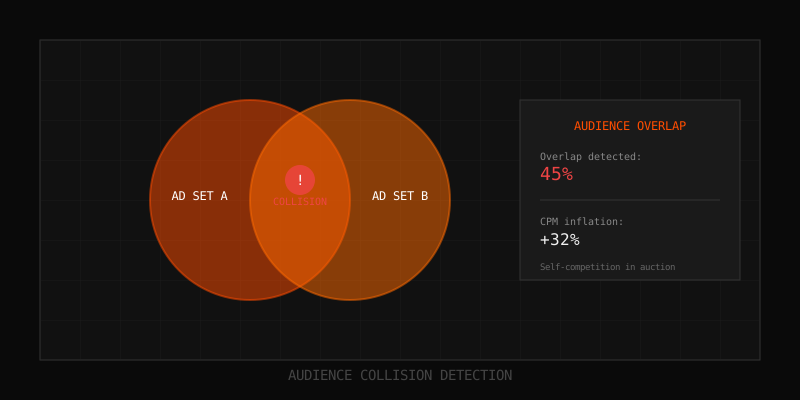
Interest targeting was once the foundation of Meta advertising. Target people interested in yoga, target people who like hiking, target parents of toddlers. The targeting options were specific, the audiences were large, and the results were predictable. Then iOS 14.5 happened, privacy regulations tightened, and advertisers started abandoning interest targeting for broad and Advantage+ approaches.
But is interest targeting actually dead in 2025? The data tells a more nuanced story. Interest targeting has changed - it is less precise than before, less reliable for some use cases, but far from obsolete. Understanding what changed, what still works, and when to use interest targeting versus alternatives is now a critical skill for Meta advertisers.
What Changed with Interest Targeting
To understand whether interest targeting is dead, we need to understand what broke and what remained intact.
The iOS 14.5 Impact
App Tracking Transparency (ATT) did not directly affect interest targeting - interests are inferred from on-platform behavior, not cross-app tracking. However, ATT had indirect effects:
- Reduced signal for optimization: With less conversion data flowing back to Meta, the algorithm has fewer signals to learn which interest segments actually convert
- Smaller optimization pools: Audiences based on interests combined with conversion optimization have less data to work with
- Attribution challenges: Even when interest targeting works, proving it works became harder due to measurement gaps
Deprecation of Detailed Targeting
Meta has progressively removed sensitive interest categories over the past few years:
- Health-related interests (removed 2022)
- Political affiliation and social causes (removed 2022)
- Sexual orientation and religious beliefs (removed 2022)
- Low-activity interest categories (ongoing removal)
Each removal shrinks the interest targeting toolkit. Categories that remain are generally broader, less specific, and shared by more advertisers competing for the same users.
The Rise of Automation
Meta has been pushing advertisers toward Advantage+ and broad targeting. The messaging is clear: trust the algorithm, let AI find your customers, stop trying to outsmart the machine. This is not purely philosophical - Meta has economic incentives to encourage broad targeting that maximizes their inventory utilization.
The push toward automation has led many advertisers to abandon interest targeting preemptively, assuming it no longer works. In some cases, they are right. In others, they are leaving performance on the table.
The Data: Interest Targeting Performance in 2025
Industry benchmarks and aggregated account data reveal a mixed picture for interest targeting:
Where Interest Targeting Still Wins
| Scenario | Interest Targeting Performance vs Broad |
|---|---|
| New accounts with no pixel data | 15-30% better CPA |
| Niche products with specific audiences | 10-25% better CPA |
| Low budget campaigns (under $5k/month) | 5-20% better CPA |
| B2B targeting with job-related interests | Often significant advantage |
Where Broad/Advantage+ Wins
| Scenario | Broad Targeting Performance vs Interest |
|---|---|
| Mature accounts with 100+ conversions/week | 5-15% better CPA |
| Mass market products | 10-20% better CPA |
| High budget campaigns (over $50k/month) | Often significant advantage |
| Strong creative with broad appeal | Typically wins |
The Pattern
Interest targeting works better when Meta algorithm has less data to work with: new accounts, low budgets, niche products. Broad targeting works better when the algorithm has rich data: mature accounts, high volume, mass market appeal.
This makes intuitive sense. Interest targeting is essentially a human hypothesis about who will convert. Broad targeting lets the algorithm develop its own hypothesis from data. With enough data, the algorithm usually wins. With limited data, human judgment provides valuable direction.
When to Use Interest Targeting in 2025
Use Case 1: New Account Launch
Fresh ad accounts have no pixel history, no conversion data, no signal for the algorithm to optimize against. Telling Meta to target broadly means the algorithm is guessing blindly.
Interest targeting provides initial direction. Target interests aligned with your ideal customer, run until you accumulate 50-100 conversions, then test transitioning to broader targeting as the algorithm learns.
Use Case 2: Niche Products
If your product appeals to 0.5% of the population, broad targeting wastes impressions on the 99.5% who will never buy. Interest targeting narrows the pool to users with at least directional relevance.
Examples: specialized hobby equipment, professional tools, luxury goods with specific appeal. The more niche your product, the more value interest targeting provides.
Use Case 3: Budget-Constrained Campaigns
At $50/day budget, the algorithm cannot run enough experiments to find your best audience through broad targeting. The learning phase requires conversion volume that low budgets cannot support.
Interest targeting front-loads the algorithm with a hypothesis, reducing the experimentation needed to find converting users. For budgets under $3-5k/month, interest targeting often outperforms broad.
Use Case 4: B2B Advertising
B2B targeting benefits from interest categories around job functions, industries, and professional behaviors. These interests are less affected by privacy changes and provide meaningful segmentation.
Targeting business owners interested in marketing software is more efficient than broad targeting for a SaaS product - the audience is specific enough that human direction adds value.
Use Case 5: Testing Creative Messaging
When testing whether a specific message resonates with a specific audience segment, interest targeting isolates the variable. You can test yoga-focused creative against yoga-interested users and hiking-focused creative against hiking-interested users.
Broad targeting muddles this analysis - you cannot tell if the creative resonated with the intended segment or just happened to find buyers elsewhere.
Interest Targeting Best Practices for 2025
Practice 1: Stack Interests Thoughtfully
Stacking multiple related interests narrows the audience to users who exhibit several relevant signals. A user interested in both marathon running AND healthy eating is likely more committed to fitness than someone interested in only one.
But do not over-stack. Combining 10 interests creates an audience so small that the algorithm cannot optimize effectively. Two to four related interests is typically optimal.
Practice 2: Use Interest Exclusions
Excluding irrelevant interests can be as powerful as including relevant ones. If you sell premium products, excluding bargain shopper interests may improve audience quality more than adding luxury interests.
Interest exclusions are underutilized - most advertisers focus only on what to include, missing the opportunity to filter out poor-fit users.
Practice 3: Layer with Demographics
Pure interest targeting is less precise than before. Layering interests with demographic constraints (age, location, device type) improves precision without over-narrowing.
Example: Instead of just fitness enthusiasts, target fitness enthusiasts aged 25-45 in urban areas using iOS devices. Each layer adds signal.
Practice 4: Test Against Broad
Never assume interest targeting is optimal. Always run interest-targeted ad sets alongside broad targeting ad sets with identical creative. Let data determine which approach works for your specific account.
If broad targeting wins consistently, phase out interest targeting. If interest targeting wins, keep using it but retest quarterly as your pixel data accumulates.
Practice 5: Use Advantage Detailed Targeting Wisely
Advantage Detailed Targeting lets Meta expand beyond your selected interests if it finds better opportunities. This is a middle ground between pure interest targeting and pure broad targeting.
Enable it when you want interest targeting as a starting point with algorithmic flexibility. Disable it when you need strict audience control for messaging alignment or testing purposes.
The Hybrid Approach
The most sophisticated advertisers in 2025 are not choosing between interest targeting and broad targeting - they are using both strategically within the same account.
The Portfolio Model
- Broad/Advantage+ campaigns: 50-70% of budget for scale and efficiency
- Interest-targeted campaigns: 20-40% of budget for specific segments and testing
- Retargeting campaigns: 10-20% of budget for engaged users
This portfolio approach lets broad targeting drive volume while interest targeting captures specific opportunities the algorithm might miss.
The Funnel Model
- Top of funnel: Broad targeting for awareness and reach efficiency
- Middle of funnel: Interest targeting to reach relevant non-converters
- Bottom of funnel: Retargeting for conversion
Interest targeting serves a specific role in the middle funnel - reaching users who should be interested but have not engaged yet. This is different from broad prospecting or warm retargeting.
Interest Targeting Mistakes to Avoid
Mistake 1: Too Many Interests
Selecting 20+ interests creates an audience that is either too fragmented (if using narrow match) or too broad (if using expand). Pick 2-5 highly relevant interests rather than every tangentially related option.
Mistake 2: Conflicting Interest Combinations
Targeting users interested in both budget travel AND luxury hotels creates a confused audience with conflicting intent signals. Ensure your interest combinations are coherent.
Mistake 3: Ignoring Audience Size
Interest combinations that create audiences under 500k users often struggle to exit learning phase. Check estimated audience size before launching and ensure sufficient scale for optimization.
Mistake 4: Set-and-Forget
Interest targeting needs regular review. Meta updates interest categories, removes some, adds others. What worked 6 months ago may no longer exist or may have changed in composition.
Mistake 5: Using Interest Targeting as a Crutch
Some advertisers cling to interest targeting because it feels more controlled, even when data shows broad targeting performs better. Trust the data, not the comfort of manual control.
The Future of Interest Targeting
Interest targeting will continue evolving as privacy regulations expand and Meta's AI improves:
- More category removals: Expect continued deprecation of sensitive or low-activity interest categories
- Stronger algorithm: As Meta's AI improves, broad targeting will become more competitive
- Hybrid features: Features like Advantage Detailed Targeting blur the line between manual and algorithmic targeting
- First-party emphasis: Custom audiences and lookalikes may increasingly replace interest targeting for precision
Interest targeting is not dead in 2025, but it is diminished and increasingly situational. Advertisers who treat it as one tool among many will outperform those who either abandon it entirely or rely on it exclusively.
Key Takeaways
- Interest targeting is not dead, but it is less dominant than pre-iOS 14.5
- It still wins for new accounts, niche products, low budgets, and B2B
- Broad/Advantage+ typically wins for mature accounts with high volume
- The hybrid approach - using both interest and broad targeting strategically - is optimal
- Always test interest targeting against broad to let data decide
- Use interest stacking, exclusions, and demographic layers to improve precision
FAQ
Should I stop using interest targeting entirely?
No. Test it against broad targeting for your specific account. If interest targeting loses consistently, reduce its budget allocation. But for many advertisers - especially those with smaller budgets or niche products - it still outperforms.
How many interests should I select?
Two to five highly relevant interests is optimal for most cases. Avoid the extremes of single interests (too narrow) or 15+ interests (too scattered).
Does Advantage Detailed Targeting make interest targeting obsolete?
Advantage Detailed Targeting is a hybrid - it uses your interests as a starting point but expands algorithmically. It is not a replacement for interest targeting but rather an evolution of it. Test both strict interest targeting and Advantage Detailed Targeting to see which performs better.
Will interest targeting continue to decline?
Likely yes. As Meta's algorithm improves and privacy restrictions tighten, interest targeting will become more situational. But decline does not mean death - it will remain a valid tool for specific use cases.
Learn more: How it works · Why bundles beat raw thread history