
Thread Transfer
Broad Targeting Strategy: Letting Meta's Algorithm Work
Counter-intuitive but true: removing targeting restrictions often improves performance. Here's the strategy behind going broad.
Thread Transfer
Founder, Meta Ads Audit
You spent hours crafting the perfect interest stack. Demographics dialed in. Behaviors selected. Your targeting was precise. And then a competitor running broad targeting - no interests, no behaviors, just age and country - beat your CPA by 20%. Counter-intuitive, but increasingly common in 2025.
Broad targeting - removing detailed targeting restrictions and letting Meta algorithm find your customers - has become a legitimate strategy, not just a lazy shortcut. Understanding when to go broad, how to set it up correctly, and what guardrails to maintain is now essential knowledge for Meta advertisers.
Why Broad Targeting Works
On the surface, broad targeting seems wrong. How can targeting everyone outperform targeting specific customer profiles? The answer lies in how Meta algorithm actually operates.
The Algorithm Knows More Than You
Meta processes billions of signals daily: scroll patterns, dwell time, engagement history, purchase behavior, app usage, and countless micro-behaviors invisible to advertisers. Your interest targeting is based on a handful of declared interests. Meta algorithm sees the whole picture.
When you restrict targeting, you are essentially telling the algorithm: ignore everything you know about these users, only show ads to people who match my limited criteria. Sometimes that is valuable. Often, it is not.
Constraints Create Inefficiencies
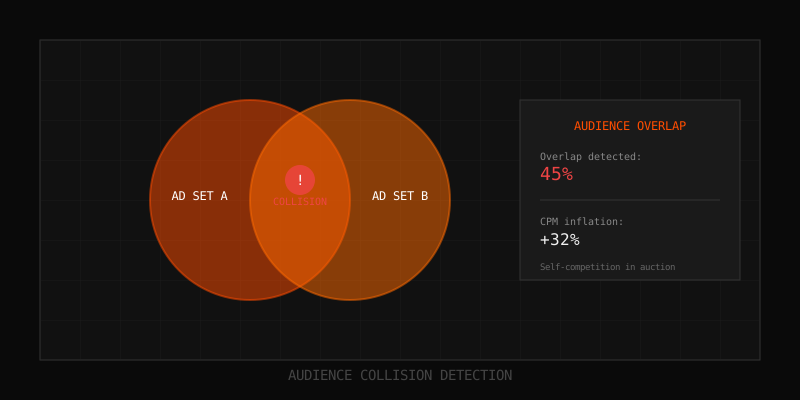
Every targeting restriction narrows the auction pool. Narrower pools mean:
- Higher CPMs: Less inventory means more competition for available impressions
- Less optimization flexibility: The algorithm has fewer users to experiment with
- Audience exhaustion: Smaller audiences get saturated faster
- Missed opportunities: Potential converters who do not match your criteria never see your ads
Creative Drives Targeting
In the broad targeting model, creative becomes the primary targeting mechanism. Your ad itself filters the audience - people who are not interested scroll past, people who are interested engage. The algorithm learns from these engagement signals and optimizes accordingly.
Strong creative makes broad targeting viable. Weak creative makes it a waste of money.
When Broad Targeting Makes Sense
Scenario 1: Mature Accounts with Rich Pixel Data
If your account generates 50+ conversions weekly, Meta algorithm has substantial learning data. It knows what converters look like based on actual behavior, not hypothetical interests.
At this data volume, the algorithm prediction often outperforms human targeting hypotheses. Removing restrictions lets it optimize fully against its learned model.
Scenario 2: Mass Market Products
Products with broad appeal (food delivery, fashion basics, consumer electronics) have potential customers across many demographic and interest segments. Restricting targeting arbitrarily excludes valid buyers.
If your product could reasonably appeal to 20% of the population, interest targeting may exclude 15% of your addressable market for no good reason.
Scenario 3: High Budget Campaigns
At $20k+/month spend, narrow audiences exhaust quickly. You will reach frequency 10+ on your interest-targeted audience while broad targeting is still at frequency 3.
Broad targeting supports sustained spend by continuously finding fresh users. High budgets plus narrow audiences equals wasted impressions on fatigued users.
Scenario 4: Strong Creative with Clear Value Proposition
When your creative clearly communicates who the product is for, the ad itself does the targeting. A yoga mat ad will not convert CrossFit enthusiasts regardless of targeting - the creative filters them out.
Strong creative enables broad targeting. Weak creative requires targeting restrictions to avoid wasting impressions.
Setting Up Broad Targeting Correctly
Broad targeting does not mean no targeting. It means strategic minimalism with appropriate guardrails.
Step 1: Set Geographic and Age Boundaries
Keep basic constraints that reflect genuine business limitations:
- Geography: Countries where you ship/serve and speak the language
- Age: Minimum age for your product (18+ for alcohol, 25+ for insurance, etc.)
- Language: Languages your landing page supports
These are not targeting preferences - they are operational requirements. Someone in a country you do not ship to cannot convert regardless of intent.
Step 2: Remove Interest and Behavior Targeting
Leave detailed targeting blank. No interests, no behaviors, no employer targeting. The algorithm will find your audience based on conversion signals, not declared interests.
This feels uncomfortable. Resist the urge to add just one interest. Even one restriction narrows the optimization pool.
Step 3: Consider Advantage+ Audience
Advantage+ Audience lets you provide targeting suggestions that Meta uses as a starting point, then expands beyond if it finds better opportunities. This is a middle ground for advertisers not ready for pure broad targeting.
Enable it when transitioning from detailed targeting to broad. Disable it when you want pure algorithmic control.
Step 4: Use Appropriate Exclusions
Exclusions are different from targeting restrictions. You should exclude:
- Existing customers: Do not waste prospecting budget on people who already bought
- Recent website visitors: These belong in retargeting campaigns
- Employees: Exclude your company page followers if significant
Exclusions remove people who should not see your ad regardless of targeting strategy. They do not narrow your prospecting pool - they clean it.
Step 5: Set Budget for Learning
Broad targeting requires more learning budget than narrow targeting. The algorithm needs to experiment across a larger pool to find patterns.
Plan for 50+ conversions before evaluating performance. At $30 CPA, that means $1,500 minimum spend before making decisions. Underfunded broad targeting looks like failure - it is actually insufficient learning.
The Creative Requirement
Broad targeting transfers the targeting burden to creative. Your ads must:
Signal Who the Product Is For
Within the first second, viewers should understand whether this product is relevant to them. Fitness products should show fitness activities. Business software should show business contexts.
Ambiguous creative gets ambiguous audiences. Specific creative gets specific audiences - without any targeting restrictions.
Filter Out Non-Buyers Early
The opening frames should make non-buyers scroll past quickly. This is not wasted opportunity - it is efficient filtering. Clicks from non-buyers hurt your optimization signals.
A luxury product should look luxurious immediately. Budget hunters will scroll past, preserving your budget for actual prospects.
Test Multiple Angles
In narrow targeting, your audience is fixed and you test creative. In broad targeting, creative determines your audience - each angle attracts different users.
Test multiple creative themes to discover which audience segments convert best. The winning creative reveals your best audience.
Broad Targeting Guardrails
Going broad does not mean going reckless. Implement these safeguards:
Guardrail 1: Monitor Audience Insights
Check who Meta is actually reaching in Ads Manager audience insights. If the algorithm is serving ads to demographics that do not match your buyer profile, investigate.
This does not mean restrict targeting - it means improve creative to better signal your ideal audience.
Guardrail 2: Track Quality Metrics Beyond CPA
Broad targeting might hit CPA targets while acquiring lower-quality customers. Monitor:
- Return rates and refunds
- LTV of broad-sourced customers vs targeted customers
- Repeat purchase rates
- Customer support ticket volume
If broad targeting acquires cheaper but worse customers, the CPA advantage is illusory.
Guardrail 3: A/B Test Against Controlled Alternatives
Always run broad targeting alongside interest-targeted campaigns with identical creative. Let actual performance data determine winner, not assumptions.
Some accounts see broad targeting win by 30%. Others see it lose by 30%. Your data determines which camp you are in.
Guardrail 4: Set Frequency Caps
Even broad audiences can experience frequency creep if the algorithm finds a responsive segment and hammers it. Use frequency caps (via reach and frequency buying) or monitor frequency closely.
Transitioning from Detailed to Broad Targeting
Do not flip the switch overnight. Transition gradually:
Phase 1: Test Alongside (Weeks 1-2)
Launch a new campaign with broad targeting alongside your existing detailed targeting campaigns. Same creative, same budget split (50/50 or 70/30 toward existing).
Compare CPA, conversion rate, and quality metrics. Gather initial data without risking your current performance.
Phase 2: Expand if Positive (Weeks 3-4)
If broad targeting shows comparable or better performance, increase its budget share. Move to 50/50 or 60/40 favoring broad.
Keep detailed targeting running as a baseline and safety net.
Phase 3: Optimize and Scale (Weeks 5+)
If broad targeting consistently wins, shift more budget toward it. You may eventually run 80%+ broad with detailed targeting only for specific tests or segments.
Never completely abandon the ability to use detailed targeting - market conditions and algorithm updates can shift the balance.
Common Broad Targeting Mistakes
Mistake 1: Insufficient Budget
Broad targeting with $20/day budget will not work. The algorithm needs conversion volume to learn from a large pool. Budget too low for your CPA means perpetual learning phase.
Mistake 2: Weak Creative
Going broad with generic creative means reaching generic audiences. If your creative does not signal who the product is for, the algorithm has nothing to optimize against.
Mistake 3: Premature Conclusions
Judging broad targeting after 3 days and 5 conversions is meaningless. Give it at least 50 conversions before evaluating. Statistical significance requires sample size.
Mistake 4: No Exclusions
Forgetting to exclude existing customers and recent visitors wastes prospecting budget on warm audiences. Exclusions are essential hygiene for broad targeting.
Mistake 5: Ignoring Quality
Celebrating low CPA while customer quality drops is a trap. Broad targeting can attract price-sensitive or low-intent buyers. Track downstream metrics.
Broad Targeting for Different Business Types
E-commerce
Broad targeting works well for e-commerce with diverse product catalogs. The algorithm can match users to products dynamically, especially with catalog ads.
Best for: Fashion, home goods, gifts, accessories. Less ideal for: Highly specialized or technical products.
Lead Generation
More cautious approach recommended. Lead quality matters more than volume. Test broad targeting but monitor lead-to-sale conversion rates closely.
Consider broad targeting for top-of-funnel offers (guides, webinars) with detailed targeting for high-commitment offers.
Local Businesses
Geography is your natural constraint. Within your service area, broad targeting often works because the relevant audience is already limited by location.
B2B
Generally more challenging for broad targeting. Business decision-makers are a small percentage of Meta users. Interest or job title targeting often outperforms.
Exception: B2B products with broad professional appeal (productivity tools, professional development).
Key Takeaways
- Broad targeting works because Meta algorithm has more data than your targeting hypotheses
- It performs best with mature accounts, mass market products, high budgets, and strong creative
- Set geographic/age boundaries but remove interest and behavior targeting
- Creative becomes your primary targeting mechanism - it must signal who the product is for
- Use exclusions (customers, visitors) but not restrictions
- Transition gradually with A/B tests against detailed targeting
- Monitor quality metrics beyond CPA - cheap customers are not always good customers
FAQ
Will broad targeting waste my budget on irrelevant users?
Initially, there may be some exploration waste. But the algorithm learns quickly from conversion signals. Strong creative filters irrelevant users by making them scroll past. The key is sufficient budget for learning and creative that clearly signals your target audience.
How much budget do I need for broad targeting?
Plan for 50+ conversions minimum before evaluating. At $30 CPA, that is $1,500. At $100 CPA, that is $5,000. Underfunded broad targeting looks like failure but is actually insufficient data.
Can I use broad targeting for a new account?
It is harder. New accounts lack pixel data for the algorithm to optimize against. Consider starting with interest targeting to accumulate conversions, then testing broad targeting once you have 50+ conversions per week.
Should I use Advantage+ Shopping Campaigns instead of broad targeting?
Advantage+ Shopping is Meta's fully automated broad targeting solution for e-commerce. If you are running e-commerce, test it. It combines broad targeting with automated creative optimization. Manual broad targeting gives you more control over creative and segmentation.
Is broad targeting the same as Advantage+ Audience?
No. Advantage+ Audience uses your targeting inputs as a starting suggestion then expands. Pure broad targeting uses no targeting inputs - just demographics and exclusions. Advantage+ Audience is a middle ground.
Learn more: How it works · Why bundles beat raw thread history