
Thread Transfer
Audience Size Optimization: Too Small vs Too Large
Too small and you exhaust the pool. Too large and you waste on low-intent users. Here's how to find the sweet spot.
Thread Transfer
Founder, Meta Ads Audit
Your targeting is dialed in. Interests selected. Demographics defined. Then you see it: estimated audience size 45,000. Too small? You expand, reaching 5 million. Too large? The truth is that audience size directly impacts delivery, learning phase duration, CPM, and ultimately your campaign success. Finding the sweet spot is not guesswork - it is math.
Too small and you exhaust the pool, driving up frequency and CPM while stuck in learning phase. Too large and you waste impressions on low-intent users, diluting conversion signals. Understanding the relationship between audience size and campaign performance unlocks a powerful optimization lever most advertisers overlook.
Why Audience Size Matters
Audience size affects nearly every aspect of campaign delivery and performance:
Learning Phase Requirements
Meta requires approximately 50 conversions per week to exit learning phase. Your audience must be large enough to deliver these conversions at your budget level. If audience size limits your reach, you will never accumulate sufficient conversion volume.
The math: If your conversion rate is 2% and you need 50 conversions weekly, you need to reach 2,500 converting users per week. With a 10% reach efficiency (users seeing your ad who might convert), your audience needs at least 25,000 active users. Smaller audiences cannot support the required velocity.
CPM Economics
CPM rises as audiences shrink because:
- Auction competition: Fewer available impressions means more competition per impression
- Inventory scarcity: Meta must work harder to find your audience across placements
- Algorithmic constraints: Less optimization flexibility increases costs
A 100,000-person audience typically has 10-30% higher CPM than a 5 million-person audience, all else equal.
Frequency and Fatigue
Small audiences saturate quickly. If you are spending $1,000/day against a 100,000-person audience with $10 CPM, you are showing 100,000 impressions daily to 100,000 people - frequency 1 per day, 30 per month. That audience will fatigue within weeks.
Larger audiences absorb spend without frequency spikes, supporting sustained campaigns without creative exhaustion.
Algorithm Optimization
Meta algorithm needs room to experiment. With a small audience, the algorithm has limited users to test, reducing its ability to find optimal delivery patterns. Larger audiences provide more optimization surface area.
The Audience Size Sweet Spot
There is no universal correct audience size - it depends on budget, conversion value, and campaign objectives. Here are general guidelines:
Minimum Viable Audience by Budget
| Monthly Budget | Minimum Audience Size | Optimal Range |
|---|---|---|
| Under $3,000 | 500,000 | 500K - 2M |
| $3,000 - $10,000 | 1,000,000 | 1M - 5M |
| $10,000 - $50,000 | 2,000,000 | 2M - 15M |
| Over $50,000 | 5,000,000 | 5M - 50M+ |
These are starting points, not rules. Your actual optimal size depends on conversion rates, CPM, and campaign objectives.
The Formula Approach
To calculate minimum audience size for your specific situation:
Minimum Audience = (Daily Budget / CPM) x 1000 x Desired Frequency x 30 / Target Monthly Frequency
Example: $100/day budget, $15 CPM, targeting frequency 3 per month:
- Daily impressions: ($100 / $15) x 1000 = 6,667 impressions
- Monthly impressions: 6,667 x 30 = 200,000 impressions
- At frequency 3: 200,000 / 3 = 66,667 minimum audience
Add a 50% buffer for optimization flexibility: ~100,000 minimum audience for this scenario.
Signs Your Audience Is Too Small
Stuck in Learning Limited
If your ad set shows Learning Limited status, insufficient audience size may be the cause. The algorithm cannot find enough converters to reach 50 conversions weekly. Check whether expanding audience size helps exit Learning Limited.
Rapid Frequency Increase
Frequency climbing faster than expected indicates audience exhaustion. If you are at frequency 5 after two weeks of moderate spend, your audience cannot absorb your budget without saturation.
CPM Significantly Above Benchmarks
If your CPM is 20-50% higher than industry benchmarks without obvious quality or competition explanations, audience size constraints may be inflating costs. Expand audience and observe CPM changes.
Delivery Throttling
Campaigns that consistently underspend their budget may face audience limitations. If budget is available but delivery lags, the algorithm may have exhausted responsive users in your audience.
Declining Performance Over Time
Strong initial performance that degrades quickly often indicates audience exhaustion. You converted the easy users; now performance declines because only harder-to-convert users remain.
Signs Your Audience Is Too Large
Low Relevance Scores
If ad relevance diagnostics show below average quality or engagement rate rankings, your audience may include too many non-relevant users. The breadth dilutes the precision.
High Click Volume, Low Conversions
Many clicks but few conversions suggests you are reaching curious but non-buying users. Oversized audiences include users who engage but do not convert.
Generic Audience Demographics
Check audience insights. If your actual reached audience demographics do not match your target buyer profile, your audience may be too broad. The algorithm is finding cheap reach rather than qualified prospects.
Inconsistent Performance
Very large audiences can produce erratic results as the algorithm explores different segments. If performance swings wildly day to day, excessive audience size may be allowing too much experimentation.
Optimizing Audience Size by Campaign Type
Prospecting Campaigns
Prospecting benefits from larger audiences. You are trying to find new customers, so casting a wider net makes sense. Target the upper end of the optimal range for your budget.
Exception: Niche products with very specific buyers should maintain narrower audiences even for prospecting. A product for left-handed golfers has a naturally small audience.
Retargeting Campaigns
Retargeting audiences are inherently limited by your traffic and engagement volume. You cannot artificially expand a retargeting audience - it is defined by who has visited/engaged.
For small retargeting audiences:
- Extend lookback windows (30 days to 90 days)
- Include multiple engagement sources (website + video viewers + page engagers)
- Lower daily budget to reduce frequency pressure
Lookalike Campaigns
Lookalike percentage directly controls audience size. Use this framework:
- 1% lookalike: Highest quality, smallest size. Use when seed audience is high-value (purchasers, repeat buyers)
- 2-3% lookalike: Balance of quality and scale. Good default for most campaigns
- 5-10% lookalike: Maximum scale, lower precision. Use for awareness campaigns or when smaller lookalikes exhaust
Lead Generation Campaigns
Lead quality correlates with audience precision. Overly large audiences generate more leads but lower quality leads. Balance volume needs against lead quality requirements.
Start narrower and expand only if lead volume is insufficient. Expanding for volume while lead quality drops is a false economy.
Expanding Small Audiences
If your audience is too small, here are systematic ways to expand:
Add Related Interests
Instead of yoga enthusiasts only, add pilates, meditation, wellness, and mindfulness. Related interests expand the pool while maintaining relevance.
Broaden Demographics
If targeting ages 25-34, test expanding to 25-44. If targeting women only, test including men if your product has any male buyers. Incremental demographic expansion is often low-risk.
Expand Geographic Targeting
If targeting one city, expand to the metro area or state. If targeting one country, add similar countries if you can serve them. Geographic expansion often provides scale without quality loss.
Extend Time Windows
For custom audiences, extend the lookback period. A 30-day website visitor audience becomes a 90-day or 180-day audience. Longer windows include more users at the cost of recency.
Layer Instead of Stack
Instead of requiring users to match multiple criteria (yoga AND meditation AND female AND 25-34), use OR logic to include users matching any criteria. This dramatically expands reach.
Shrinking Large Audiences
If your audience is too large and diluted:
Add Qualification Layers
Add demographic, behavioral, or interest requirements that filter for higher-intent users. Require users to match multiple criteria using AND logic.
Use Tighter Lookalike Percentages
Switch from 5% lookalike to 2% or 1%. The smaller percentage prioritizes similarity over reach.
Implement Interest Exclusions
Exclude interests that indicate poor fit. For premium products, exclude bargain-hunting interests. For professional products, exclude consumer-focused interests.
Narrow Custom Audience Windows
For retargeting, use shorter windows. Users who visited yesterday are higher intent than users who visited 6 months ago.
Let Creative Do the Filtering
With Advantage+ or broad targeting, use creative that strongly signals your target audience. Non-targets will scroll past, effectively narrowing your audience through self-selection.
Audience Size and Budget Scaling
As you scale budget, audience size requirements change:
The Scaling Formula
When increasing budget, audience should grow proportionally to maintain frequency levels. Double the budget ideally means double the audience to keep frequency constant.
If you cannot double audience size, accept that frequency will increase. Plan creative refreshes to combat fatigue.
Audience Expansion Strategies for Scaling
- Vertical expansion: Broaden existing targeting criteria
- Horizontal expansion: Add new, related audience segments
- Lookalike stacking: Run multiple lookalike percentages simultaneously
- Broad targeting addition: Add a broad campaign alongside targeted campaigns
Diminishing Returns
At some scale, you exhaust efficient audiences in your market. Signs of diminishing returns:
- CPAs rise despite optimization efforts
- Audience expansion no longer improves delivery
- Marginal ROAS declines with each budget increase
Hitting audience ceilings requires strategic decisions: accept lower efficiency at scale, diversify to new markets/products, or cap spending at efficient levels.
Key Takeaways
- Audience size directly impacts learning phase, CPM, frequency, and optimization effectiveness
- Too small audiences exhaust quickly, drive up costs, and prevent learning phase exit
- Too large audiences dilute quality, produce inconsistent results, and waste impressions
- Optimal size depends on budget: roughly 500K minimum at low budgets, 5M+ at high budgets
- Use the formula: daily impressions x 30 / target frequency = minimum audience
- Expand small audiences through related interests, demographics, geography, or time windows
- Shrink large audiences through qualification layers, tighter lookalikes, or exclusions
FAQ
What is the minimum audience size for Meta Ads?
Meta technically allows audiences as small as 1,000 users, but practical minimums for effective campaigns are 100,000-500,000 depending on budget. Smaller audiences struggle with delivery, learning phase, and cost efficiency.
Is bigger always better for audience size?
No. Larger audiences reduce CPM and support higher budgets, but can dilute quality and produce inconsistent results. The goal is finding the right size for your budget and objectives - not maximizing size.
How do I know if my audience size is the problem?
Symptoms of size problems include: Learning Limited status (too small), rapid frequency increase (too small), high CPM (too small), inconsistent results (too large), or low conversion rates with high clicks (too large).
Should I combine multiple small audiences into one larger audience?
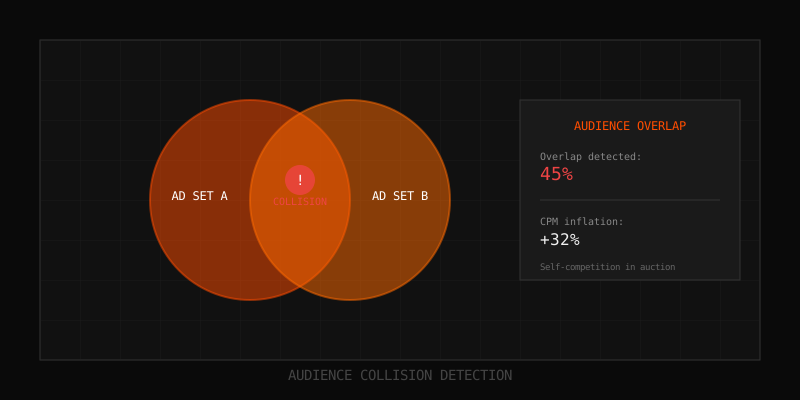
Often yes. Multiple small audiences competing for the same users creates auction overlap and inefficiency. Combining them into one larger audience lets the algorithm optimize across the full pool.
Does audience size affect ad approval or review?
No. Audience size does not affect ad policy review or approval times. However, very small audiences may trigger warnings about limited delivery potential.
Learn more: How it works · Why bundles beat raw thread history