
Thread Transfer
First-Party Data Audiences: Building Without Third-Party Cookies
The advertisers winning in 2025 own their data. Here's how to build first-party audiences that outperform third-party targeting.
Thread Transfer
Founder, Meta Ads Audit
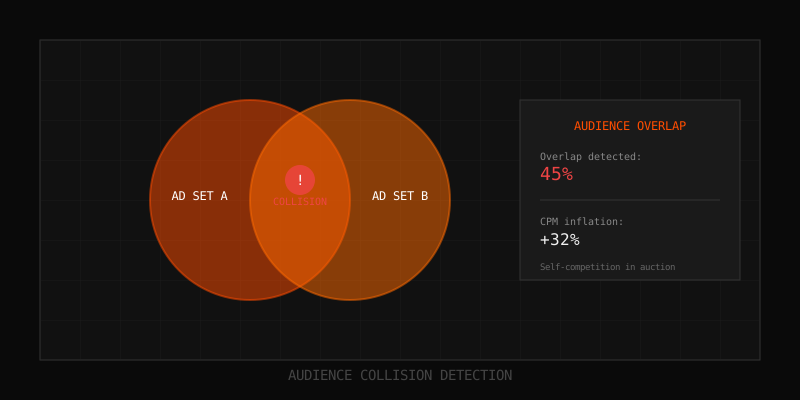
Third-party cookies are dying. Browser restrictions, privacy regulations, and user opt-outs have degraded tracking-based targeting. The advertisers winning in 2025 own their data. First-party audiences built from your customers, email lists, and website visitors outperform third-party targeting because they are based on actual relationships, not inferred behavior.
What Is First-Party Data
First-party data is information you collect directly from your customers and prospects:
- Customer lists: Email addresses, phone numbers, names
- Website behavior: Pages visited, products viewed, cart additions
- Purchase history: What they bought, when, how much
- App activity: In-app actions, engagement patterns
- CRM data: Lead scores, lifecycle stage, LTV
This is data people gave you with consent. It is yours to use within privacy guidelines.
Why First-Party Data Wins
- Accuracy: Based on actual behavior, not probabilistic matching
- Consent: Users opted in, reducing privacy friction
- Durability: Not affected by cookie deprecation or browser changes
- Uniqueness: Your competitors cannot buy the same data
- Quality: Real customers signal real purchase intent
Building First-Party Audiences on Meta
Customer Lists
Upload customer email/phone lists to create Custom Audiences. Meta matches against user profiles.
- All customers for broad targeting
- High-value customers for lookalike seeds
- Recent purchasers for cross-sell campaigns
- Lapsed customers for reactivation
Website Custom Audiences
Using Meta Pixel and CAPI, create audiences from:
- All website visitors
- Specific page visitors (product pages, pricing)
- Time-based segments (visited in last 7 days vs 30 days)
- Engagement depth (viewed 3+ pages, spent 2+ minutes)
App Activity Audiences
For mobile apps, create audiences from in-app events:
- App installers
- Active users
- Feature users (completed onboarding, used specific features)
- Purchase intent (added to cart, started checkout)
Engagement Audiences
People who engaged with your Meta presence:
- Video viewers (25%, 50%, 75%, 95% watched)
- Page/profile engagers
- Ad engagers (clicked, saved, shared)
- Instagram profile visitors
Segmentation Strategies
Generic audiences underperform. Segment by:
Purchase Behavior
- First-time vs repeat customers
- High AOV vs low AOV buyers
- Category-specific purchasers
- Frequency segments (one-time, occasional, frequent)
Lifecycle Stage
- New leads (captured in last 30 days)
- Active customers (purchased in last 90 days)
- At-risk (no purchase in 90-180 days)
- Lapsed (no purchase in 180+ days)
Engagement Level
- Email openers vs non-openers
- Website visitors vs non-visitors
- Content engagers vs passive subscribers
Lookalike Audiences from First-Party Data
First-party seeds create better lookalikes because the source audience is verified quality:
- Seed from actual purchasers, not just leads
- Use high-value customers for better quality signal
- Value-based lookalikes if you have LTV data
- Start with 1% for quality, expand for scale
Data Hygiene
First-party data requires maintenance:
- Clean duplicates and invalid entries
- Remove unsubscribes and bounces
- Update lists regularly (weekly/monthly)
- Segment inactive users separately
Dirty data creates audiences that do not match well, wasting targeting precision.
Privacy and Consent
First-party data still has privacy requirements:
- Collect with clear consent and privacy policy
- Honor opt-outs and deletion requests
- Hash data before uploading to Meta
- Use Custom Audiences TOS compliant data only
Key Takeaways
- First-party data is your competitive moat as third-party tracking dies
- Build Custom Audiences from customer lists, website behavior, and engagement
- Segment by purchase behavior, lifecycle, and engagement for better performance
- Use first-party data as lookalike seeds for quality prospecting
- Maintain data hygiene and privacy compliance
Learn more: How it works · Why bundles beat raw thread history