
Thread Transfer
Advantage+ Shopping Campaigns: Complete 2025 Setup Guide
Advantage+ Shopping handles targeting, placements, and creative automatically. But the wrong setup burns budget fast. Here's how to configure ASC for maximum ROAS.
Thread Transfer
Founder, Meta Ads Audit
Advantage+ Shopping Campaigns (ASC) represent Meta's most ambitious automation push yet. Instead of building ad sets with manual targeting, placements, and creative combinations, you hand the reins to Meta's machine learning. The algorithm handles everything: who sees your ads, where they appear, and which creative variations get shown. Meta promises better ROAS with less work.
The reality is more nuanced. ASC can deliver exceptional results for the right accounts with the right setup. But configuration mistakes can tank performance before you even start, and the reduced control means problems are harder to diagnose. This guide covers everything you need to launch ASC successfully in 2025.
What Is Advantage+ Shopping?
Advantage+ Shopping Campaigns are a fully automated campaign type designed specifically for ecommerce advertisers. Unlike traditional campaigns where you build targeting, choose placements, and structure ad sets manually, ASC consolidates everything into a single campaign with minimal configuration.
How ASC Differs from Traditional Campaigns
| Feature | Traditional Campaign | Advantage+ Shopping |
|---|---|---|
| Targeting | Manual audiences, interests, demographics | Fully automated with optional existing customer cap |
| Placements | Choose specific placements or use Advantage+ | All placements, no manual control |
| Creative | Structured ad sets with specific creatives | Up to 150 creative combinations tested automatically |
| Ad Sets | Multiple ad sets with different strategies | Single consolidated structure |
| Budget Control | Ad set or campaign level | Campaign level only |
| Optimization | Manual adjustments based on data | Algorithm-driven with minimal intervention |
When ASC Works Best
ASC tends to outperform traditional campaigns in specific scenarios:
- High volume accounts: ASC needs data to learn. Accounts with 50+ weekly purchases see faster optimization and better results
- Broad appeal products: Products that sell across demographics benefit from ASC's wide exploration. Niche products may see wasted spend on irrelevant audiences
- Strong creative libraries: ASC tests up to 150 combinations. More quality creative means more opportunities for the algorithm to find winners
- Mature pixel data: ASC relies heavily on your pixel history. New accounts with limited conversion data may see inconsistent results
Pre-Launch Requirements
Before creating your first ASC, ensure your account meets these prerequisites:
Pixel and Conversions API Setup
ASC optimization quality depends directly on your tracking setup. At minimum, you need:
- Meta Pixel installed and firing correctly on all pages
- Purchase event tracking with accurate value data
- Conversions API (CAPI) implemented for server-side redundancy
- Event Match Quality score of 6.0 or higher (8.0+ ideal)
Without solid tracking, ASC optimizes on incomplete data. Every missed conversion degrades the algorithm's ability to find similar customers. If your Event Match Quality is below 6.0, fix your CAPI implementation before launching ASC.
Product Catalog Requirements
ASC can pull creative from your product catalog for dynamic ads. Ensure your catalog includes:
- High-quality product images (1080x1080 minimum)
- Accurate pricing that matches your website
- Complete product titles and descriptions
- Proper availability status updates
- Product set segmentation for better control
Creative Assets
ASC performs best with diverse creative options:
- Minimum 5-10 unique creative concepts
- Mix of formats: static images, videos, carousels
- Multiple aspect ratios: 1:1, 4:5, 9:16 for different placements
- Variety of messaging angles: social proof, features, lifestyle, urgency
More creative variety gives the algorithm more combinations to test. Accounts launching ASC with only 2-3 creatives typically see slower optimization and worse results.
Step-by-Step ASC Setup
Step 1: Create the Campaign
In Ads Manager, click "Create" and select "Sales" as your objective. You'll see the option for "Advantage+ Shopping Campaign" prominently displayed. Select it and proceed to campaign setup.
Step 2: Configure Campaign Settings
Set your campaign name with a clear naming convention. I recommend including "ASC" in the name for easy identification: "ASC - Spring Collection - May 2025"
Set your daily or lifetime budget. For ASC, I recommend starting with a daily budget that can generate at least 50 purchases per week. If your average CPA is $30, that means roughly $215/day minimum ($30 x 50 / 7). Starting with insufficient budget extends learning phase and produces unreliable data.
Step 3: Set Your Existing Customer Cap
This is the most important ASC configuration decision. The "Existing Customer Budget Cap" controls what percentage of your budget can be spent on people who have already purchased from you.
The default setting allows unlimited spend on existing customers. This is problematic because:
- Existing customers convert more easily, inflating your reported ROAS
- You're paying to acquire customers you already have
- Incremental revenue (true new customer acquisition) suffers
Recommendation: Set the existing customer cap between 10-25% depending on your goals. Lower caps (10-15%) prioritize new customer acquisition. Higher caps (20-25%) balance retention and acquisition.
To set this, you'll need to define your "Existing Customers" audience. Create a Custom Audience of all past purchasers (180-day window recommended) and select it in the ASC setup flow.
Step 4: Geographic and Demographic Constraints
ASC allows minimal targeting constraints:
- Location: Select the countries/regions where you ship and want to acquire customers
- Age: Set minimum age if your products have restrictions (18+ for alcohol, etc.)
- Language: Optional, but consider setting if your creatives are language-specific
Resist the urge to add more constraints. ASC works best with broad parameters, letting the algorithm discover who converts rather than limiting its exploration based on assumptions.
Step 5: Add Your Creative
Upload your creative assets. For best results:
- Add at least 5-10 different creative concepts
- Include multiple formats per concept (video + static of same message)
- Ensure each creative has appropriate aspect ratios for all placements
- Write 3-5 primary text variations per creative
- Add multiple headlines and descriptions
ASC will mix and match these elements to create combinations. More inputs mean more testing opportunities.
Step 6: Enable Dynamic Creative (Optional)
If you're using catalog-based dynamic ads, connect your product catalog and select relevant product sets. Dynamic ads automatically show users products they've viewed or similar items, which can significantly boost retargeting performance.
Step 7: Set Attribution Window
Choose your attribution window based on your sales cycle:
- 7-day click, 1-day view: Best for impulse purchases under $50
- 7-day click: Good for considered purchases $50-200
- 28-day click: Better for high-consideration purchases $200+
Longer attribution windows capture more conversions but make optimization slower. Shorter windows optimize faster but may miss delayed purchases.
Step 8: Review and Launch
Before launching, verify:
- Budget is sufficient for at least 50 weekly conversions at your target CPA
- Existing customer cap is set appropriately
- All creative displays correctly across preview placements
- Pixel and CAPI are firing correctly
- Attribution window matches your sales cycle
Post-Launch Optimization
The Hands-Off Period
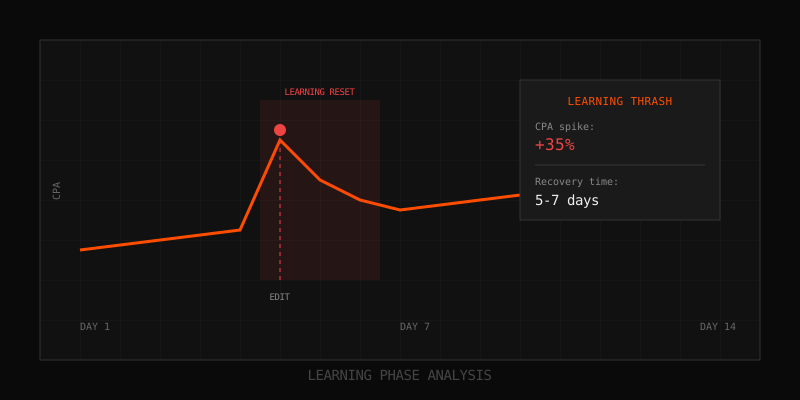
After launching ASC, resist the urge to make changes for at least 7 days (ideally 14). The algorithm needs time to explore and learn. Early intervention resets learning and extends the optimization period.
During this period, monitor but don't modify:
- Daily spend rate (is budget being utilized?)
- CPA trend (is it stabilizing or diverging?)
- ROAS direction (improving, stable, or declining?)
- Creative performance (which assets are spending?)
What to Optimize After Learning Phase
Once ASC exits learning (typically 50+ conversions), you can make targeted adjustments:
Creative Refresh
Identify top-performing creatives and create variations. Remove creatives that spent significantly but converted poorly. Add new creative concepts to test. Aim to refresh 20-30% of creative monthly.
Budget Scaling
Scale budget gradually (15-20% increases every 4-7 days) to avoid resetting learning. Large budget jumps (50%+) can destabilize performance.
Existing Customer Cap Adjustment
If you're hitting your existing customer cap early in the day, you may be missing new customer opportunities. Consider lowering the cap. If new customer CPA is significantly higher than blended CPA, you might increase the cap slightly.
Common ASC Mistakes to Avoid
Mistake 1: Insufficient Budget
ASC with $20/day targeting $25 CPAs will never exit learning phase. The algorithm needs conversion volume to optimize. Underfunded ASCs produce noisy data and unreliable results.
Fix: Budget for at least 50 weekly conversions at your target CPA. If that's too expensive, ASC may not be right for your account yet.
Mistake 2: No Existing Customer Cap
Without a cap, ASC will happily spend 50-70% of budget on existing customers because they convert easily. Your ROAS looks great, but you're just churning your customer base.
Fix: Always set an existing customer cap. Start at 20% and adjust based on your new customer acquisition goals.
Mistake 3: Sparse Creative
Launching with 2 images and 1 video limits ASC's testing ability. The algorithm can't find winners if there aren't enough options to test.
Fix: Launch with minimum 5-10 creative concepts across multiple formats. More is better for ASC.
Mistake 4: Constant Tweaking
Making changes every few days keeps ASC in perpetual learning mode. Each significant change resets optimization, and you never reach stable performance.
Fix: Commit to a 7-14 day hands-off period after launch and after any major changes.
Mistake 5: Running ASC Alongside Overlapping Manual Campaigns
If you run ASC and manual campaigns targeting similar audiences, they compete against each other in auctions. You bid against yourself, inflating CPMs.
Fix: Either consolidate into ASC or segment your manual campaigns to avoid overlap. Consider geographic splits or audience exclusions.
ASC vs Manual: When to Use Each
Use ASC When:
- You have strong pixel data with 50+ weekly purchases
- Your products have broad appeal across demographics
- You have a robust creative library to test
- You want to reduce manual management overhead
- You're willing to sacrifice granular control for algorithmic optimization
Use Manual Campaigns When:
- You're targeting a specific niche audience
- You need detailed control over placements
- Your conversion volume is too low for ASC to learn effectively
- You want to test specific hypotheses with controlled variables
- You need to exclude specific audiences or placements for brand safety
The Hybrid Approach
Many advertisers run ASC for broad prospecting while maintaining manual campaigns for specific segments. For example:
- ASC: Broad prospecting and dynamic retargeting
- Manual: High-value lookalikes, specific product launches, seasonal promotions
The key is ensuring minimal overlap between the two. Use audience exclusions in manual campaigns to prevent auction collision.
Measuring ASC Success
Primary Metrics
- Blended ROAS: Overall return including both new and existing customers
- New Customer ROAS: Return from first-time purchasers only (requires proper tracking)
- CPA by Customer Type: Cost to acquire new vs existing customers
- Incremental Revenue: Revenue from customers who wouldn't have purchased otherwise
Diagnostic Metrics
- Existing Customer %: What portion of conversions come from repeat purchasers?
- CPM Trends: Rising CPMs may indicate audience saturation
- Frequency: High frequency suggests audience size constraints
- Creative Spend Distribution: Is budget concentrating on few creatives or spreading?
Troubleshooting Common Issues
Issue: ASC Won't Spend Budget
If ASC is spending significantly under budget:
- Check if existing customer cap is too restrictive
- Verify geographic targeting isn't too narrow
- Ensure creative passes all policies (rejected ads don't run)
- Review bid strategy - cost cap may be too restrictive
Issue: High Existing Customer Percentage
If existing customers exceed your cap percentage:
- Lower the existing customer cap setting
- Verify your existing customer audience is properly defined
- Check that audience is updating with recent purchasers
Issue: CPA Much Higher Than Manual Campaigns
If ASC CPA significantly exceeds manual campaign performance:
- Verify you're comparing apples to apples (new customers to new customers)
- Check if ASC has exited learning phase (needs 50+ conversions)
- Review creative quality - ASC may need more/better creative options
- Consider if your product is too niche for ASC's broad approach
Key Takeaways
- ASC automates targeting, placements, and creative testing in one campaign
- Set existing customer caps (10-25%) to prioritize new customer acquisition
- Launch with sufficient budget for 50+ weekly conversions at target CPA
- Include 5-10+ creative concepts across multiple formats
- Maintain a 7-14 day hands-off period after launch and major changes
- Monitor new customer ROAS, not just blended ROAS
- Use ASC for broad prospecting, manual for specific segments
FAQ
Can I run ASC and manual campaigns simultaneously?
Yes, but manage overlap carefully. Use audience exclusions in manual campaigns to prevent bidding against yourself. Many advertisers run ASC for broad prospecting while manual campaigns target specific segments.
How long until ASC exits learning phase?
ASC needs approximately 50 conversions to exit learning. Timeline depends on your budget and CPA. At $50 CPA with $100/day budget, expect 3-4 weeks. At $50 CPA with $500/day budget, expect 5-7 days.
Should I use cost cap bidding with ASC?
Cost caps can work with ASC but may limit spend if set too aggressively. If using cost cap, set it 20-30% above your target CPA initially and tighten gradually. Starting too tight prevents learning.
Can I exclude specific placements in ASC?
No. ASC uses all available placements automatically. If you need placement control, use manual campaigns instead. This is one of the key trade-offs of ASC's full automation.
Is ASC better than manual campaigns?
It depends on your account. ASC typically outperforms manual campaigns for accounts with strong pixel data, broad appeal products, and robust creative libraries. Accounts with niche products or low conversion volume often see better results with manual targeting.
Learn more: How it works · Why bundles beat raw thread history