
Thread Transfer
Controlling the Uncontrollable: Advantage+ Budget Guardrails
Advantage+ wants full control. You want accountability. These budget guardrails let the algorithm optimize while keeping spend within bounds.
Thread Transfer
Founder, Meta Ads Audit
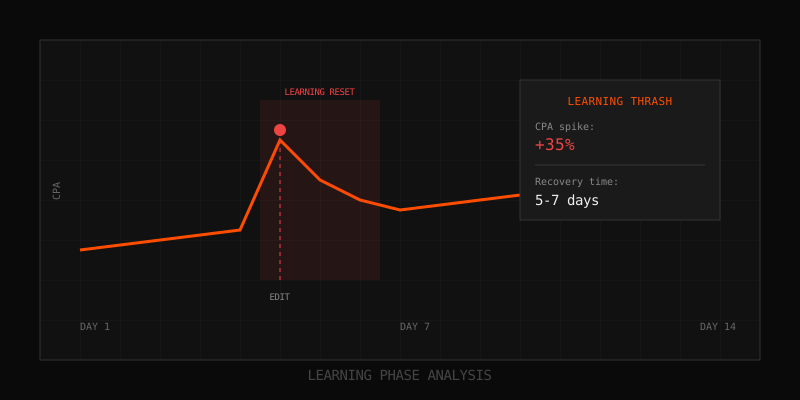
You handed Meta the keys and they drove your budget off a cliff. Advantage+ Shopping promised better performance through AI-driven optimization. Instead, you woke up to find 60% of your daily budget spent by 10am, targeting audiences you never approved, at CPAs 40% above your target. The automation worked exactly as designed. It just was not designed for your goals.
Advantage+ campaigns operate on a simple premise: give Meta maximum flexibility and the algorithm will find the most efficient paths to conversions. But most efficient from Meta's perspective means maximizing conversion volume, not minimizing your CPA. Without guardrails, the algorithm will happily spend your entire budget on marginal conversions that technically count but destroy your unit economics.
The good news: you can control Advantage+ without abandoning it entirely. Budget guardrails, bid strategies, and spend limits let you constrain the algorithm while still benefiting from its pattern-matching capabilities. The key is knowing which levers actually work and which are theater.
Why Advantage+ Needs Guardrails
Meta's algorithm optimizes for what you tell it to optimize for. If you select Maximize Conversions with no constraints, it will find conversions at any cost. The algorithm does not know your target CPA, your margin structure, or your customer lifetime value. It only knows that conversions are good and more is better.
The Volume vs Efficiency Tradeoff
Every advertiser faces this fundamental tension. At low spend levels, you can cherry-pick the highest-intent users and achieve excellent efficiency. As spend increases, you exhaust that cream and must reach into lower-intent audiences. CPA rises. This is the natural consequence of scaling.
Advantage+ accelerates this process. The algorithm is designed to spend your budget, not preserve it. Given unlimited flexibility, it will push deep into marginal audiences to hit your daily budget. Your job is to set boundaries that force the algorithm to stay within profitable territory.
Meta's Incentives vs Yours
Remember: Meta makes money when you spend money. The algorithm that controls Advantage+ was built by a company whose revenue depends on ad spend. This does not make Advantage+ bad, but it does mean you should not trust the algorithm to protect your margins. That is your job.
The guardrails we will cover are not about fighting the algorithm. They are about giving it the right constraints so its optimization aligns with your business goals. A well-constrained Advantage+ campaign can outperform manual campaigns. An unconstrained one will burn your budget and leave you wondering what happened.
Budget Guardrails That Actually Work
Guardrail 1: Campaign Budget Optimization (CBO) Limits
Advantage+ Shopping campaigns use campaign-level budgets by default. You set one budget for the entire campaign and Meta distributes it across your product sets. This sounds efficient but creates a problem: Meta can concentrate spend wherever it sees opportunity, even if that concentration hurts overall performance.
The fix: use ad set spend limits within your Advantage+ campaign. You can set minimum and maximum daily spend limits for each product set or audience segment. This prevents the algorithm from abandoning some products entirely while over-investing in others.
- Minimum spend limits: Ensure every product category gets some budget, even if Meta's algorithm prefers others. Essential for maintaining catalog breadth.
- Maximum spend limits: Cap spend on any single segment to prevent over-concentration. If one product is consuming 80% of budget, you are not testing the full catalog.
- Ratio rules: Set maximums as percentages of total budget. No single ad set should exceed 40% of campaign spend.
Guardrail 2: Cost Cap Bidding
Cost Cap is the single most effective guardrail for Advantage+. Instead of telling Meta to maximize conversions, you tell it to get conversions at or below $X CPA. The algorithm still optimizes, but it will not pursue conversions that exceed your cap.
How Cost Cap works in practice:
- Set your cap at your target CPA: If your target is $25 CPA, set the cost cap at $25. The algorithm will prioritize conversions below this threshold.
- Expect under-delivery initially: Cost Cap may spend less than your budget if efficient conversions are not available. This is a feature, not a bug. You are paying for efficiency, not volume.
- Monitor actual CPA vs cap: If actual CPA consistently runs 10-20% below your cap, you can tighten it. If it hits the cap exactly, you are at the efficiency frontier.
- Allow learning time: Cost Cap needs 50+ conversions to stabilize. Do not judge performance in the first week.
Guardrail 3: Bid Cap (When You Need Hard Limits)
Bid Cap is stricter than Cost Cap. While Cost Cap targets an average CPA, Bid Cap sets an absolute maximum on what you will pay per conversion. Meta will not bid above your cap under any circumstances.
Use Bid Cap when:
- You have hard margin constraints that cannot be exceeded
- Cost Cap is consistently exceeding your target by 20%+
- You need predictable unit economics for financial planning
The tradeoff: Bid Cap significantly reduces delivery. If your cap is too aggressive, you will barely spend. Start with a bid cap 20% above your Cost Cap to ensure delivery, then tighten gradually.
Guardrail 4: ROAS Targets
For e-commerce advertisers, ROAS targets can be more useful than CPA caps. Instead of limiting cost per conversion, you are targeting revenue return per dollar spent.
Set your minimum ROAS target based on your margin structure:
- Calculate break-even ROAS: If your gross margin is 40%, your break-even ROAS is 2.5x (1 / 0.40). Any ROAS below this loses money on first purchase.
- Add margin for overhead: If you need 20% profit margin after ad spend, target 3.0x ROAS (break-even plus buffer).
- Account for LTV: If customers repeat-purchase, you can accept lower first-purchase ROAS. Factor in 12-month LTV when setting targets.
Spend Limits and Pacing Controls
Daily vs Lifetime Budgets
Advantage+ campaigns perform differently depending on budget type:
Daily budgets give you predictable spend but limit Meta's flexibility. The algorithm cannot shift spend between days, even if some days have better opportunities. Good for consistent cash flow management.
Lifetime budgets give Meta more flexibility to optimize across the campaign duration. The algorithm can spend more on high-opportunity days and less on weak days. Better for efficiency but requires trust in the algorithm.
Recommendation: Start with daily budgets until you trust Advantage+ performance. Once you have validated the algorithm works for your account, consider switching to lifetime budgets for 10-15% efficiency gains.
Ad Scheduling (Dayparting)
Advantage+ Shopping campaigns do not support traditional ad scheduling where you choose specific hours. But you can influence timing through budget adjustments:
- Accelerated delivery: If you want to spend earlier in the day when your audience is most active, use higher budgets with aggressive bid caps. The algorithm will front-load to hit targets.
- Standard delivery: Default pacing spreads spend evenly throughout the day. Better for testing but may miss peak windows.
- Manual campaigns for timing control: If precise timing matters, run a separate manual campaign with dayparting and allocate a portion of budget there.
The 50 Conversion Rule
Meta's algorithm needs approximately 50 conversions per week per ad set to optimize effectively. Below this threshold, you are in learning limited territory where performance is unstable and inefficient.
Budget guardrail implication: Your daily budget should be high enough to generate roughly 7 conversions per day (50 / 7 days). If your target CPA is $25, that means a minimum daily budget of $175 for each ad set or Advantage+ campaign segment.
If you cannot afford $175/day per segment:
- Consolidate segments to concentrate budget
- Accept learning limited performance (still works, just less stable)
- Consider higher-funnel optimization events (add-to-cart instead of purchase)
Audience Guardrails for Advantage+
Audience Suggestions vs Audience Expansion
Advantage+ Audience lets you provide audience suggestions but then expands beyond them if the algorithm sees opportunity. This is where many advertisers lose control.
You can still set hard limits:
- Location restrictions: Lock to specific countries or regions. The algorithm cannot expand beyond these boundaries.
- Age minimums: Set a minimum age that makes sense for your product. If you sell alcohol, set 21+. If you sell B2B software, consider 25+.
- Language requirements: Require specific languages to prevent serving ads to users who cannot read them.
- Exclusions: Exclude existing customers, recent purchasers, or specific custom audiences that should not see acquisition ads.
Custom Audience Exclusions
The most underused guardrail for Advantage+. You cannot tell the algorithm exactly who to target, but you can tell it who NOT to target:
- Exclude purchasers: People who bought in the last 30-180 days. Do not pay to acquire customers you already have.
- Exclude email subscribers: If they are already in your funnel, reach them through email at lower cost.
- Exclude high-engagement non-converters: Users who have visited 10+ times without buying may never convert. Stop spending on them.
- Exclude competitor employees: If you have a list, block them from seeing your ads and inflating your costs.
Placement Guardrails
Advantage+ Placements distributes budget across all Meta placements: Facebook Feed, Instagram Feed, Stories, Reels, Audience Network, Messenger, and more. Not all placements perform equally.
You can exclude specific placements that historically underperform:
- Audience Network: Often the worst performer. Check your placement breakdown; if Audience Network converts at 50% lower rate than Feed, exclude it.
- Messenger: Low volume and often low quality. Consider excluding unless you have a Messenger-specific strategy.
- Right Column: Remnant inventory with poor performance. Usually safe to exclude.
Keep Feed and Stories as your core placements. Reels can perform well but varies by product and creative format.
Monitoring and Intervention Triggers
Daily Check: Spend Pacing
Check at midday: is your campaign on pace to spend its full budget? Significant under-delivery (less than 40% of budget spent by noon) suggests your bid caps are too aggressive. Over-delivery (more than 60% spent by noon) suggests front-loading that may exhaust your budget before peak hours.
Weekly Check: CPA Drift
Compare your actual CPA to your target CPA each week. Some drift is normal, but consistent deviation suggests the guardrails need adjustment:
- CPA 10-20% above target: Tighten cost caps or bid caps by 10%
- CPA 20%+ above target: Check placement breakdown, audience expansion, and creative performance. Something is off.
- CPA below target with under-delivery: Loosen caps by 10% to capture more volume while maintaining efficiency
Monthly Review: Audience Quality
Advantage+ may find conversions in unexpected audiences. Review monthly to ensure these audiences are actually valuable:
- Are new customers from Advantage+ repeating at the same rate as other channels?
- Is average order value consistent with your baseline?
- Are refund/return rates normal?
If Advantage+ is finding cheaper but lower-quality customers, the short-term CPA efficiency may be misleading. Consider tightening audience restrictions.
When to Override the Algorithm
Guardrails let the algorithm operate within bounds. But sometimes you need to override it entirely:
Seasonal Events
During Black Friday, Prime Day, or other high-volume events, Advantage+ may not adapt quickly enough. Consider:
- Temporarily removing bid caps to capture surge demand
- Increasing daily budgets 2-3x for the event period
- Running parallel manual campaigns for products you know will perform
New Product Launches
Advantage+ has no data on new products. The algorithm will initially under-deliver because it does not know how the product will perform. For launches:
- Run new products in manual campaigns for the first 2-4 weeks
- Once you have 100+ conversions, migrate to Advantage+ with appropriate guardrails
- Use minimum spend limits to force some budget to new products
Creative Tests
Advantage+ will automatically favor winning creative and starve losers. Good for efficiency, bad for testing. If you need to test new creative concepts:
- Run tests in a separate manual campaign with even budget split
- Collect data for 1-2 weeks
- Graduate winners to your Advantage+ campaign
The Meta Ads Audit Guardrail Check
Our Meta Ads Audit tool automatically evaluates your Advantage+ guardrail configuration. We flag:
- Campaigns running without bid or cost caps
- CPA consistently exceeding targets despite caps being set
- Placements consuming budget disproportionate to conversions
- Audience expansion reaching demographics unlikely to convert
- Budget concentration in single ad sets or product categories
Upload your CSV export and we will show you exactly where guardrails are missing or ineffective, with specific recommendations for each campaign.
Key Takeaways
- Advantage+ optimizes for volume, not efficiency. Guardrails force alignment with your goals.
- Cost Cap is the most important guardrail. Set it at your target CPA.
- Use audience exclusions since you cannot control inclusions directly.
- Exclude underperforming placements like Audience Network.
- Monitor CPA drift weekly and adjust caps accordingly.
- Override the algorithm for seasonal events, new products, and creative tests.
- Trust but verify. The algorithm works, but only within proper constraints.
FAQ
Will guardrails hurt my Advantage+ performance?
Properly configured guardrails improve performance by preventing wasteful spend. You may see lower volume, but efficiency and ROI typically improve. The goal is not maximum conversions; it is maximum profitable conversions.
How tight should my cost cap be?
Start with your target CPA as the cost cap. If delivery is good and actual CPA is below cap, tighten by 10%. If delivery stalls, loosen by 10%. Find the equilibrium where you are getting maximum volume at acceptable efficiency.
Can I use multiple bid strategies in one Advantage+ campaign?
No. Advantage+ Shopping campaigns use a single campaign-level bid strategy. If you need different strategies for different products, you will need multiple campaigns or a hybrid approach with manual campaigns.
How long should I wait before adjusting guardrails?
Allow at least 7 days and 50+ conversions before making changes. The algorithm needs time to stabilize within your constraints. Making frequent adjustments keeps the campaign in perpetual learning mode.
Learn more: How it works · Why bundles beat raw thread history