
Thread Transfer
When Advantage+ Fails: 7 Warning Signs to Watch
Meta promised AI optimization. You got rising CPA and declining ROAS. These 7 warning signs tell you when Advantage+ is failing your campaigns.
Thread Transfer
Founder, Meta Ads Audit
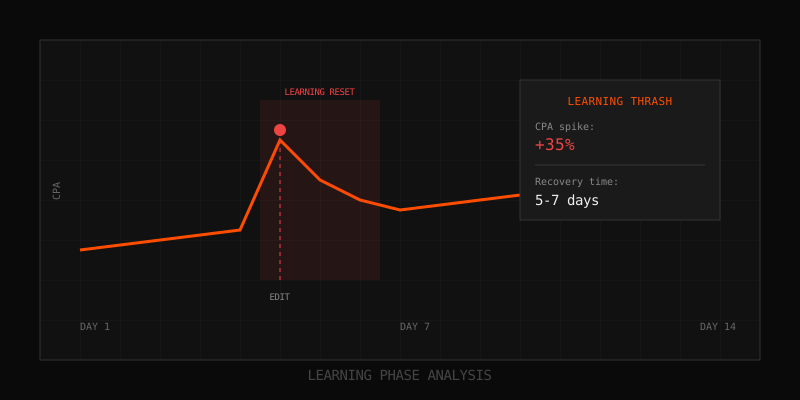
Meta sold you on Advantage+ with promises of AI-powered optimization that outperforms human decision-making. For three weeks, the results looked promising. Then CPA started creeping up. ROAS declined. Conversion volume flatlined. The algorithm that was supposed to get smarter over time appeared to be getting worse.
Advantage+ does not work for every advertiser, every product, or every situation. Meta's case studies highlight success stories, not the campaigns that quietly fail. Knowing the warning signs of Advantage+ failure lets you intervene before wasted budget compounds into a serious problem.
This article covers the seven most common warning signs that Advantage+ is failing your campaigns, along with diagnostic steps and intervention strategies for each.
Warning Sign 1: CPA Consistently Above Target
What It Looks Like
You set a target CPA of $25. For the first week, Advantage+ delivered at $23. By week two, it crept to $27. Week three hit $32. The algorithm is supposed to optimize toward efficiency, but it is moving in the wrong direction.
Why It Happens
Advantage+ optimizes for conversion volume, not CPA. If the algorithm finds more conversions by expanding into lower-quality audiences, it will do so even if CPA rises. Meta counts this as success because total conversions increased. You count it as failure because profitability decreased.
Common causes:
- Audience expansion into demographics with lower purchase intent
- Placement expansion into cheaper but lower-converting inventory
- Creative fatigue where top performers are exhausted
- Increased auction competition from seasonal advertisers
How to Diagnose
Pull a 30-day trend of daily CPA. Look for:
- Gradual climb: Suggests audience fatigue or expansion drift
- Sudden spike: Suggests external factor like competitor entry or algorithm reset
- Volatile swings: Suggests insufficient conversion volume for stable optimization
Intervention Options
- Add cost cap: Force the algorithm to respect your CPA ceiling
- Reduce budget: Force the algorithm to be more selective
- Refresh creative: Give the algorithm new assets to test
- Test manual alternative: Run a parallel manual campaign to benchmark
Warning Sign 2: ROAS Declining Week Over Week
What It Looks Like
Week one: 4.2x ROAS. Week two: 3.8x ROAS. Week three: 3.1x ROAS. Week four: 2.7x ROAS. The trend is unmistakably downward, and you are approaching break-even territory.
Why It Happens
Declining ROAS usually indicates the algorithm is prioritizing cheaper conversions that generate less revenue. This happens when:
- Algorithm shifts from high-AOV products to low-AOV items
- Expansion reaches price-sensitive audiences who buy less
- Retargeting pool is exhausted and prospecting efficiency drops
- Seasonal demand shift reduces willingness to pay
How to Diagnose
Compare these metrics week over week:
- Average order value: Is it dropping?
- Conversion rate: Is it declining?
- CPM: Is it rising (indicating worse auction performance)?
- Product mix: Which SKUs are selling more vs less?
Intervention Options
- Set minimum ROAS target: Force the algorithm to prioritize value
- Exclude low-AOV products: Remove items that drag down ROAS
- Refresh product catalog: Update feed with new or seasonal items
- Segment campaigns: Separate high-value and low-value products
Warning Sign 3: Spend Under-Delivery Despite Available Budget
What It Looks Like
You allocated $500/day but the campaign only spends $200. There is plenty of budget available, but the algorithm cannot or will not use it. Your scale ambitions are stalled while budget sits idle.
Why It Happens
Under-delivery indicates the algorithm cannot find enough conversions that meet your constraints. Common causes:
- Cost cap too aggressive: Algorithm cannot find conversions below your ceiling
- Audience too narrow: Insufficient reach to spend full budget
- Creative fatigue: All assets have been shown to available audience
- Conversion event too rare: Not enough signal for optimization
How to Diagnose
Check these indicators:
- Delivery status: Is the campaign learning limited?
- Frequency: High frequency with low spend suggests exhausted audience
- Cost cap vs actual CPA: If actual CPA equals cost cap, cap is limiting delivery
- Reach: Is reach plateauing despite budget availability?
Intervention Options
- Loosen cost cap: Raise cap by 10-20% to unlock delivery
- Expand geographic targeting: Add new markets
- Add new creative: Give algorithm fresh assets to test
- Switch optimization event: Optimize for add-to-cart instead of purchase
Warning Sign 4: Conversion Volume Plateaus or Declines
What It Looks Like
Weeks one through three delivered 50 conversions each. Week four dropped to 40. Week five hit 35. Budget has not changed, but conversions are falling. The algorithm is losing its edge.
Why It Happens
Conversion decline with stable budget usually indicates one of these problems:
- Audience saturation: Everyone likely to convert has already seen the ad
- Competitive pressure: New advertisers are winning more auctions
- Algorithm overfitting: Optimization is too narrow to find new converters
- Seasonal decline: Demand is naturally decreasing
How to Diagnose
Analyze these patterns:
- Frequency trend: Rising frequency suggests audience saturation
- CPM trend: Rising CPM suggests competitive pressure
- New vs returning: Are new customer conversions declining faster?
- External data: Is site traffic declining overall?
Intervention Options
- Expand targeting: Remove audience restrictions or add new locations
- Refresh creative: New assets can re-engage fatigued audiences
- Reduce budget: Match budget to available demand
- Pause and restart: Sometimes a fresh campaign resets the algorithm
Warning Sign 5: High Spend on Low-Converting Placements
What It Looks Like
You check placement breakdown and find that Audience Network is consuming 40% of budget but delivering only 15% of conversions. The algorithm is chasing cheap impressions on low-quality inventory.
Why It Happens
Advantage+ Placements optimizes for impressions at efficient CPM, not for conversions on high-quality placements. Audience Network and Right Column have cheap inventory, so the algorithm buys it. The conversion rate is terrible, but the CPM is attractive.
This mismatch happens because:
- Algorithm lacks sufficient conversion data to learn placement quality
- Budget exceeds demand on premium placements
- Creative does not perform well on Feed/Stories, pushing to alternatives
How to Diagnose
Create a placement efficiency table:
- Calculate CPA by placement
- Calculate spend share by placement
- Flag any placement where spend share exceeds conversion share by 2x+
Intervention Options
- Exclude underperformers: Remove Audience Network, Right Column, Messenger
- Switch to manual placements: Limit to Feed and Stories only
- Create placement-specific creative: Optimize for premium placements
- Reduce budget: Force algorithm to be selective about placements
Warning Sign 6: Learning Limited Status Persists
What It Looks Like
The campaign has been running for three weeks, but status still shows Learning Limited. Performance is volatile. CPA swings 50% day to day. The algorithm never stabilizes.
Why It Happens
Learning Limited means the campaign is not generating enough conversions (roughly 50 per week) for the algorithm to optimize effectively. This happens when:
- Budget too low: Cannot generate enough conversions at current CPA
- CPA too high: Each conversion is expensive, limiting volume
- Conversion event too narrow: Purchase is rare; add-to-cart is more common
- Targeting too restrictive: Audience cannot support required volume
How to Diagnose
Calculate your required daily budget:
- Target: 50 conversions per week = ~7 per day
- At $30 CPA, you need $210/day minimum
- If your budget is below this threshold, Learning Limited is expected
Intervention Options
- Increase budget: Give the algorithm enough spend to generate 50+ weekly conversions
- Switch optimization event: Optimize for add-to-cart instead of purchase
- Consolidate campaigns: Merge small campaigns to concentrate conversions
- Accept Learning Limited: Some accounts cannot exit; performance may still be acceptable
Warning Sign 7: Manual Campaigns Consistently Outperform
What It Looks Like
You run a parallel manual campaign as a control group. After four weeks, manual delivers $22 CPA while Advantage+ delivers $28 CPA. The algorithm that promised better results is losing to human decisions.
Why It Happens
Advantage+ underperforms manual when:
- Target audience is narrow: Algorithm expansion hurts efficiency
- Conversion volume is low: Insufficient data for learning
- Product has niche appeal: Broad targeting wastes on uninterested users
- You have strong first-party data: Custom audiences outperform algorithmic targeting
How to Diagnose
Run a proper A/B test:
- Allocate equal budget to Advantage+ and manual campaigns
- Run for minimum 14 days with 100+ conversions each
- Compare CPA, ROAS, and conversion volume
- Account for statistical significance before declaring a winner
Intervention Options
- Shift budget to manual: If manual wins consistently, allocate more there
- Hybrid approach: Use Advantage+ for prospecting, manual for retargeting
- Constrain Advantage+: Add more guardrails to limit algorithm freedom
- Abandon Advantage+: Some accounts simply perform better with manual control
The Diagnostic Framework
When you suspect Advantage+ is failing, follow this systematic approach:
Step 1: Confirm the Problem (1-2 Days)
- Verify metrics are actually below target (not just daily noise)
- Calculate week-over-week trends to confirm direction
- Check for external factors (seasonality, competitors, site issues)
Step 2: Identify the Pattern (1 Day)
- Match symptoms to the seven warning signs above
- Pull relevant diagnostic data for that specific issue
- Determine whether this is algorithm failure or environmental change
Step 3: Implement Intervention (Same Day)
- Choose one intervention from the options listed
- Make a single change (not multiple simultaneous changes)
- Document what you changed and why
Step 4: Monitor Results (7-14 Days)
- Allow sufficient time for the algorithm to re-optimize
- Track the same metrics you used to identify the problem
- Compare post-intervention to pre-intervention performance
Step 5: Decide Next Steps
- If improved: Maintain current settings and monitor
- If unchanged: Try the next intervention option
- If worsened: Revert and try a different approach
When to Abandon Advantage+ Entirely
Sometimes the right answer is to turn off Advantage+ and return to manual campaigns. Consider this when:
- Manual campaigns consistently outperform Advantage+ over 30+ days
- Multiple intervention attempts have failed
- CPA is 30%+ above target with no improvement trend
- Learning Limited status persists despite budget and targeting adjustments
- Your product requires narrow targeting that Advantage+ cannot respect
Abandoning Advantage+ is not failure. It is recognition that the tool does not fit your specific situation. Manual campaigns offer control and transparency that some advertisers need.
Key Takeaways
- CPA above target for 2+ weeks is the clearest sign of Advantage+ failure
- Declining ROAS often indicates the algorithm is prioritizing cheap conversions
- Under-delivery suggests constraints are too aggressive or audience is too narrow
- High spend on low-converting placements requires placement exclusions
- Learning Limited status means insufficient conversion volume for optimization
- If manual consistently wins, consider shifting budget away from Advantage+
- Follow a systematic diagnostic process before making changes
FAQ
How long should I give Advantage+ before concluding it is failing?
Minimum 14 days with 100+ conversions. The algorithm needs time to learn. But if performance is 20%+ below target after 30 days, intervention is warranted.
Can Advantage+ recover after a period of poor performance?
Yes, with intervention. Refreshing creative, adjusting constraints, or expanding targeting can reset the optimization and improve results. But the algorithm rarely fixes itself without changes.
Should I completely replace Advantage+ with manual if it fails?
Consider a hybrid approach first. Keep Advantage+ for specific use cases (broad prospecting) while using manual for controlled segments (retargeting, specific demographics). Total abandonment is a last resort.
Will Meta improve Advantage+ to address these failure modes?
Meta continuously updates its algorithms. Some issues may improve over time. But the fundamental tension between volume optimization and efficiency optimization will remain. Guardrails and monitoring will always be necessary.
Learn more: How it works · Why bundles beat raw thread history