
Thread Transfer
Meta Ads Learning Phase Explained: What It Is and Why It Matters
Your ad set enters learning phase and CPA spikes 40%. Most advertisers panic. Here's exactly what's happening under the hood and why it matters for your bottom line.
Thread Transfer
Founder, Meta Ads Audit
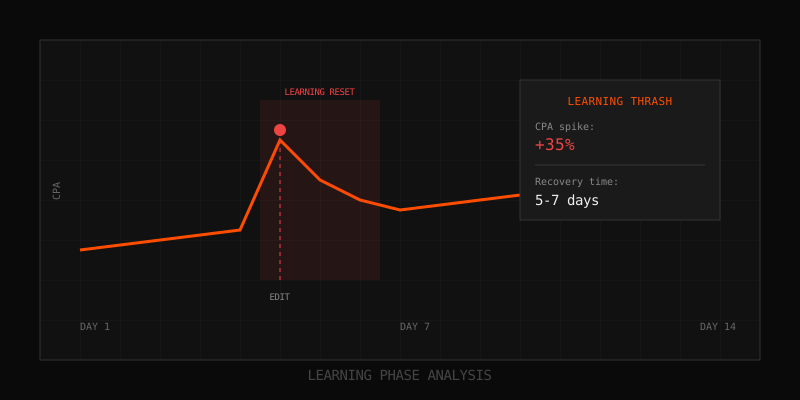
You launch a new ad set with a $100 daily budget and a $20 CPA target. The first day, CPA comes in at $32. Day two, it is $28. By day four, you are questioning your targeting, your creative, your entire strategy. But here is what most advertisers miss: this elevated cost is not failure. It is the algorithm doing exactly what it is designed to do. You are in learning phase, and understanding this period is the difference between panicking into bad decisions and patiently riding to efficient performance.
Learning phase is Meta's optimization period where the algorithm experiments with your ad delivery to find the best audience, placement, and timing combinations. During this phase, CPA typically runs 20-50% higher than your eventual stable performance. It is not wasted spend. It is the algorithm gathering the data it needs to optimize efficiently. The problem is that most advertisers do not understand what is happening, how long it lasts, or what actions extend it unnecessarily.
What Is Learning Phase?
When you create a new ad set or make significant changes to an existing one, Meta's delivery system enters learning phase. During this period, the algorithm actively experiments to discover how to best deliver your ads. It tests different combinations of audiences, placements, times of day, and creative formats to identify what produces the most optimization events (usually conversions) at the lowest cost.
Think of it like this: when you tell Meta "I want purchases at $20 each," the algorithm does not immediately know which of Meta's 2.9 billion daily active users are most likely to buy from you. Learning phase is when it figures that out. The algorithm shows your ad to different user segments, measures who converts, and gradually builds a model of your ideal customer.
Why Learning Phase Exists
Meta's ad delivery system is fundamentally a prediction machine. It tries to predict which user, at which moment, on which placement, is most likely to take your desired action. But predictions require data. Without historical performance data for your specific ad set, the algorithm must make educated guesses and then refine those guesses based on actual results.
Learning phase serves several purposes:
- Audience discovery: Even with detailed targeting, Meta does not know which individuals within your audience are most valuable until it tests
- Placement optimization: Your audience might respond better to Stories than Feed, or Instagram Reels over Facebook. The algorithm needs data to know
- Timing calibration: Some audiences convert in the morning, others at night. Learning phase identifies these patterns
- Creative matching: Different audience segments respond to different messages. The algorithm learns which creative resonates where
The 50-Conversion Threshold
Meta considers learning phase complete when your ad set accumulates approximately 50 optimization events within a 7-day window. If you are optimizing for purchases, that means 50 purchases in 7 days. If you are optimizing for leads, 50 leads. The event type depends on your optimization objective.
Why 50? Meta's research suggests this is the minimum sample size needed for statistically reliable optimization. With fewer events, the algorithm cannot distinguish signal from noise. Random variation in early conversions might lead to suboptimal audience targeting. Fifty events provide enough data to identify genuine patterns.
This threshold has important implications. If your ad set generates 10 conversions per day, you will exit learning in about 5 days. If you get 2 per day, it takes 3-4 weeks. Low-volume ad sets spend much longer in learning, facing elevated CPAs for extended periods.
How Learning Phase Affects Performance
The CPA Premium
During learning phase, expect CPA to run 20-50% above your eventual stable rate. In some cases, it can be even higher, especially in the first 24-48 hours. This premium exists because the algorithm is deliberately exploring, not exploiting. It is showing ads to users it is uncertain about, testing whether its predictions are accurate.
Consider this scenario: you are targeting "fitness enthusiasts" with a protein supplement ad. The algorithm knows fitness enthusiasts broadly, but it does not know which specific users within that audience buy protein supplements online. During learning, it might show ads to marathon runners (who do not typically buy protein), yoga practitioners (mixed results), and weightlifters (high conversion rate). By the end of learning, it has concentrated delivery on weightlifters and similar profiles, but it had to "waste" some spend discovering this.
Volatility and Inconsistency
Beyond elevated averages, learning phase performance is highly volatile. You might see $18 CPA on Monday, $35 on Tuesday, $22 on Wednesday. This inconsistency is not random. It reflects the algorithm testing different delivery strategies. Some tests work better than others. The variance stabilizes as learning completes.
This volatility is psychologically challenging. Advertisers see a spike and want to "fix" something. But intervening often makes things worse, as we will discuss in the thrash cycle section below.
Delivery Fluctuations
During learning phase, you may also notice uneven spend pacing. Some days the ad set might underspend its budget; other days it might accelerate. The algorithm is adjusting delivery based on what it is learning. If early signals suggest evening delivery converts better, it might hold spend until evening hours. If a particular placement suddenly shows promise, spend might shift there rapidly.
What Triggers Learning Phase?
Understanding what triggers learning phase is crucial for managing it. Not all changes are equal. Some trigger full resets, others have no impact.
Changes That Trigger Learning Phase Reset
| Change Type | Threshold | Impact |
|---|---|---|
| New ad set creation | N/A | Always triggers learning |
| Budget change | More than 20% increase or decrease | Full reset |
| Bid strategy change | Any change (lowest cost to cost cap, etc.) | Full reset |
| Bid/cost cap amount change | Any significant adjustment | Full reset |
| Targeting change | Adding/removing audiences, interests, exclusions | Full reset |
| Optimization event change | Any change (purchases to add-to-cart, etc.) | Full reset |
| Adding new creative | Adding ads to the ad set | Partial reset |
| Pausing ad set | Paused for 7+ days | Full reset when resumed |
Changes That Do Not Trigger Learning Phase
- Budget changes under 20% (e.g., $100 to $115)
- Editing ad creative text or images within existing ads
- Adjusting ad scheduling within reasonable bounds
- Renaming ad sets, campaigns, or ads
- Pausing for less than 7 days
- Changing campaign spending limits
Learning Phase vs. Learning Limited
These two statuses are often confused but represent different situations.
Learning Phase
Active optimization period where the algorithm is gathering data and CPA is elevated but progress is being made toward the 50-event threshold. This is normal and expected for new or modified ad sets.
Learning Limited
The ad set is in learning phase but is not generating enough optimization events to exit. You are stuck, not making progress toward 50 events in 7 days. This status indicates a structural problem:
- Budget too low relative to your CPA (cannot afford 50 events in 7 days)
- Audience too narrow (not enough reach to generate events)
- Bid cap too low (algorithm cannot compete in auctions)
- Optimization event too rare (Purchase events on a low-traffic site)
Learning Limited is worse than Learning because it suggests your ad set may never exit learning under current conditions. It requires structural changes: bigger budget, broader audience, different optimization event.
The Learning Phase Math
Understanding the math helps set realistic expectations. Here is how to calculate your expected learning duration and cost:
Expected Duration
If you are optimizing for purchases and your site converts at 2% with a $50 average order value:
- Daily budget: $100
- Expected CPA during learning (assuming 30% premium): ~$25
- Expected daily conversions: $100 / $25 = 4 conversions
- Days to reach 50 conversions: 50 / 4 = 12.5 days
That is nearly two weeks in learning phase. With a $200 budget, you would exit in about 6 days. With a $50 budget, you might never exit (learning limited).
Learning Phase Cost
The "cost" of learning phase is the premium you pay during this period. Using the example above:
- Stable CPA (post-learning): $20
- Learning CPA: $26 (30% premium)
- Premium per conversion: $6
- 50 conversions to exit: 50 x $6 = $300 premium
That $300 is the "price" of learning. It is an investment in future efficiency. Once you exit, you will earn it back through sustained lower CPAs. The question is whether you can afford the investment and remain patient while it completes.
Why Learning Phase Matters for Your Strategy
Budget Planning
Do not launch an ad set unless you can fund it through learning. If you need 50 conversions at $25 CPA to exit, that is $1,250 minimum. Launching with a $200 total budget and expecting immediate results sets you up for failure. You will run out of money before learning completes, never seeing the efficient performance you are paying to discover.
Testing Methodology
When testing new audiences or creative, remember that learning phase inflates CPAs. Do not compare learning phase results to stable performance on other ad sets. You are not comparing apples to apples. Let tests complete learning before drawing conclusions, or you will kill potentially winning ad sets prematurely.
Scaling Decisions
Aggressive scaling restarts learning. If you double budget overnight, you reset the clock. Strategic scaling keeps increases under 20% to avoid resets. Yes, it is slower. But you maintain efficiency throughout. Rapid scaling trades stability for speed. Sometimes worth it, often not.
Edit Discipline
Every significant edit resets learning. Frequent edits create "thrash," perpetual learning without ever reaching stability. The impatient advertiser who tweaks daily pays the learning phase premium indefinitely. The patient advertiser who resists tweaking for 2 weeks enjoys stable efficiency afterward.
Detecting Learning Phase Issues
Method 1: Check Delivery Status
In Ads Manager, the "Delivery" column shows current status. "Learning" or "Learning Limited" indicates active learning. "Active" indicates learning is complete. If you see "Learning" persisting beyond 2 weeks, something is wrong. Either you are not generating enough events, or edits keep resetting the process.
Method 2: Track Conversion Velocity
Calculate your 7-day rolling conversion count. If it is consistently below 50 and you are in learning status, you are heading toward Learning Limited. You need to increase conversion velocity: bigger budget, broader audience, or higher-funnel optimization event.
Method 3: CPA Trend Analysis
Plot CPA over time. During healthy learning, you should see a downward trend as the algorithm improves. If CPA is flat or increasing after 7+ days, learning is not progressing. If CPA has a sawtooth pattern (spike, recover, spike, recover), you are likely in a thrash cycle from repeated edits.
Our Meta Ads Audit tool automatically monitors learning phase status, conversion velocity, and CPA trends across all your ad sets. We flag ad sets stuck in learning, identify thrash patterns, and calculate the cost premium you are paying due to learning phase inefficiencies, all from your CSV exports with row-level evidence.
Key Takeaways
- Learning phase is Meta's optimization period requiring ~50 conversions in 7 days to exit
- CPA typically runs 20-50% higher during learning. This is normal, not failure
- Budget changes over 20%, targeting changes, and bid changes trigger full resets
- Learning Limited means you are stuck and need structural changes (more budget, broader audience)
- Budget for the full learning investment before launching. Underfunded tests never reach efficiency
- Patience through learning is rewarded with stable, efficient performance afterward
FAQ
Can I skip learning phase?
No. Every new ad set goes through learning. However, you can minimize its duration by launching with adequate budget, broad enough audiences, and optimization events that occur frequently enough to hit 50 in 7 days. You can also reduce resets by avoiding unnecessary edits.
Does learning phase apply to all campaign objectives?
Yes, but the optimization event varies. For Conversions campaigns, it is typically your pixel event (purchase, lead, etc.). For Traffic campaigns, it is link clicks. For Engagement, it is engagements. The 50-event threshold applies to whatever you are optimizing for.
Will CBO (Campaign Budget Optimization) help with learning phase?
CBO distributes budget to top-performing ad sets, which can help ad sets exit learning faster by concentrating spend. However, it can also starve underperforming ad sets before they complete learning. CBO is a tool, not a solution to learning phase fundamentals.
Should I pause ad sets in learning if performance is bad?
Be careful. Elevated CPA during learning is normal. Do not panic and pause prematurely. However, if CPA is 3x+ your target after 7 days with no improvement trend, pausing may be warranted. Just know that pausing for 7+ days means full reset when you resume. Consider lowering budget instead to reduce losses while preserving learning progress.
Is learning phase different for Advantage+ campaigns?
Advantage+ Shopping Campaigns still go through learning, but the automation handles more of the optimization. You have less control but the algorithm has more levers to pull. Learning can be faster because Advantage+ tests more variables simultaneously. However, this also means more volatility during the learning period.
Learn more: How it works · Why bundles beat raw thread history