
Thread Transfer
How to Exit Learning Phase Faster (Without Wasting Budget)
Two weeks in learning phase is two weeks of elevated CPA. Here's how to compress that timeline to days while keeping efficiency intact.
Thread Transfer
Founder, Meta Ads Audit
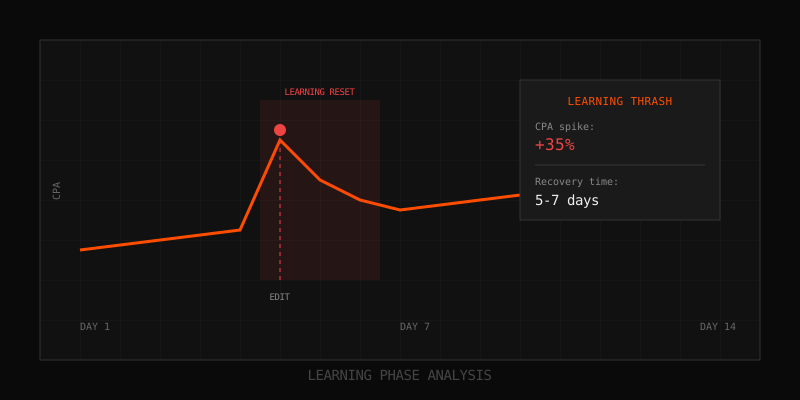
Every day in learning phase costs you money. CPA runs 20-50% higher while the algorithm experiments. If you can cut your learning duration from 14 days to 5, you save 9 days of premium pricing on every conversion. At 10 conversions per day with a $6 premium, that is $540 saved per ad set. The question is not whether to accelerate learning. It is how to do it without wasting budget on shortcuts that backfire.
Most advertisers approach learning phase passively. They launch, wait, and hope. But there are concrete strategies that compress the timeline without inflating costs. The key is understanding that learning phase exits when you hit 50 optimization events in 7 days. Everything you do should focus on increasing that velocity while maintaining the quality of those events.
Understanding What You Are Optimizing
Before discussing acceleration strategies, clarify what "faster" means. Learning phase does not have a fixed duration. It ends when you accumulate approximately 50 optimization events in a 7-day rolling window. If you are optimizing for purchases, that means 50 purchases. If you are optimizing for leads, 50 leads.
The math is simple: Daily conversions x 7 days = Total events. You need this to hit 50+. If you are getting 4 conversions per day, you will hit 28 in 7 days. That is not enough. Learning continues. If you can get to 8 per day, you hit 56 in 7 days. Learning exits.
Every strategy below aims to increase daily conversion velocity. Some do it by spending more. Some do it by converting more efficiently. Some do it by changing what you are converting on. All are valid depending on your situation.
Strategy 1: Launch with Adequate Budget
The most common reason for slow learning is insufficient budget. If your expected CPA is $25 and you launch with $50/day budget, you will get about 2 conversions per day. At that rate, you need 25 days to hit 50 conversions. But the 7-day window means you never actually accumulate enough. You are stuck.
The Budget Formula
Calculate the minimum daily budget needed to exit learning:
- Target: 50 conversions in 7 days = ~7.2 conversions per day
- Expected learning CPA: Your target CPA x 1.3 (assume 30% premium)
- Minimum daily budget: 7.2 x learning CPA
Example: If your target CPA is $20, learning CPA is likely $26. Minimum daily budget: 7.2 x $26 = $187/day. Round up to $200/day to give yourself margin.
If you cannot afford $200/day, either save up before launching or adjust your optimization event (more on this below). Launching underfunded means paying learning phase premiums for weeks instead of days.
The Budget Burst Strategy
If you have limited total budget, consider a "burst" approach: launch with higher daily budget for the first 7-10 days, then reduce once you exit learning. Example: $300/day for 7 days ($2,100 total) to exit learning fast, then drop to $150/day for ongoing spend.
This works because the 20% budget change rule only applies after learning completes. During learning, you can reduce budget without triggering a reset. Just do not increase it by more than 20% once you have exited.
Strategy 2: Broaden Your Audience
Narrow audiences limit reach and slow learning. If your audience is only 50,000 people and you are spending $200/day, you will exhaust the available pool quickly. The algorithm runs out of new people to test and learning stalls.
Audience Size Guidelines
For efficient learning, aim for these minimum audience sizes:
- Under $100/day budget: 100,000+ audience
- $100-500/day budget: 500,000+ audience
- $500+/day budget: 1,000,000+ audience
These are minimums. Larger is generally better for learning speed. Once learning completes, you can test narrower segments.
How to Broaden Without Sacrificing Quality
- Expand lookalike percentage: Instead of 1% lookalike, try 3-5%. More reach, still based on your best customers
- Add related interests: If targeting "CrossFit," add "Fitness," "Weight Training," "Gym"
- Remove exclusions temporarily: Those audience exclusions limit reach. Consider removing them during learning and adding back after
- Expand geography: If targeting a specific city, expand to the region or country
- Go broad: Consider removing all targeting and letting Meta's algorithm find your audience. Counter-intuitive but often effective for learning speed
Strategy 3: Optimize for a Higher-Funnel Event
If purchases are rare, the algorithm cannot learn because there is not enough signal. Optimizing for a higher-funnel event temporarily can accelerate learning by giving the algorithm more data points.
The Funnel Ladder
From easiest to hardest to generate:
- Link clicks (highest volume, lowest value)
- Landing page views
- Add to cart
- Initiate checkout
- Purchase (lowest volume, highest value)
If you are getting 2 purchases per day, you might be getting 20 add-to-carts. Optimizing for add-to-cart during the first week can give the algorithm enough signal to learn who your buyers are. Then switch to purchase optimization once you have exited learning.
The Tradeoff
Higher-funnel optimization attracts more tire-kickers. The algorithm will find people who add to cart, not necessarily people who buy. This is acceptable during learning because you are paying for signal, not conversions. But do not stay on higher-funnel optimization forever. It is a learning accelerator, not an endpoint.
When to Switch
Once you exit learning on the higher-funnel event, switch to purchase optimization. Yes, this triggers a new learning phase. But you are now starting with an audience model that is warmer than cold launch. The second learning phase is typically shorter and cheaper than starting cold on purchases.
Strategy 4: Consolidate Ad Sets
Fragmenting budget across many ad sets means each one learns slowly. If you have $500/day spread across 5 ad sets, each gets $100 and struggles to exit learning. Consolidate to 2 ad sets at $250 each and both learn faster.
The Consolidation Principle
Meta recommends no more than 2-3 ad sets per campaign for optimal learning. More ad sets dilute budget and slow learning for all of them. If you have 10 ad sets testing different audiences, you are not testing. You are guaranteeing slow learning across the board.
How to Consolidate
- Merge similar audiences: Instead of 5 ad sets with different lookalikes (1%, 2%, 3%, etc.), use one ad set with 1-5% lookalike
- Use flexible targeting: Instead of separate ad sets for different interests, combine interests into one ad set with broader targeting
- Kill underperformers early: Do not let weak ad sets drain budget. Kill them after 3-5 days if they are clearly not working, and redirect budget to stronger performers
Strategy 5: Use Campaign Budget Optimization (CBO)
CBO automatically shifts budget to top-performing ad sets. This can accelerate learning for winners by concentrating spend, while starving losers before they waste too much budget.
How CBO Helps Learning
With CBO, Meta reallocates budget in real-time based on performance signals. If one ad set shows early promise, it gets more budget and exits learning faster. If another struggles, it gets less budget. You do not have to wait and manually adjust.
CBO Caveats
CBO can starve ad sets before they have a fair chance to learn. If an ad set has a slow start (normal variance), CBO might cut its budget before it has time to recover. Monitor closely and consider minimum spend limits per ad set to prevent premature starvation.
Strategy 6: Launch at Optimal Times
Launching on a Monday gives you a full week of business days for learning. Launching on a Friday means 2 days of weekend behavior before the work week starts. Weekend performance often differs from weekday, which can confuse the algorithm during early learning.
Optimal Launch Timing
- Launch Monday or Tuesday morning
- Avoid launching before weekends or holidays
- Avoid launching during sales events if you are not running sales
- Give yourself 7+ clear days without known disruptions
Why Timing Matters
The algorithm builds a model of your audience based on early data. If that data comes from an unusual period (holiday weekend, flash sale, etc.), the model is skewed. You want the first 50 conversions to represent normal buying behavior so the algorithm optimizes for your typical customer.
Strategy 7: Creative Volume and Quality
More creative variations give the algorithm more options to test. If you launch with one ad, the algorithm can only test audience and placement variations. With 5 ads, it can also test which creative resonates with which audience segment.
Recommended Creative Load
- Minimum: 3-4 ads per ad set
- Optimal: 5-6 ads per ad set
- Maximum: 8-10 ads (beyond this, budget fragments too much)
Creative Diversity
Do not just upload 5 variations of the same concept. Give the algorithm genuinely different options:
- Different formats (static image, carousel, video)
- Different hooks (problem-focused, benefit-focused, social proof)
- Different visual styles (bright, muted, product-focused, lifestyle)
Diversity helps the algorithm find what works for different audience segments. One creative might resonate with younger users, another with older. The algorithm learns these patterns faster with more options.
What NOT to Do
Some "acceleration" tactics backfire. Avoid these:
Do Not Make Frequent Edits
Every significant edit resets learning. If you change budget, targeting, or bid strategy during learning, you restart the clock. The worst thing you can do is make "optimizations" during the first 7 days.
Do Not Panic at Early Results
Day 1 CPA of $45 when your target is $20 is normal. Day 2-3 improvement to $30 is normal. Do not kill ad sets based on 2-3 days of data. Wait for at least 5-7 days and 20+ conversions before making judgments.
Do Not Split Test During Learning
A/B tests fragment budget and slow learning for both variants. Run your test after learning completes, not during. The exception: Meta's built-in A/B test feature, which handles budget allocation differently.
Do Not Duplicate and Iterate
Duplicating an ad set does not carry over learning. The duplicate starts fresh. If you duplicate to "test" a small change, you now have two ad sets in learning instead of one exited ad set.
Putting It Together: The Fast Learning Launch Checklist
- Budget: Calculate minimum daily budget using the formula above. Double it if possible
- Audience: Ensure 500,000+ reach. Broaden if necessary
- Optimization event: Start with purchase if volume supports it. Drop to add-to-cart if not
- Ad set count: Maximum 2-3 per campaign. Consolidate if you have more
- Creative: 5-6 diverse ads per ad set
- Timing: Launch Monday/Tuesday morning. Avoid holidays
- Discipline: No edits for 7 days minimum after launch
Monitoring Progress
Track these metrics daily during learning:
- 7-day conversion count: Is it trending toward 50? If below 30 by day 4, you are at risk
- CPA trend: Should be decreasing after day 2-3. Flat or increasing is warning sign
- Delivery status: "Learning" is normal. "Learning Limited" means structural problem
- Spend pacing: Underspend suggests audience exhaustion or bid issues
Our Meta Ads Audit tool automatically tracks learning progress across all ad sets. We calculate projected exit dates, flag at-risk ad sets, and identify the specific bottleneck (budget, audience, or event volume) slowing your learning, all from your CSV exports.
Key Takeaways
- Learning exits when you hit 50 conversions in 7 days. All strategies aim to increase this velocity
- Launch with adequate budget: 7.2 x expected learning CPA minimum daily spend
- Broaden audiences during learning. You can narrow after exit
- Consider higher-funnel optimization if purchase volume is too low
- Consolidate ad sets. 2-3 per campaign maximum for optimal learning
- No edits for 7 days. Patience is the hardest but most important tactic
FAQ
Can I speed up learning by increasing budget mid-flight?
During learning, budget increases under 20% are generally safe. Larger increases may trigger a reset. The safer approach is to launch with adequate budget from the start rather than trying to accelerate mid-flight.
Does adding creative during learning reset it?
Adding new ads to an ad set causes a partial reset. The impact is less severe than budget or targeting changes, but it still disrupts learning. Add all creative before launch, not during.
Should I use Advantage+ for faster learning?
Advantage+ Shopping Campaigns often learn faster because they test more variables simultaneously. However, they also give you less control and can drift toward volume over efficiency. Worth testing if standard campaigns are learning slowly.
What if I cannot afford the minimum budget?
Options: (1) Optimize for a higher-funnel event that generates more volume at lower cost, (2) Start with broader geographic targeting where CPMs are lower, (3) Save up and launch with proper budget later rather than launching underfunded now.
How do I know if learning is progressing normally?
Normal learning shows CPA decreasing after day 2-3, conversion volume increasing, and volatility decreasing. If CPA is flat or increasing after 5 days, something is wrong. Check audience size, budget adequacy, and creative quality.
Learn more: How it works · Why bundles beat raw thread history