
Thread Transfer
Edits That Reset Learning Phase: The Complete List
That budget tweak just reset your learning phase and spiked CPA 35%. Here's the complete list of edits that trigger resets—and which are safe.
Thread Transfer
Founder, Meta Ads Audit
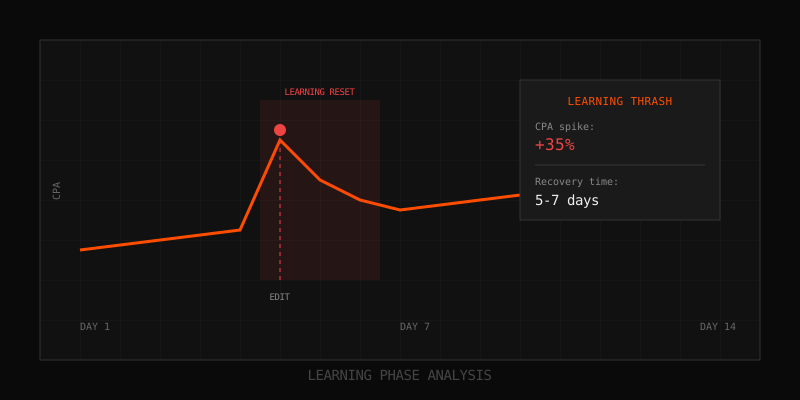
You increased budget from $100 to $150 because the ad set was performing well. Two days later, CPA spiked 40%. You panicked and lowered it back to $100. CPA spiked again. What happened? Each budget change reset learning phase, forcing the algorithm to start over. You paid the learning premium twice because you did not know which edits trigger resets. This is the most common and expensive mistake in Meta Ads management.
Not all edits are equal. Some changes completely reset learning phase, erasing all the optimization the algorithm has done. Others have no impact at all. And some fall in a gray area where the impact depends on magnitude. This guide is the definitive reference for what triggers resets, what is safe, and how to make necessary changes without paying the learning tax.
Why Edits Trigger Learning Resets
Learning phase is when Meta's algorithm builds a model of who converts for your ad set. It experiments with different audiences, placements, and timing to discover patterns. When you make certain changes, that model becomes invalid. The algorithm has to start fresh because the conditions are now different.
Think of it like this: the algorithm learned that women aged 25-34 in urban areas convert best at 8pm on Reels. If you change targeting to include men, or change the optimization event from purchase to lead, that learning is no longer relevant. The algorithm must re-learn under the new conditions.
The threshold for reset is whether the change fundamentally alters who the algorithm should target or how it should value conversions. Changes that affect delivery mechanics or audience composition trigger resets. Changes that are purely cosmetic do not.
The Complete Reset Trigger List
Full Reset: Budget Changes Over 20%
Budget changes exceeding 20% in either direction trigger a full learning reset. This is one of the most common triggers because advertisers frequently scale or cut budgets based on performance.
| Original Budget | Safe Range (No Reset) | Reset Triggers |
|---|---|---|
| $50 | $40 - $60 | Below $40 or above $60 |
| $100 | $80 - $120 | Below $80 or above $120 |
| $200 | $160 - $240 | Below $160 or above $240 |
| $500 | $400 - $600 | Below $400 or above $600 |
Why 20%? Meta determined that budget changes beyond this threshold significantly alter delivery dynamics. A 50% budget increase means the algorithm must find twice as many conversions per day. The users it was targeting may not have that capacity, so it must explore new audiences.
Full Reset: Any Bid Strategy Change
Switching between bid strategies always triggers a full reset. Each strategy optimizes differently:
- Lowest Cost: Maximizes conversions within budget, no CPA constraint
- Cost Cap: Maintains average CPA at or below your cap
- Bid Cap: Never bids above your maximum bid in any auction
- ROAS Goal: Optimizes for return on ad spend rather than conversion volume
Each strategy requires a different audience model. Lowest Cost finds the cheapest conversions anywhere. Cost Cap finds conversions at a specific price point. These are fundamentally different optimization objectives, requiring fresh learning.
Full Reset: Bid/Cost Cap Amount Changes
If you are using Cost Cap or Bid Cap and change the cap amount significantly, learning resets. The algorithm must find a new set of users who convert at the new price point.
Example: Your Cost Cap is $25. You lower it to $18. The users who converted at $25 might not convert at $18. The algorithm must find a different, more efficient audience segment. This requires re-learning.
Small adjustments (5-10%) are generally safer but can still trigger resets. Meta has not published an exact threshold for bid/cost cap changes, so err on the side of caution.
Full Reset: Targeting Changes
Any modification to targeting resets learning:
- Adding or removing custom audiences
- Adding or removing lookalike audiences
- Adding or removing interest targeting
- Adding or removing detailed targeting (demographics, behaviors)
- Adding or removing geographic locations
- Adding or removing age ranges
- Adding or removing gender targeting
- Adding or removing exclusions
Even "small" changes like adding one interest or excluding one audience trigger resets. The algorithm's model is built on the exact audience definition. Any change invalidates that model.
Full Reset: Optimization Event Changes
Changing what you are optimizing for always triggers reset:
- Purchase to Add to Cart
- Lead to Purchase
- Link Click to Landing Page View
- Any conversion event to any other conversion event
Each event type has different user characteristics. People who click are different from people who buy. The algorithm must learn an entirely new audience model for the new event.
Full Reset: Pausing for 7+ Days
If you pause an ad set for 7 or more consecutive days, it enters learning phase when you resume. The reasoning: after a week, the competitive landscape, user behavior, and audience composition may have changed enough that the old model is stale.
Partial Reset: Adding New Creative
Adding new ads to an ad set causes a partial learning reset. The algorithm must test the new creative against existing ones to determine optimal delivery allocation. This is less disruptive than targeting or budget changes but still impacts performance temporarily.
The severity depends on how different the new creative is. Adding a slight variation of an existing ad causes minimal disruption. Adding a completely different format (video when you had static images) causes more significant learning.
Partial Reset: Removing Underperforming Ads
Pausing or removing ads from an ad set can trigger partial learning. If you remove an ad that was receiving significant delivery, the algorithm must redistribute that delivery to other ads and may need to re-learn optimal allocation.
Changes That Do NOT Trigger Reset
Budget Changes Under 20%
Small budget adjustments are safe:
- $100 to $110: Safe (10% increase)
- $100 to $115: Safe (15% increase)
- $100 to $119: Safe (19% increase)
- $100 to $85: Safe (15% decrease)
Editing Existing Ad Creative
Changing the text, image, video, or headline of an existing ad does not reset ad set learning. The ad-level changes affect only that ad's performance, not the ad set's audience model.
Caveat: Significant creative changes may affect that specific ad's performance. The ad set continues learning, but delivery to the edited ad may shift as the algorithm re-evaluates its quality.
Renaming
Renaming campaigns, ad sets, or ads has zero impact on learning. Names are cosmetic and do not affect delivery or optimization.
Ad Scheduling Adjustments
Minor schedule changes within the existing delivery window are safe. However, dramatically changing the schedule (e.g., from 24/7 to weekends only) may impact delivery significantly enough to trigger partial learning.
Changing Campaign Spending Limits
Campaign-level spending limits do not directly trigger ad set learning resets. However, hitting a campaign spending limit can cause ad sets to pause, which affects delivery patterns.
Pausing for Less Than 7 Days
Short pauses (under 7 days) do not trigger learning reset when you resume. The algorithm picks up where it left off, though there may be a brief adjustment period.
The Gray Areas
Placement Changes
Adding or removing placements falls in a gray area. Meta documentation suggests this can trigger learning, but the impact varies. Removing a low-traffic placement has minimal effect. Removing a high-traffic placement (like Facebook Feed) forces significant redistribution and likely triggers learning.
Best practice: Set placements at launch and do not change them during learning.
Advantage+ Toggles
Enabling or disabling Advantage+ features (Advantage+ Audience, Advantage+ Placements, Advantage+ Creative) changes how the algorithm operates. This typically triggers learning because you are fundamentally changing the optimization approach.
Attribution Window Changes
Changing attribution windows (e.g., 7-day click to 1-day click) changes how conversions are counted. Meta suggests this may impact learning, though the effect is less documented than other triggers.
How to Make Changes Without Resetting
Incremental Budget Scaling
To scale from $100 to $200 without reset:
- Day 1: $100 to $118 (18% increase)
- Wait 3-4 days for stabilization
- Day 5: $118 to $140 (19% increase)
- Wait 3-4 days
- Day 9: $140 to $165 (18% increase)
- Wait 3-4 days
- Day 13: $165 to $195 (18% increase)
This is slower than instant doubling but maintains learning throughout. Each step stays under 20%.
Duplicate Instead of Edit
If you want to test a targeting change, do not edit the existing ad set. Duplicate it with the new targeting and run both in parallel. The original maintains its learning while you test the variation.
If the duplicate outperforms after completing its own learning, pause the original. If it underperforms, kill the duplicate and keep the original running.
Batch Changes at Launch
If you know you want to make multiple changes, do them all at once at launch rather than incrementally. One learning phase with all changes is better than multiple resets from staggered edits.
Accept the Reset When Necessary
Sometimes a reset is unavoidable. If your targeting is wrong, keeping it just to avoid reset is worse than fixing it and accepting the learning cost. Make the change, commit to hands-off for 7+ days, and let learning complete.
Detecting Unintended Resets
Signs of Learning Reset
- Delivery status changes to "Learning" after being "Active"
- CPA spikes 20-50% within 24-48 hours of an edit
- Volatility increases after a period of stability
- Spend pacing becomes erratic
Checking Edit History
In Ads Manager, click the three dots on an ad set and select "View History." This shows all changes made and when. Look for changes 24-72 hours before performance degradation. If you see a budget change, targeting edit, or bid change, that is likely the culprit.
Our Meta Ads Audit tool automatically correlates edit timestamps with performance changes. We flag when CPA spikes align with recent edits, with row-level evidence showing exactly which change triggered the reset.
The Learning Reset Decision Framework
Before making any edit, ask:
- Is this change necessary? If you are just tinkering because you are anxious, stop.
- Will this trigger reset? Check the lists above.
- Can I achieve the same goal without triggering reset? (e.g., incremental budget changes)
- Is the benefit worth the learning cost? A reset costs 7-14 days of elevated CPA. Is the change worth that?
- Can I test this with a duplicate instead? Preserves original while testing variation.
If you pass through this framework and still need to make the change, do it. Then commit to no further edits for at least 7 days.
Key Takeaways
- Budget changes over 20%, targeting changes, and bid strategy changes trigger full learning reset
- Budget changes under 20%, creative edits, and renaming are safe
- Adding new creative causes partial reset; add all creative at launch
- Pausing 7+ days triggers reset when resumed; shorter pauses are safe
- Use incremental scaling (under 20% per step) to scale without reset
- Duplicate to test changes rather than editing existing performers
- Accept resets when necessary but commit to 7+ day hands-off afterward
FAQ
Does the 20% budget rule apply to CBO campaigns?
Yes. Changing the campaign-level budget by more than 20% triggers learning across all ad sets. Individual ad set performance may also shift as CBO reallocates the changed budget.
If I make two small edits close together, do they compound?
Meta evaluates each edit independently. Two 15% budget increases on consecutive days each stay under 20% individually, so neither should trigger reset. However, rapid changes can cause delivery instability even without formal reset.
Does time zone affect budget reset calculations?
Budget changes are evaluated at the moment they are made, not at midnight. The 20% is calculated against the most recent budget, regardless of when in the day you make the change.
What if I need to make an emergency edit?
Some situations require immediate action regardless of learning impact: policy violations, broken landing pages, or product out of stock. Make the necessary fix, accept the reset, and move on. Business requirements override learning preservation.
Are there any edits that improve learning without resetting?
Fixing creative quality issues (better images, clearer copy) can improve conversion rates without resetting ad set learning. Better creative means more conversions at the same spend, which accelerates learning exit. The algorithm benefits from more signal even though no reset occurs.
Learn more: How it works · Why bundles beat raw thread history