
Thread Transfer
The Learning Phase Budget Math: 50 Conversions in 7 Days
50 conversions in 7 days sounds simple until you do the math. Here's exactly how to calculate the budget you need to exit learning on schedule.
Thread Transfer
Founder, Meta Ads Audit
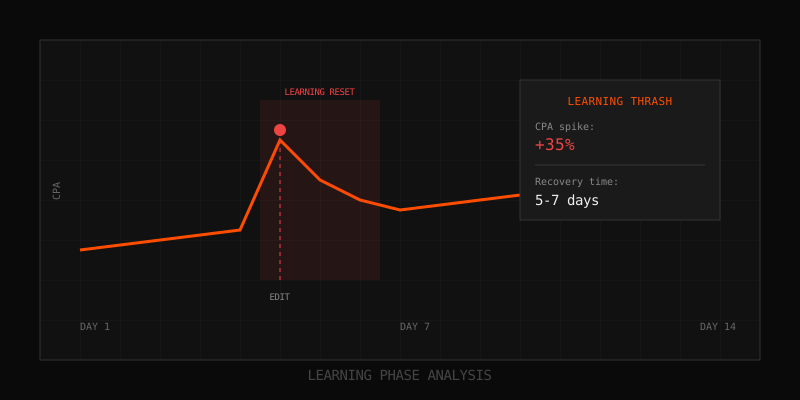
Learning phase requires approximately 50 optimization events in 7 days. That sounds simple until you do the math. If your CPA is $30 and you need 50 conversions, that is $1,500 in 7 days, or roughly $215 per day minimum. Launch with $50/day and you are mathematically guaranteed to fail. Most advertisers never run these numbers, which is why they spend weeks stuck in learning wondering what went wrong.
This guide breaks down the exact budget calculations for learning phase success. We will cover the core formula, adjustments for learning phase CPA premiums, and budget planning frameworks for different scenarios. By the end, you will know exactly how much to budget before launching any ad set.
The Core Learning Phase Formula
Meta exits learning when an ad set accumulates approximately 50 optimization events within a 7-day rolling window. The math starts there:
- Required events: 50
- Time window: 7 days
- Required daily events: 50 / 7 = 7.14 (round to 7-8)
To hit 7-8 conversions per day, you need sufficient budget to buy them. The formula:
Minimum Daily Budget = Required Daily Conversions x Expected CPA During Learning
Note that this is learning CPA, not your target CPA. Learning phase CPA typically runs 20-50% higher than stable performance. Using target CPA in your calculation will underestimate the required budget.
Calculating Learning Phase CPA
If you do not have historical data, estimate learning CPA as 1.3x your target CPA (30% premium). This is conservative but safer than underestimating.
Example Calculation
Given:
- Target CPA: $25
- Learning CPA estimate: $25 x 1.3 = $32.50
- Required daily conversions: 7.14
Minimum Daily Budget: 7.14 x $32.50 = $232/day
Round up to $250/day for margin. This is the minimum to have a reasonable chance of exiting learning in 7 days.
If You Have Historical Data
If you have existing ad sets that have completed learning, use their learning phase performance as your estimate:
- Find an ad set that completed learning
- Look at CPA for the first 7 days
- Use that as your learning CPA estimate for similar ad sets
Historical data from your own account is more accurate than generic estimates because it reflects your specific audience, creative quality, and competitive environment.
Budget Calculation Tables
Reference tables for common CPA ranges:
Low CPA Products ($10-25 target)
| Target CPA | Learning CPA (1.3x) | Min Daily Budget | 7-Day Total |
|---|---|---|---|
| $10 | $13 | $93 | $651 |
| $15 | $19.50 | $139 | $973 |
| $20 | $26 | $186 | $1,302 |
| $25 | $32.50 | $232 | $1,624 |
Medium CPA Products ($30-75 target)
| Target CPA | Learning CPA (1.3x) | Min Daily Budget | 7-Day Total |
|---|---|---|---|
| $30 | $39 | $279 | $1,953 |
| $40 | $52 | $371 | $2,597 |
| $50 | $65 | $464 | $3,248 |
| $75 | $97.50 | $696 | $4,872 |
High CPA Products ($100+ target)
| Target CPA | Learning CPA (1.3x) | Min Daily Budget | 7-Day Total |
|---|---|---|---|
| $100 | $130 | $929 | $6,503 |
| $150 | $195 | $1,393 | $9,751 |
| $200 | $260 | $1,857 | $12,999 |
| $300 | $390 | $2,786 | $19,502 |
The Learning Phase Investment Calculation
Beyond minimum budget, calculate the total "cost" of learning phase. This is the premium you pay during learning compared to stable performance.
Learning Phase Premium Formula
Learning Premium = (Learning CPA - Target CPA) x 50 conversions
Example:
- Target CPA: $25
- Learning CPA: $32.50
- Premium per conversion: $7.50
- 50 conversions to exit: $7.50 x 50 = $375
The $375 is the "price" of learning. It is an investment that pays back through efficient delivery after exit. But you must have this capital available to invest.
What If You Cannot Afford the Minimum?
If the minimum budget is beyond your means, you have several options:
Option 1: Optimize for a Higher-Funnel Event
Higher-funnel events (add to cart, lead, landing page view) have lower CPA than purchases. The math becomes more favorable:
- Purchase CPA: $50 | Min daily budget: $464
- Add to Cart CPA: $5 | Min daily budget: $46
Optimizing for Add to Cart during learning lets you exit faster and cheaper. Then switch to Purchase optimization once the algorithm has learned your audience. The second learning phase will be shorter because the audience model is warmer.
Option 2: Extend the Timeline
The 7-day window is rolling. You do not strictly need 50 in 7 days. You need to maintain a velocity that trends toward exit. Lower daily conversions mean longer learning, but you can still exit eventually.
At 4 conversions per day:
- 7-day rolling total: 28 (not enough)
- 14-day accumulation: 56 (learning should exit around day 12-14)
The risk: longer learning means longer premium CPA. You pay less per day but more total days. Calculate whether lower daily spend is actually cheaper overall.
Option 3: Budget Burst Strategy
Concentrate budget in the first 7-10 days to exit learning fast, then reduce to sustainable levels:
- Days 1-7: $300/day ($2,100 total)
- Days 8+: $100/day ongoing
This front-loads the learning investment and exits faster, then drops to sustainable spend. You spend more upfront but avoid weeks of elevated CPA.
Option 4: Save Up and Launch Later
Sometimes the right move is to delay launch until you have adequate budget. Launching underfunded wastes money on a learning phase that never completes. Better to save for 2 weeks and launch properly than to bleed money into perpetual learning.
Budget Allocation Across Multiple Ad Sets
The math changes when running multiple ad sets. Each ad set needs sufficient budget independently.
The Fragmentation Problem
If you have $500/day total and split across 5 ad sets, each gets $100. At $25 CPA, each generates 4 conversions per day. None exit learning efficiently because none hit the 7/day threshold.
Better approach: 2 ad sets at $250 each. Each can hit 7-8 conversions per day and exit learning within 7 days.
Consolidation Formula
Maximum Ad Sets = Total Daily Budget / Min Budget Per Ad Set
If min budget per ad set is $250 and you have $750/day total, run maximum 3 ad sets. More than that fragments budget and slows learning for all.
CBO Budget Considerations
With Campaign Budget Optimization, budget is set at campaign level and distributed across ad sets automatically. The math is slightly different.
CBO Budget Requirement
For CBO, calculate total campaign budget as:
Campaign Daily Budget = Number of Ad Sets x Min Per Ad Set x 1.5
The 1.5x multiplier accounts for CBO's uneven distribution. Top performers get more, underperformers get less. If one ad set gets 70% of budget and another gets 30%, the second may never exit learning.
Example: 3 ad sets, $250 min each
- Calculated need: 3 x $250 x 1.5 = $1,125/day campaign budget
- This ensures even the lowest-allocation ad set gets enough to learn
CBO Minimum Spend Limits
Consider setting minimum spend limits per ad set when using CBO. This prevents starvation of ad sets that start slow but might perform well after learning. Set minimums at your calculated min budget per ad set.
Calculating ROI on Learning Investment
Learning phase is an investment. Calculate whether the payback makes sense.
Payback Period Formula
Payback Period = Learning Premium / (Daily Savings Post-Learning)
Example:
- Learning premium: $375 (50 conversions x $7.50 premium)
- Post-learning daily conversions: 8
- Post-learning savings vs learning: 8 x $7.50 = $60/day
- Payback period: $375 / $60 = 6.25 days
After 6 days of post-learning operation, you have recovered your learning investment. Everything after is net savings compared to running inefficiently forever.
When Learning Investment Does Not Pay Back
If you plan to run the ad set for only a few days, learning investment may not pay back. Short-term campaigns (flash sales, limited promotions) might be better served by accepting higher CPA rather than investing in learning.
Rule of thumb: Learning is worth it if you plan to run the ad set for 30+ days. For shorter campaigns, consider using existing proven ad sets rather than launching new ones.
Budget Planning Framework
Use this framework before any launch:
Step 1: Define Target CPA
What CPA makes this ad set profitable? This is your north star for all calculations.
Step 2: Estimate Learning CPA
Multiply target by 1.3. Use historical data if available for more accuracy.
Step 3: Calculate Minimum Daily Budget
Learning CPA x 7.14 = Minimum daily budget per ad set.
Step 4: Calculate Total Learning Investment
(Learning CPA - Target CPA) x 50 = Premium you will pay during learning.
Step 5: Calculate Total Budget Needed
Min Daily Budget x 7 days = Minimum total budget for learning. Add 20% buffer for variance.
Step 6: Verify Affordability
Compare total budget needed to available budget. If insufficient, use alternatives (higher-funnel event, budget burst, consolidation, or delay launch).
Step 7: Calculate Payback Period
Verify the investment pays back within your expected campaign duration.
Example Budget Plans
E-commerce ($40 Target CPA)
- Learning CPA: $52
- Min Daily Budget: $371
- 7-Day Total: $2,600
- Learning Premium: $600
- Payback Period: 5 days post-learning
SaaS Lead Gen ($80 Target CPA)
- Learning CPA: $104
- Min Daily Budget: $743
- 7-Day Total: $5,200
- Learning Premium: $1,200
- Payback Period: 7 days post-learning
High-Ticket Service ($200 Target CPA)
- Learning CPA: $260
- Min Daily Budget: $1,857
- 7-Day Total: $13,000
- Learning Premium: $3,000
- Payback Period: 6 days post-learning
Key Takeaways
- Minimum daily budget = 7.14 x Learning CPA (target CPA x 1.3)
- Learning investment = (Learning CPA - Target CPA) x 50 conversions
- Consolidate ad sets to ensure each has minimum budget
- Consider higher-funnel optimization if purchase budget is too high
- Budget burst strategy can concentrate learning cost upfront
- Calculate payback period to verify learning investment makes sense
FAQ
What if my actual learning CPA is higher than 1.3x target?
If learning CPA runs 50% or more above target, either your target is unrealistic, your creative needs work, or your audience is too narrow. Investigate the root cause rather than just increasing budget indefinitely. Higher-than-expected learning CPA often signals underlying issues.
Can I use lifetime budget instead of daily for learning?
Yes. Lifetime budget can actually help learning by allowing Meta to pace spend optimally. Calculate minimum lifetime budget as: Min Daily Budget x Expected Campaign Duration. The algorithm will front-load if it finds efficient opportunities.
Does budget include creative production costs?
No. These calculations cover ad spend only. Creative production is separate. Factor both when planning total campaign investment.
How do I budget for ongoing testing after initial learning?
Reserve 10-20% of total ad budget for new ad set testing. This ensures you have learning budget available for new audiences and creative without disrupting proven performers.
What if I am using value optimization instead of cost optimization?
Value optimization (ROAS-based) still requires 50 events, but uses purchase value instead of cost. The math is similar but based on expected ROAS during learning versus target ROAS.
Learn more: How it works · Why bundles beat raw thread history