
Thread Transfer
Duplicate vs Edit: When to Clone an Ad Set Instead
Editing a winning ad set is risky. Duplicating lets you test changes without destroying your baseline. Here's the decision framework.
Thread Transfer
Founder, Meta Ads Audit
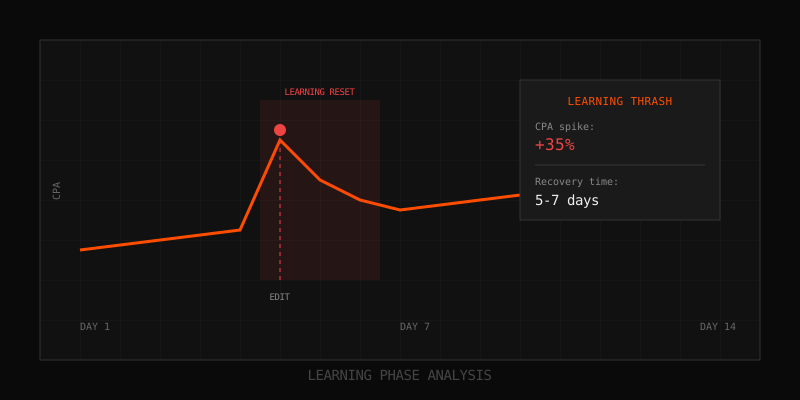
Your top-performing ad set is delivering a $15 CPA. You want to test a new audience. Do you edit the existing ad set to change the targeting, or duplicate it and run the test separately? The wrong choice could destroy months of optimization data and spike your CPA by 40%. The right choice preserves your baseline while giving you clean test data.
This decision—duplicate vs edit—is one of the most consequential choices you make in Meta Ads management. Yet most advertisers make it based on convenience rather than strategy. Understanding when each approach is appropriate can save you thousands in wasted learning phase costs and protect your best-performing campaigns.
Why This Decision Matters
When you edit an existing ad set significantly, you trigger learning phase. The algorithm discards its optimization model and starts fresh. During learning, CPA typically runs 20-50% higher. If your edit does not work out, you cannot simply undo it—the original optimization is gone.
When you duplicate, you create a new ad set that starts in learning phase while your original continues running with its established optimization. If the duplicate outperforms, great—scale it. If not, kill it and your original is untouched. You have preserved your baseline.
The cost of making the wrong choice:
- Editing when you should duplicate: You destroy proven optimization data and cannot recover it if the change fails.
- Duplicating when you should edit: You fragment budget across ad sets, potentially weakening both through insufficient data.
The Decision Framework
Use this framework to decide between duplicate and edit:
Duplicate When:
- Testing new targeting: New audiences, interests, lookalikes, or demographics are inherently risky. Duplicate to test without risking your baseline.
- Testing new bid strategies: Switching from Lowest Cost to Cost Cap changes optimization fundamentally. Duplicate to compare strategies head-to-head.
- Testing major creative changes: New creative concepts (not just minor copy tweaks) deserve isolated testing.
- Protecting high performers: Any ad set delivering strong results should be protected. Never risk a proven winner on an experiment.
- When you want clean comparison data: Duplicating gives you parallel performance data to compare objectively.
Edit When:
- Making minor adjustments: Budget changes under 20%, small bid cap tweaks, or ad copy refinements within existing ads.
- Fixing errors: Correcting targeting mistakes, wrong URLs, or policy violations that need immediate resolution.
- The ad set is already underperforming: If it is not delivering well anyway, there is less to lose from editing.
- Budget constraints prevent running both: If you cannot afford to run original and duplicate simultaneously, editing is the only option.
- Consolidating fragmented ad sets: If you have too many small ad sets, editing to consolidate may be better than creating more.
The Duplicate Workflow
When you decide to duplicate, follow this workflow:
Step 1: Document Current Performance
Before duplicating, record the original ad set's key metrics:
- CPA over the last 7 and 14 days
- ROAS over the same periods
- Daily budget and spend rate
- Learning status (in learning, stable, or limited)
This baseline lets you objectively compare duplicate performance.
Step 2: Create the Duplicate
In Ads Manager, select the ad set and click Duplicate. Choose to duplicate into the same campaign or a new one (same campaign usually makes comparison easier).
Step 3: Make Your Single Change
In the duplicate, make only the change you are testing. Do not bundle multiple changes—you want to isolate the variable. If testing new targeting, change only targeting. If testing new creative, change only creative.
Step 4: Set Appropriate Budget
The duplicate needs enough budget to exit learning (approximately 50 conversions in 7 days). Calculate:
Daily budget = (Target CPA x 50) / 7
If your target CPA is $20, you need about $143 per day to generate enough data in a week.
Step 5: Name Clearly
Name the duplicate to reflect the test. Example: "Original Name - Test New Lookalike 2%". Clear naming prevents confusion and makes results interpretation easier.
Step 6: Monitor Both
Let both ad sets run for at least 7 days (ideally until the duplicate exits learning). Compare:
- CPA (primary metric)
- ROAS (if tracking revenue)
- Conversion volume
- Delivery stability
Step 7: Make the Decision
After sufficient data:
- Duplicate wins: Scale the duplicate, pause the original (or reduce its budget gradually).
- Original wins: Pause the duplicate, continue with original. You have learned the test change does not improve results.
- Results are similar: Consider whether the change offers other benefits (broader reach, creative freshness). If not, pause the duplicate to avoid budget fragmentation.
Common Duplicate vs Edit Scenarios
Scenario 1: Testing a New Audience
Situation: You have a successful interest-based ad set and want to test a lookalike audience.
Decision: Duplicate. New audiences are fundamentally different. The lookalike may perform better or worse—you do not know. Duplicating lets you test without risking your proven interest targeting.
Process: Duplicate the ad set, change only the audience to the new lookalike. Run both at equal budgets for 1-2 weeks. Compare CPA and conversion volume.
Scenario 2: Increasing Budget 50%
Situation: Your ad set is performing well at $100 per day and you want to scale to $150.
Decision: Edit with caution. A 50% increase is above the 20% threshold, so it will trigger learning. However, duplicating at the new budget level means starting from zero optimization data.
Better approach: Edit in stages. Increase by 20% ($100 to $120), wait 3-4 days, then increase again ($120 to $145). Each step stays under 20% and minimizes learning disruption.
Scenario 3: Switching from Lowest Cost to Cost Cap
Situation: You are using Lowest Cost but CPA is creeping above your target. You want to try Cost Cap.
Decision: Duplicate. Bid strategy changes alter optimization fundamentally. The Lowest Cost ad set has learned to maximize volume; Cost Cap optimizes for efficiency. Running both lets you compare which strategy serves your goals better.
Process: Duplicate the ad set, change only the bid strategy to Cost Cap with your target CPA. Run both for 2 weeks. Compare CPA, volume, and delivery consistency.
Scenario 4: Testing New Creative Concept
Situation: Your current creative has been running for 8 weeks and CTR is declining. You want to test a completely new concept.
Decision: Duplicate. New creative concepts are risky. The declining CTR might recover with fresh creative, or the new concept might perform worse. Duplicating lets you test without abandoning the original.
Process: Duplicate the ad set with identical targeting and budget. Replace only the creative. Run both and compare CTR, CPA, and ROAS.
Scenario 5: Fixing a Targeting Error
Situation: You accidentally targeted ages 18-65 when you meant 25-45. The ad set is only 2 days old.
Decision: Edit. The ad set is new with minimal optimization history. Fixing the error outweighs the learning reset cost. Duplicating would just create unnecessary fragmentation.
Process: Edit the targeting to the correct age range. Accept the learning reset and move on.
Scenario 6: Ad Set Stuck in Learning Limited
Situation: Your ad set has been "Learning Limited" for 3 weeks with only 20 conversions weekly.
Decision: Edit. The ad set is already underperforming. There is no proven baseline to protect. Make changes that might help it exit learning—increase budget, broaden targeting, or switch to a higher-funnel optimization event.
Process: Batch your changes into one edit session. Increasing budget and broadening targeting together gives the ad set a better chance of exiting learning.
Managing Multiple Duplicates
If you create many duplicates for testing, you risk fragmenting your budget. Guidelines:
Limit Simultaneous Tests
Run no more than 2-3 duplicate tests at a time per campaign. More than that spreads budget too thin and delays reaching statistical significance.
Set Clear Kill Criteria
Before launching a duplicate, define what failure looks like. Example: "If CPA exceeds 2x target after 50 conversions, pause." This prevents letting failing tests drain budget.
Clean Up Losers Promptly
When a duplicate clearly loses, pause it immediately. Do not let it linger, consuming budget and fragmenting data.
Graduate Winners
When a duplicate wins, consider pausing the original rather than running both indefinitely. Running two similar ad sets creates audience overlap and self-competition.
Budget Allocation Strategy
When running original and duplicate simultaneously:
Equal Budget Testing
For fair comparison, give both ad sets equal budgets. If your original runs at $100 per day, run the duplicate at $100 per day too. Unequal budgets skew comparison.
Minimum Viable Budget
Each ad set needs enough budget to exit learning. If you cannot afford to run both at full budget, consider:
- Reducing original budget temporarily (staying under 20% reduction to avoid reset)
- Waiting until you have more budget before testing
- Testing in a lower-cost market or with a higher-funnel event first
CBO Considerations
If using Campaign Budget Optimization, both ad sets draw from the same campaign budget. CBO will naturally allocate more to the better performer, which accelerates testing but can starve the losing variant of data. Consider running tests in separate campaigns if you want controlled budget allocation.
Documentation and Learning
Every duplicate test generates learning. Capture it:
Test Log
Maintain a log of all tests:
- Date started
- What was tested (the single variable changed)
- Duration
- Result (winner, loser, inconclusive)
- Key metrics (CPA change, volume change)
Institutionalize Learnings
Test results should inform future decisions. If lookalike audiences consistently underperform interest targeting for your account, document that. If Cost Cap consistently beats Lowest Cost above certain spend levels, document that. Build institutional knowledge.
Avoid Repeat Tests
Before duplicating to test something, check your log. Have you tested this before? What were the results? Retesting the same hypothesis wastes budget unless conditions have changed significantly.
Key Takeaways
- Duplicate when testing new targeting, bid strategies, or creative concepts
- Duplicate to protect high-performing ad sets from experimental risk
- Edit for minor adjustments, error fixes, or already-underperforming ad sets
- Change only one variable per duplicate to isolate what is being tested
- Give duplicates enough budget to exit learning (50 conversions in 7 days)
- Set clear kill criteria and clean up losing duplicates promptly
- Document test results to build institutional knowledge
FAQ
Does duplicating copy the original's optimization data?
No. Duplicates start fresh in learning phase with no historical optimization. The duplicate inherits settings but not the algorithm's learned knowledge about who to target.
Can I duplicate and then edit the original?
Yes, but be careful. If you edit the original significantly after duplicating, you lose your baseline. The point of duplicating is to preserve the original while testing. If you edit both, you have two unknowns.
How long should I run duplicate tests?
At minimum, until both ad sets exit learning (typically 7-14 days). Ideally, 2-4 weeks with 100+ conversions per variant gives you statistically meaningful data.
Should I pause the original while testing the duplicate?
No—that defeats the purpose. The value of duplicating is running both simultaneously for comparison. If you pause the original, you lose your baseline and cannot compare.
Learn more: How it works · Why bundles beat raw thread history