
Thread Transfer
Monitoring Learning Phase: Dashboards and Alerts
Learning phase thrash can go unnoticed for weeks. Set up monitoring that catches resets early and tracks time-to-exit across all ad sets.
Thread Transfer
Founder, Meta Ads Audit
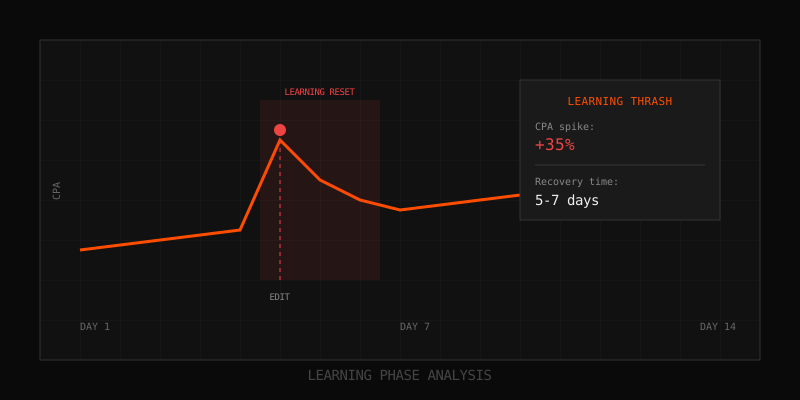
You have 47 active ad sets across 12 campaigns. Three of them entered learning phase last week. Two have been stuck in "Learning Limited" for 16 days. One exited learning yesterday but you did not notice. Without systematic monitoring, learning phase status becomes invisible—and invisible problems become expensive problems.
Learning phase monitoring is not glamorous work. It is not about clever strategies or creative breakthroughs. It is about knowing, at any moment, which of your ad sets are in learning, which are stable, and which need intervention. This visibility is the foundation of efficient Meta Ads management.
Why Monitor Learning Phase?
Learning phase has direct cost implications:
The CPA Premium
Ad sets in learning phase typically operate at 20-50% higher CPA than stable ad sets. If your stable CPA is $20, learning phase might cost you $26-30 per conversion. On 100 conversions, that is $600-1,000 in extra cost per ad set per learning cycle.
The Thrash Multiplier
Without monitoring, thrash goes undetected. An ad set might reset learning three times in a month without anyone noticing. Each reset extends the premium period. Three resets at 7 days each means 21 days of inflated CPA—potentially $2,000+ in waste on a single ad set.
The Opportunity Cost
Learning Limited ad sets consume budget without delivering results. That budget could be allocated to stable, high-performing ad sets. Every day an underperforming ad set runs unchecked is a day of misallocated spend.
What to Monitor
Effective learning phase monitoring tracks several dimensions:
Current Learning Status
For each ad set, know whether it is:
- Active (Stable): Exited learning, delivering efficiently.
- Learning: In learning phase, performance is volatile.
- Learning Limited: In learning but not getting enough conversions to exit.
Time in Learning
How many days has each ad set been in learning? Normal learning takes 7-14 days with adequate budget. Longer durations indicate problems:
- 7-14 days: Normal learning period.
- 15-21 days: Extended learning—check budget and conversion volume.
- 21+ days: Stuck—intervention needed.
Learning Phase History
How many times has each ad set entered learning in the past 30 days? Frequent resets indicate thrash:
- 1 reset: Normal, often unavoidable.
- 2 resets: Worth investigating.
- 3+ resets: Thrash pattern—review edit history.
Exit Rate
What percentage of learning phases end in successful exit vs. getting reset or stuck? Low exit rates indicate systemic issues:
- Above 80%: Healthy account with good edit discipline.
- 60-80%: Room for improvement.
- Below 60%: Serious process issues.
Building a Learning Phase Dashboard
A dedicated dashboard centralizes learning phase visibility. Here is what to include:
Core Metrics Table
Create a table showing all active ad sets with:
| Ad Set Name | Status | Days in Learning | Conversions (7d) | CPA (7d) | Resets (30d) |
|---|---|---|---|---|---|
| Prospecting - Interest A | Stable | - | 84 | $18.50 | 0 |
| Prospecting - LAL 2% | Learning | 4 | 28 | $24.00 | 1 |
| Retargeting - Website | Learning Limited | 18 | 12 | $31.00 | 2 |
Sort by status (Learning Limited first, then Learning, then Stable) to prioritize attention.
Status Distribution Chart
A pie or bar chart showing the breakdown of ad sets by status:
- What percentage are stable?
- What percentage are in learning?
- What percentage are learning limited?
Healthy accounts should have 70%+ ad sets stable. If more than 30% are in learning at any time, investigate.
Time-in-Learning Distribution
A histogram showing how long ad sets stay in learning. Most should exit within 7-14 days. A long tail of 15+ day learning periods indicates systemic issues.
Weekly Trend
Track the number of ad sets in each status week over week. Are you improving? Is the ratio of stable ad sets increasing? Trending metrics reveal whether your management practices are working.
Setting Up Alerts
Dashboards are great for scheduled review, but alerts catch problems in real time:
Alert 1: Extended Learning
Trigger: Ad set has been in learning for more than 14 days.
Action: Review budget, targeting, and conversion volume. Consider intervention.
Frequency: Check daily for any ad sets crossing the 14-day threshold.
Alert 2: Learning Limited Status
Trigger: Ad set status changes to Learning Limited.
Action: Evaluate options—increase budget, broaden targeting, change optimization event, or accept limited performance.
Frequency: Alert on status change.
Alert 3: Frequent Resets
Trigger: Ad set has entered learning more than twice in 30 days.
Action: Review edit history. Identify what triggered resets. Implement edit discipline.
Frequency: Weekly audit of reset counts.
Alert 4: Account-Level Learning Threshold
Trigger: More than 40% of active ad sets are in learning phase.
Action: Pause non-essential testing. Focus on stabilizing existing ad sets before launching new ones.
Frequency: Daily check.
Implementation Options
Several approaches to implementing learning phase monitoring:
Option 1: Native Ads Manager Columns
Meta Ads Manager includes a "Delivery" column showing learning status. Customize your column view to include:
- Delivery (shows learning status)
- Results (conversions)
- Cost per Result
- Amount Spent
Save this as a custom view for quick access. Filter by Learning or Learning Limited to see problem ad sets.
Pros: No setup required, real-time data.
Cons: No historical tracking, no automated alerts, manual review required.
Option 2: Spreadsheet Tracking
Export ad set data weekly and track in a spreadsheet. Record:
- Date
- Ad set name
- Learning status
- Days since last status change
- Conversion count
Build formulas to calculate time in learning, flag extended learning, and count resets.
Pros: Historical tracking, customizable analysis, no cost.
Cons: Manual data entry, delayed alerts, time-consuming at scale.
Option 3: Third-Party Tools
Tools like Triple Whale, Northbeam, or Revealbot offer learning phase monitoring with automated alerts and historical tracking.
Pros: Automated, historical, cross-account visibility.
Cons: Monthly cost, another tool to manage.
Option 4: Custom API Integration
For technical teams, the Meta Marketing API provides delivery status data. Build custom dashboards in Looker, Tableau, or a custom application.
Pros: Fully customizable, integrates with existing systems.
Cons: Development required, API knowledge needed, maintenance overhead.
Weekly Review Process
Regardless of tooling, establish a weekly learning phase review:
Step 1: Pull Current Status (5 minutes)
Export or view all active ad sets with their learning status. Note counts: how many stable, learning, learning limited?
Step 2: Review Learning Limited (10 minutes)
For each Learning Limited ad set:
- How long has it been limited?
- What is preventing exit? (Low budget, narrow targeting, low-volume event)
- What is the intervention plan?
Step 3: Review Extended Learning (10 minutes)
For ad sets in learning more than 14 days:
- Were there recent edits that reset progress?
- Is budget sufficient for learning exit?
- Should you increase budget or accept longer learning?
Step 4: Check Reset Counts (5 minutes)
Identify ad sets with 2+ resets in the past 30 days. Review edit history to understand what triggered resets. Document patterns and share with the team to prevent future thrash.
Step 5: Document and Action (10 minutes)
Record findings and planned actions. Assign owners for interventions. Track outcomes for next week's review.
Intervention Playbook
When monitoring reveals problems, here is how to respond:
For Extended Learning (14+ Days)
- Check if any edits occurred recently that might have reset progress.
- Verify budget is sufficient—aim for 50+ conversions weekly.
- If budget is adequate, consider broadening targeting slightly.
- If conversion volume is inherently low, consider accepting extended learning or switching to a higher-funnel event.
For Learning Limited
- Calculate required budget: (Target CPA x 50) / 7 = daily budget needed.
- If budget is below this, increase it (accepting the reset if over 20%).
- If budget is adequate but targeting is narrow, broaden targeting.
- If both are adequate but product or offer has limited appeal, consider switching optimization event.
For Frequent Resets (Thrash)
- Pull edit history and identify what triggered each reset.
- Categorize resets: necessary (error fixes) vs. avoidable (impatience).
- Implement edit batching and minimum waiting periods.
- If a team member is causing thrash, address through training or process controls.
Key Performance Indicators
Track these KPIs at the account level monthly:
Percentage of Ad Sets Stable
Target: 70%+ of active ad sets should be in stable delivery at any given time.
Average Days to Exit Learning
Target: 7-10 days average. Longer averages indicate budget or targeting issues.
Learning Phase Exit Rate
Target: 80%+ of learning phases should end in successful exit, not reset or pause.
Learning Phase Cost Premium
Calculate: (CPA during learning - CPA after learning) / CPA after learning. Target: under 30% premium.
Key Takeaways
- Monitor learning status across all ad sets—visibility prevents waste
- Track time in learning, reset frequency, and exit rates
- Set alerts for extended learning (14+ days) and Learning Limited status
- Conduct weekly reviews to catch problems early
- Implement intervention playbooks for common issues
- Measure account-level KPIs: percentage stable, days to exit, exit rate
FAQ
How do I see learning status in Ads Manager?
In Ads Manager, add the "Delivery" column to your view. It shows whether each ad set is Active (stable), Learning, or Learning Limited. You can filter by delivery status to see only problem ad sets.
What if most of my ad sets are Learning Limited?
This usually indicates insufficient budget or overly narrow targeting. Calculate the budget needed for learning exit (Target CPA x 50 / 7) and compare to your actual daily budgets. Consider consolidating ad sets to concentrate budget or switching to higher-funnel optimization events.
Should I pause ad sets that are stuck in learning?
Pausing for 7+ days triggers a full reset when you unpause. If the ad set has potential, try increasing budget or broadening targeting instead. If it is fundamentally unviable (tiny audience, inadequate budget with no room to increase), pausing and reallocating budget may be better than letting it limp along.
How do I track learning history if Meta does not show it?
You need manual tracking. Export ad set data weekly and record status changes in a spreadsheet. Over time, this builds a historical record that reveals patterns. Third-party tools can automate this tracking.
Learn more: How it works · Why bundles beat raw thread history