
Thread Transfer
Meta Ads Bid Strategies Compared: Lowest Cost vs Cost Cap vs Bid Cap
Lowest Cost maximizes volume. Cost Cap balances efficiency and scale. Bid Cap gives you control. Here's how to choose the right strategy.
Thread Transfer
Founder, Meta Ads Audit
You launch a new campaign. Meta asks you to choose a bid strategy: Lowest Cost, Cost Cap, or Bid Cap. You pick Lowest Cost because it is the default and you are not sure what the others do. Three weeks later, CPA is 40% above target and you are wondering if a different strategy would have worked better.
Bid strategy is one of the most impactful decisions you make in Meta Ads, yet most advertisers never change from the default. Each strategy has distinct trade-offs between volume, efficiency, and control. Understanding these trade-offs lets you match your bid strategy to your actual business goals.
The Three Bid Strategies
Meta offers three primary bid strategies for conversion campaigns:
Lowest Cost (Default)
What it does: Meta bids whatever is necessary to get you the most conversions within your budget. There is no upper limit on what Meta will pay per conversion.
Best for: Maximizing conversion volume when efficiency is secondary.
Risk: CPA can climb as Meta pursues more expensive conversions to maximize volume.
Cost Cap
What it does: You set a target CPA. Meta aims to get you conversions at or below that cost on average. The algorithm will skip expensive auction opportunities to maintain your average CPA.
Best for: Balancing efficiency and volume when you have a clear CPA target.
Risk: Delivery can be inconsistent. If your cap is too low, Meta may not spend your budget.
Bid Cap
What it does: You set the absolute maximum Meta can bid in any auction. Meta will never exceed this bid, regardless of the opportunity.
Best for: Maximum CPA control in competitive or volatile markets.
Risk: Most restrictive strategy. Volume can suffer significantly if cap is too low.
Side-by-Side Comparison
| Factor | Lowest Cost | Cost Cap | Bid Cap |
|---|---|---|---|
| CPA Control | None | Average target | Hard maximum |
| Volume Potential | Highest | Medium | Lowest |
| Budget Spend Rate | Always spends budget | May underspend | Often underspends |
| Learning Phase | Exits fastest | May take longer | Can get stuck |
| Setup Complexity | None (default) | Need CPA target | Need bid amount |
| Best Use Case | Scale campaigns | Efficiency + scale | Strict margins |
Lowest Cost: Deep Dive
How It Works
With Lowest Cost, you give Meta a budget and an optimization event. Meta's algorithm bids in auctions to maximize conversions within that budget. If spending $100 gets you 5 conversions at $20 each, or 4 conversions at $15 each plus one at $40, Meta chooses the path that produces 5 conversions.
The algorithm is not trying to minimize your CPA—it is trying to maximize your conversion count. This is a critical distinction. Meta will happily pay $50 for a conversion if that gets you more total conversions than being more selective.
When to Use Lowest Cost
- New campaigns or ad sets: Lowest Cost helps exit learning phase faster because Meta can bid aggressively to gather data.
- Scale-focused campaigns: When your priority is volume (new product launch, market expansion) and you can accept variable CPA.
- Retargeting with small audiences: Limited audiences do not offer many auction opportunities. Lowest Cost ensures you capture available conversions.
- When you do not have a clear CPA target: If you are still establishing baseline performance, Lowest Cost provides data to set future targets.
When to Avoid Lowest Cost
- Tight margin businesses: If your product margin only supports a $20 CPA and Lowest Cost delivers $35, you lose money on every sale.
- Mature campaigns needing efficiency: Once you know what efficient looks like, Lowest Cost may pursue volume beyond profitable thresholds.
- Competitive auction environments: In hot categories, Lowest Cost can chase expensive conversions, spiking CPA.
Lowest Cost Pitfall: The Volume Trap
The most common mistake: assuming Lowest Cost produces the lowest CPA. It does not. It produces the most conversions. If your budget can buy 10 conversions at $30 each or 8 conversions at $20 each, Lowest Cost chooses 10 at $30. Total spend is $300 vs $160, but volume is higher.
If your goal is efficient conversions, Lowest Cost works against you at scale.
Cost Cap: Deep Dive
How It Works
With Cost Cap, you set a CPA target. Meta aims to maintain that CPA on average over time. The algorithm bids on auction opportunities that are likely to convert at or below your target, and passes on opportunities that would exceed it.
Important: Cost Cap is an average target, not a hard limit. Some individual conversions may cost more than your cap, but Meta works to keep the overall average at or below your target.
Setting Your Cost Cap
Your Cost Cap should be:
- At or slightly above your actual target CPA: If your target is $25, set the cap at $25-30. Setting it lower than realistic causes under-delivery.
- Based on historical data: Look at what your ad set achieved with Lowest Cost. If it averaged $28, a Cost Cap of $25-28 is reasonable.
- Account for learning phase: New ad sets with Cost Cap may take longer to exit learning because the cap limits aggressive early bidding.
When to Use Cost Cap
- Established campaigns with known CPA: Once you know what good looks like, Cost Cap maintains that efficiency while still pursuing volume.
- Budget scaling: When increasing budget on a successful ad set, Cost Cap prevents CPA from inflating as Meta reaches for incremental conversions.
- Balancing efficiency and volume: Cost Cap is the middle ground—more control than Lowest Cost, more volume than Bid Cap.
When to Avoid Cost Cap
- New campaigns without baseline data: If you do not know what CPA is achievable, you might set the cap too low and get no delivery.
- When budget must be fully spent: Cost Cap may underspend if your target is below market rates. Use Lowest Cost if spending the full budget matters more than efficiency.
- Highly competitive auctions: If competition pushes CPAs above your cap, Cost Cap will not spend. Consider whether your target is realistic.
Cost Cap Pitfall: The Under-Delivery Spiral
Common mistake: setting Cost Cap too low, seeing no spend, lowering it further hoping to force efficiency. This does not work. If your cap is below what the market will bear, Meta simply will not bid. The solution is raising the cap to a realistic level or accepting that your target CPA is not achievable.
Bid Cap: Deep Dive
How It Works
With Bid Cap, you set the maximum amount Meta can bid in any single auction. If your Bid Cap is $20, Meta will never bid more than $20 for any impression, regardless of how valuable that user might be.
This is the most restrictive strategy. While Cost Cap targets an average, Bid Cap is a hard ceiling on every bid.
Setting Your Bid Cap
Bid Cap requires understanding auction dynamics:
- Bid Cap is not the same as CPA target: Your bid determines which auctions you enter, not your final CPA. A $20 bid might result in conversions at various CPAs depending on conversion rates.
- Start higher than you think: If your target CPA is $25, try a Bid Cap of $30-40 initially. You can lower it once you see delivery patterns.
- Monitor delivery closely: Bid Cap often causes severe under-delivery. Be ready to adjust quickly.
When to Use Bid Cap
- Strict margin requirements: If exceeding a certain CPA means losing money, Bid Cap provides hard protection.
- Volatile auction environments: During Black Friday or other high-competition periods, Bid Cap prevents being swept up in bidding wars.
- Testing auction sensitivity: Bid Cap helps you understand at what bid level your audience is available.
When to Avoid Bid Cap
- New campaigns: Bid Cap makes exiting learning phase very difficult. Meta cannot bid aggressively enough to gather data quickly.
- Volume-focused campaigns: Bid Cap sacrifices volume for control. If you need scale, it is the wrong choice.
- When you do not understand auction dynamics: Bid Cap requires more expertise. Misuse leads to zero delivery.
Bid Cap Pitfall: The Zero Delivery Problem
Bid Cap is the strategy most likely to result in no spend. If your cap is below competitive bid levels, Meta loses every auction and your ads never show. Start higher and lower gradually rather than starting low and hoping for the best.
Strategy Selection Framework
Use this decision tree to select your bid strategy:
Question 1: Is this a new campaign or ad set?
Yes: Use Lowest Cost to exit learning phase faster. Switch to Cost Cap once stable.
No: Continue to Question 2.
Question 2: Do you have hard CPA constraints (margin-based)?
Yes, exceeding X means losing money: Use Bid Cap with careful monitoring.
No, CPA is a target not a constraint: Continue to Question 3.
Question 3: What is more important, volume or efficiency?
Volume: Use Lowest Cost. Accept variable CPA for maximum conversions.
Efficiency: Use Cost Cap set at your target CPA.
Both matter equally: Use Cost Cap with a cap slightly above your ideal CPA.
Testing Bid Strategies
If you are unsure which strategy works best, test:
Test Design
- Choose an ad set with stable performance and adequate budget.
- Duplicate it twice, creating three versions: one with each bid strategy.
- For Cost Cap and Bid Cap, set values based on the original's CPA (e.g., if CPA was $22, set Cost Cap at $22 and Bid Cap at $30).
- Allocate equal budgets to each.
- Run for 2-3 weeks or until each has 100+ conversions.
Metrics to Compare
- CPA: Which strategy delivers the lowest CPA?
- Volume: Which delivers the most conversions?
- Budget utilization: Which actually spends its budget?
- Consistency: Which has the most stable day-to-day performance?
Interpreting Results
The "winner" depends on your priorities:
- If volume matters most, highest conversions wins (usually Lowest Cost).
- If efficiency matters most, lowest CPA wins (often Cost Cap).
- If predictability matters most, most consistent performance wins (varies).
Common Mistakes
Mistake 1: Never Changing from Default
Lowest Cost is the default, so many advertisers never try anything else. Test alternatives—you may be leaving significant efficiency gains on the table.
Mistake 2: Setting Cost Cap Below Historical CPA
If your ad set historically delivered at $28 CPA, setting a Cost Cap of $20 will not force efficiency—it will cause under-delivery. Set caps at or slightly above what you have demonstrated is achievable.
Mistake 3: Using Bid Cap Without Understanding Auctions
Bid Cap controls bids, not CPA directly. Setting it equal to your target CPA often results in zero delivery. Bid Cap requires understanding how bids translate to final costs.
Mistake 4: Changing Strategy Too Frequently
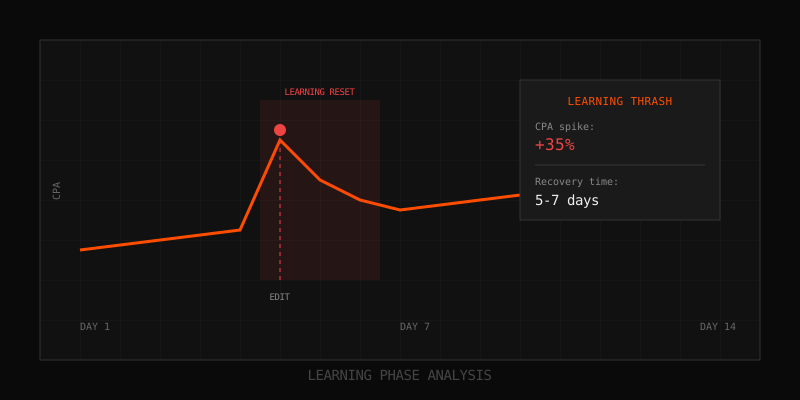
Each strategy change triggers learning phase. Do not switch back and forth trying to optimize—pick a strategy, let it stabilize, and evaluate with sufficient data.
Key Takeaways
- Lowest Cost maximizes volume with no CPA control—best for scale and learning exit
- Cost Cap targets an average CPA—best for balancing efficiency and volume
- Bid Cap sets a hard maximum bid—best for strict margin requirements
- New campaigns should start with Lowest Cost, then switch to Cost Cap once stable
- Set Cost Cap at or above historical CPA to avoid under-delivery
- Test strategies with duplicate ad sets if unsure which works best
FAQ
Which bid strategy has the lowest CPA?
It depends on your account and market. Cost Cap often delivers the lowest CPA because it explicitly optimizes for efficiency. But if set too aggressively, it under-delivers and you get no conversions. Lowest Cost can have lower CPA in some cases when the algorithm finds efficient opportunities while pursuing volume.
Can I change bid strategy without resetting learning?
No. Changing bid strategy is a significant edit that triggers learning phase. Factor this into your decision— do not switch strategies casually.
Should I use the same strategy across all campaigns?
Not necessarily. Different campaigns may have different goals. A prospecting campaign focused on volume might use Lowest Cost while a retargeting campaign focused on efficiency uses Cost Cap. Match strategy to objective.
What if Cost Cap is not spending my budget?
Your cap is probably set below market rates. Options: raise the cap to something realistic, switch to Lowest Cost to understand true market CPA, or accept that your target is not achievable in the current auction environment.
Learn more: How it works · Why bundles beat raw thread history