
Thread Transfer
Cost Cap Bidding: When and How to Use It Effectively
Cost Cap sounds perfect: 'Never pay more than $X per conversion.' Reality is messier. Here's how to use it without killing your delivery.
Thread Transfer
Founder, Meta Ads Audit
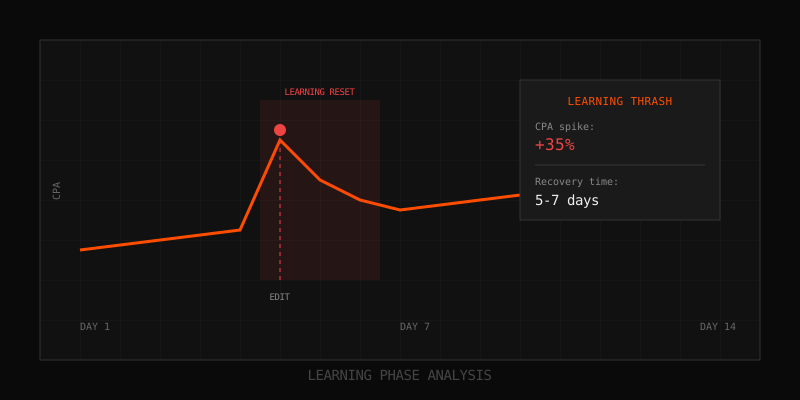
Cost Cap sounds like the perfect bid strategy: set your target CPA and Meta delivers conversions at that cost. In practice, it is more complicated. Set the cap too low and you get zero delivery. Set it too high and you might as well use Lowest Cost. Get it right and you unlock the best balance of efficiency and scale.
This guide covers everything about Cost Cap: how it actually works, how to set caps correctly, how to diagnose and fix delivery issues, and when to use alternative strategies instead.
How Cost Cap Actually Works
Understanding Cost Cap mechanics is essential to using it effectively.
The Averaging Principle
Cost Cap is an average target, not a per-conversion guarantee. If your cap is $25, some conversions may cost $18 and others may cost $32, but Meta aims to keep your average around $25 over time.
This has implications:
- Early conversions may exceed your cap as the algorithm calibrates.
- Individual days may run over or under cap.
- The cap works over longer periods (weeks) better than short periods (days).
The Auction Selection Process
With Cost Cap, Meta's algorithm evaluates each auction opportunity:
- Estimate the probability of conversion if this impression is won.
- Calculate the likely cost per conversion for this opportunity.
- Compare to the cost cap and current running average.
- Bid if the opportunity is likely to convert at or below cap, skip if not.
This selectivity is why Cost Cap can deliver better efficiency than Lowest Cost—but also why it can under-deliver if opportunities below cap are scarce.
The Learning Phase Challenge
Cost Cap makes learning phase harder because it limits aggressive bidding. With Lowest Cost, Meta can bid high to win auctions and gather data quickly. With Cost Cap, Meta must balance data collection against efficiency constraints.
Result: Cost Cap ad sets often take longer to exit learning. Plan for 10-14 days rather than 7.
Setting Your Cost Cap: The Right Way
Method 1: Historical Data Baseline
The most reliable approach uses your own data:
- Run the campaign or ad set with Lowest Cost for 2-4 weeks.
- Calculate your average CPA during this period.
- Set Cost Cap at 90-100% of this average.
Example: If Lowest Cost delivered an average $28 CPA, set Cost Cap at $25-28.
Why this works: You are setting a cap you have already demonstrated is achievable. Meta can hit the target because the algorithm already knows it is possible in your specific context.
Method 2: Unit Economics Calculation
When launching new campaigns without historical data:
- Calculate your maximum profitable CPA from unit economics.
- Add a 20-30% buffer to account for learning phase inefficiency.
- Use this as your initial cap.
Example: If your product margin is $50 and you want to acquire customers profitably, your max CPA is $50. Set initial Cost Cap at $60-65 to allow learning room.
Why the buffer: New ad sets with no optimization history will run inefficiently initially. A too-tight cap prevents learning and causes zero delivery.
Method 3: Competitive Benchmarking
When you have no historical data and need external reference:
- Research industry benchmarks for your vertical and objective.
- Start at benchmark levels or slightly above.
- Adjust based on observed performance.
Caution: Benchmarks are averages. Your specific account, audience, and creative may perform very differently. Treat benchmarks as rough starting points, not targets.
Common Cost Cap Problems and Fixes
Problem 1: Zero or Low Delivery
Symptoms: Budget is barely spent. Few or no conversions despite active campaign.
Causes:
- Cost cap is set below what the market will bear.
- Audience is too competitive for your cap level.
- Creative quality is poor, reducing conversion probability.
Fixes:
- Raise the cap: Increase by 20-30% and observe. If delivery improves, your cap was unrealistically low.
- Broaden targeting: Wider audiences offer more opportunities below cap.
- Improve creative: Higher conversion rates mean more opportunities meet your cap.
- Switch to Lowest Cost temporarily: Gather data on what CPA is actually achievable, then return to Cost Cap with realistic expectations.
Problem 2: Inconsistent Delivery
Symptoms: Some days spend full budget, other days spend almost nothing. CPA swings widely.
Causes:
- Cap is near the edge of what is achievable—some days have opportunities below cap, some do not.
- Auction competition varies by day (weekends vs. weekdays, month-end vs. month-start).
- Small audience size means limited opportunities each day.
Fixes:
- Raise cap slightly: A cap with more headroom delivers more consistently.
- Use lifetime budgets: Lifetime budgets let Meta shift spend between days, smoothing delivery over time.
- Expand audience: Larger audiences provide more consistent opportunity flow.
- Accept variability: Some inconsistency is normal with Cost Cap. Evaluate over weeks rather than days.
Problem 3: Cap Works Initially, Then Delivery Drops
Symptoms: Ad set delivered well for weeks, then spending dropped despite no changes.
Causes:
- Auction competition increased (seasonal, competitors entered).
- Audience became saturated—easy conversions captured, remaining audience is more expensive.
- Creative fatigue reduced conversion rates, making fewer opportunities meet cap.
Fixes:
- Raise cap to match new reality: Market conditions change. Your cap may need updating.
- Refresh creative: New creative can restore conversion rates.
- Expand or refresh audience: New audiences offer fresh, less saturated opportunities.
- Evaluate if the product or offer changed: External factors affecting demand impact what CPA is achievable.
Problem 4: CPA Exceeds Cap
Symptoms: Your actual CPA is higher than the cap you set.
Causes:
- Cap is an average target, not a guarantee. Some conversions cost more.
- Learning phase distorts early numbers—CPA may settle lower once exited.
- Attribution window mismatch—conversions attributed late inflate apparent CPA.
Fixes:
- Wait for more data: Cost Cap averages over time. Short-term variance is normal.
- Check if still in learning: Learning phase runs inefficiently. CPA should improve after exit.
- Lower cap if persistent: If CPA consistently exceeds cap after learning exit, lower the cap or improve conversion rates.
Cost Cap vs Lowest Cost: Decision Guide
Choose Cost Cap When:
- You have a clear CPA target based on unit economics or historical data.
- Efficiency matters as much as or more than volume.
- You are scaling a successful campaign and want to maintain efficiency.
- You can tolerate some delivery inconsistency for better CPA.
Choose Lowest Cost When:
- Volume is the primary goal and you can accept variable CPA.
- You are launching new campaigns and need to exit learning quickly.
- You do not have reliable CPA benchmarks yet.
- Budget must be fully spent regardless of efficiency.
When to Switch Between Them
Lowest Cost to Cost Cap: After exiting learning phase with stable performance, switch to Cost Cap to lock in efficiency as you scale.
Cost Cap to Lowest Cost: If Cost Cap is severely under-delivering and you need to gather data on actual market CPA, switch temporarily to Lowest Cost.
Advanced Cost Cap Tactics
Tactic 1: Graduated Cap Reduction
Instead of setting your ideal cap immediately, start higher and reduce gradually:
- Start with cap at 120% of target.
- After learning exit and stable delivery, reduce by 10%.
- Wait 7 days, evaluate delivery. If stable, reduce another 10%.
- Stop when delivery becomes inconsistent—that is your floor.
This approach finds the lowest sustainable cap without causing delivery collapse.
Tactic 2: Campaign Budget Optimization with Cost Cap
Using CBO with Cost Cap ad sets can improve overall efficiency:
- Set the same Cost Cap across all ad sets in the campaign.
- CBO shifts budget to ad sets that can deliver at or below cap.
- Ad sets that cannot meet cap receive less budget automatically.
Caution: If all ad sets struggle to meet cap, the entire campaign under-delivers.
Tactic 3: Cost Cap for Budget Scaling
Cost Cap helps control CPA inflation during budget increases:
- Establish stable CPA with Lowest Cost at initial budget.
- Switch to Cost Cap set at current CPA.
- Increase budget. Cost Cap prevents Meta from chasing expensive incremental conversions.
- If delivery drops significantly, raise cap slightly or accept lower scale.
Tactic 4: Testing Efficiency Limits
Use Cost Cap to discover how efficient your campaigns can get:
- Duplicate a successful Lowest Cost ad set.
- Set Cost Cap at 80% of current CPA.
- Run for 2 weeks. If it delivers well, you have found hidden efficiency.
- If delivery is poor, the original CPA is likely near your floor.
Cost Cap and Learning Phase
The Learning Phase Trade-Off
Cost Cap slows learning exit because it limits bidding. Strategies to mitigate:
- Start with higher cap: A cap at 120-130% of target allows more aggressive learning phase bidding.
- Use adequate budget: Ensure daily budget can generate 50 conversions per week at your cap level.
- Accept longer learning: Plan for 10-14 days rather than 7 with Cost Cap.
- Consider starting with Lowest Cost: Exit learning faster, then switch to Cost Cap.
When Cost Cap Gets Stuck in Learning
If an ad set is Learning Limited with Cost Cap:
- Check if budget is sufficient. Calculate: (Cost Cap x 50) / 7 = minimum daily budget.
- If budget is adequate, cap is probably too low for your audience.
- Either raise cap or switch to Lowest Cost to gather data.
Monitoring Cost Cap Performance
Key Metrics to Track
| Metric | Target | Action if Off-Target |
|---|---|---|
| Actual CPA vs Cap | Within 10% of cap | If consistently over, lower cap or improve creative |
| Budget Utilization | Above 80% | If low, raise cap or broaden targeting |
| Delivery Consistency | Daily spend within 30% of average | If variable, raise cap or use lifetime budget |
| Learning Phase Duration | Under 14 days | If longer, raise cap or switch strategy |
Weekly Review Checklist
- Is actual CPA at or below cap on average?
- Is budget being fully utilized?
- Is delivery consistent day to day?
- Are any ad sets stuck in learning?
- Has anything changed that might require cap adjustment?
Key Takeaways
- Cost Cap is an average target, not a per-conversion guarantee
- Set caps based on historical data or unit economics with a buffer
- Zero delivery usually means cap is too low—raise it
- Inconsistent delivery is normal; evaluate over weeks not days
- Cost Cap slows learning exit—plan for longer learning periods
- Use graduated cap reduction to find your efficiency floor
- Monitor budget utilization alongside CPA
FAQ
Can Cost Cap actually lower my CPA?
Yes, compared to Lowest Cost. Lowest Cost maximizes volume without efficiency constraints, which can chase expensive conversions. Cost Cap is selective about which auctions to enter, which often results in lower average CPA at the expense of some volume.
Why is my Cost Cap not spending any budget?
Your cap is set below what the market will bear for your audience and creative. Options: raise the cap, broaden targeting, improve creative, or switch to Lowest Cost to understand actual market CPA.
Should I set Cost Cap at my break-even CPA?
No—add a buffer. Cost Cap is an average, and learning phase runs inefficiently. If break-even is $30, set Cost Cap at $35-40 initially. You can lower it once stable if actual CPA comes in below target.
Can I use Cost Cap for new campaigns?
You can, but learning phase will be slower. Consider starting with Lowest Cost to exit learning faster, then switching to Cost Cap. Alternatively, set a higher initial cap (120-130% of target) and reduce gradually.
How often should I adjust my Cost Cap?
Avoid frequent changes—each change can trigger learning phase. Evaluate weekly, adjust monthly or when there is clear evidence the cap is misaligned (persistent under-delivery or over-delivery).
Learn more: How it works · Why bundles beat raw thread history