
Thread Transfer
Bid Cap Strategy: Manual Control for Maximum Efficiency
Bid caps give you the control Meta's algorithm won't. Set your maximum CPA and watch spend efficiency improve—if you set it right. Here's the complete guide.
Thread Transfer
Founder, Meta Ads Audit
Bid Cap is Meta's most restrictive bid strategy. Unlike Cost Cap (which controls average CPA), Bid Cap sets an absolute maximum on every individual bid. The algorithm will never bid more than your cap, period. This gives you precise CPA control but comes with significant delivery trade-offs.
Most advertisers should not use Bid Cap. But for those with strict efficiency requirements and sufficient scale, it can be powerful. This guide covers when Bid Cap makes sense and how to implement it correctly.
How Bid Cap Works
When you set a Bid Cap, you are telling Meta: "Never bid more than $X in any auction." If an auction requires a higher bid to win, Meta skips it entirely. Your ads only appear when the winning bid is at or below your cap.
The mechanics differ from Cost Cap:
- Cost Cap: Controls average CPA, allows individual variations
- Bid Cap: Controls every bid, no exceptions
This distinction matters. Cost Cap might pay $80 for one conversion and $20 for another to average $50. Bid Cap will never pay $80 - it skips that auction, even if that user would have converted.
When Bid Cap Makes Sense
Bid Cap is appropriate for specific situations:
Margin-Sensitive Businesses
If your margins are thin and every dollar of CPA matters, Bid Cap ensures you never pay above your break-even point. Arbitrage models, high-volume e-commerce, and lead aggregators often need this control.
High-Volume Accounts
Bid Cap works best when there is plenty of inventory at your price point. Large audiences with broad targeting provide enough impressions meeting your requirements. Small audiences with Bid Cap often deliver nothing.
Sophisticated Advertisers
Bid Cap requires understanding of auction dynamics, conversion rates, and delivery trade-offs. If you do not actively manage and adjust caps, you will either spend nothing or miss valuable opportunities.
Stable, Mature Campaigns
Bid Cap is terrible for new campaigns. The learning phase requires exploration, and hard caps prevent exploration. Only apply Bid Cap to campaigns that have already exited learning and stabilized.
Setting Your Bid Cap
Bid Cap is not the same as target CPA. You are setting the maximum bid per action, not the expected cost per result. The calculation:
Bid Cap = Target CPA × Conversion Rate
Example: If your target CPA is $50 and your conversion rate is 2%:
- Bid Cap = $50 × 0.02 = $1.00 per optimization event
This ensures that even at your maximum bid, the expected cost per conversion stays at target.
Adding Buffer
In practice, start 10-20% above your calculated cap. This provides room for the algorithm to work and avoids immediate under-delivery. You can tighten later once performance stabilizes.
Using the example above:
- Calculated cap: $1.00
- Starting cap with buffer: $1.10-$1.20
Managing Under-Delivery
Under-delivery is Bid Cap's primary challenge. When your cap is below market clearing price, you get no impressions.
Signs of under-delivery:
- Minimal or zero spend against budget
- Delivery status shows limited or inactive
- Impressions near zero
- Learning phase never exits
Fixing Under-Delivery
- Raise cap 20%: First response - see if slightly higher cap restores delivery
- Expand audiences: More inventory at your price point
- Improve ad quality: Better ads win auctions at lower bids
- Check timing: CPMs vary by hour/day - your cap may work at some times but not others
- Switch strategies: If Bid Cap consistently under-delivers, it may not fit your situation
Bid Cap and Learning Phase
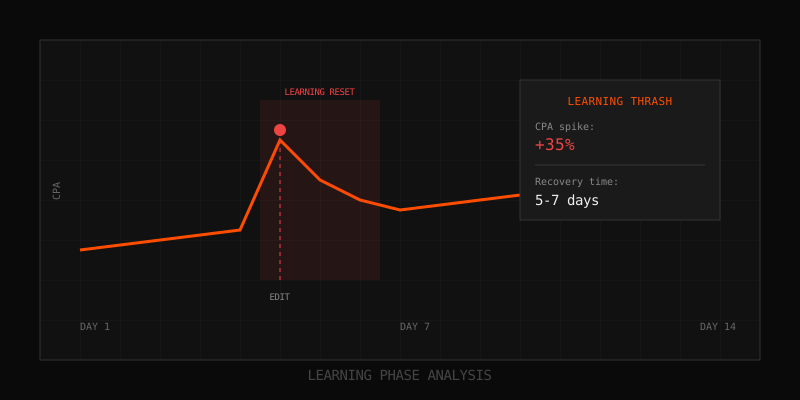
Never launch a new campaign with Bid Cap. The learning phase requires the algorithm to explore different bids and audiences. Hard caps prevent this exploration, causing perpetual "Learning Limited" status.
Recommended approach:
- Launch with Lowest Cost - gather baseline data
- Graduate to Cost Cap once stable - add soft guardrails
- Apply Bid Cap only after sustained performance - maximum control
This progression lets you understand what CPAs are achievable before constraining the algorithm.
Bid Cap vs Cost Cap: Decision Framework
Choose Cost Cap When:
- You want CPA control with delivery flexibility
- Some CPA variation is acceptable
- Volume matters alongside efficiency
- Your audiences are moderate-sized
Choose Bid Cap When:
- You need absolute CPA ceiling (cannot exceed X ever)
- Your audiences are very large with ample inventory
- You have sophisticated bid management capabilities
- Campaign is mature and stable
Choose Lowest Cost When:
- Scale is the priority, efficiency is secondary
- You are launching new campaigns
- You want to establish baseline performance
- Your CPA tolerance is flexible
Monitoring Bid Cap Performance
Track these metrics with Bid Cap:
- Spend Rate: What percentage of budget are you spending?
- Actual CPA: Should be at or below cap
- Delivery Status: Watch for "Limited" warnings
- Auction Participation: What percentage of eligible auctions are you winning?
- Competitive Index: How do your CPMs compare to benchmarks?
Set up alerts for significant under-delivery. Bid Cap problems can develop quickly as competition changes.
Advanced Bid Cap Tactics
Time-Based Adjustments
CPMs fluctuate throughout the day. Some advertisers adjust Bid Caps by daypart:
- Higher caps during peak conversion hours
- Lower caps during off-peak when competition drops
This requires automation (rules or scripts) and deep understanding of your auction dynamics.
Creative-Based Differentiation
High-performing creatives can win auctions at lower bids. For Bid Cap campaigns:
- Invest heavily in creative quality
- Test extensively to find winners
- Replace fatigued creative quickly
Better creative = better engagement rates = lower required bids = more delivery at your cap.
Audience Stratification
Different audiences have different CPAs. Consider:
- Higher Bid Caps for high-value segments (lookalikes of best customers)
- Lower Bid Caps for broader prospecting
- Separate campaigns per segment for independent cap management
Common Bid Cap Mistakes
Setting Cap Too Low
The most common mistake. Advertisers set Bid Cap at their target CPA without accounting for conversion rate. Result: zero delivery.
Applying to New Campaigns
Bid Cap on new campaigns prevents learning. The algorithm cannot explore, gets stuck, and never delivers efficiently.
Ignoring Competition Changes
A Bid Cap that worked in January may fail in Q4 when competition spikes. Caps need regular review and adjustment based on market conditions.
No Delivery Monitoring
Bid Cap failures can be silent. Budget sits unspent, but if you are not checking, you miss it. Daily delivery monitoring is essential.
When to Abandon Bid Cap
Switch away from Bid Cap when:
- Persistent under-delivery despite cap increases
- Your audience is too small for hard caps
- You cannot dedicate time to active management
- Scaling is more important than maximum efficiency
- Competition has made your caps unworkable
Bid Cap is a tool for specific situations. Using it when conditions do not support it just burns opportunity.
Key Takeaways
- Bid Cap sets absolute maximum bid - the algorithm never exceeds it
- Calculate cap using Target CPA × Conversion Rate, not just target CPA
- Under-delivery is the main risk - start with buffer and monitor closely
- Never use Bid Cap on new campaigns - let them learn first
- Large audiences and high-performing creative help Bid Cap work
- Most advertisers should stick with Cost Cap or Lowest Cost
- Daily delivery monitoring is essential with Bid Cap
Learn more: How it works · Why bundles beat raw thread history