
Thread Transfer
Meta Ads Auction Dynamics: How Your Bid Actually Works
You can bid $50 and lose to someone bidding $20. Meta's auction system rewards relevance, not just spend. Here's how total value scoring actually works.
Thread Transfer
Founder, Meta Ads Audit
You bid $50 per purchase. Your competitor bids $20. They win the auction. This isn't a bug—it's exactly how Meta's ad auction is designed to work. The highest bidder doesn't automatically win because Meta optimizes for total value, not maximum revenue per impression.
Understanding auction dynamics isn't academic—it directly impacts your cost per acquisition, delivery volume, and campaign profitability. Advertisers who understand the system consistently outperform those who treat it as a black box. This guide breaks down exactly how Meta's auction works and how to use that knowledge to your advantage.
The Total Value Formula
Every time an ad impression becomes available, Meta runs an auction among all eligible ads. The winner isn't determined by bid alone. Instead, Meta calculates a "Total Value" score for each ad using three components:
Total Value = Advertiser Bid x Estimated Action Rate x Ad Quality
The ad with the highest Total Value wins the auction—regardless of who bid the most. This is why a $20 bid with high relevance beats a $50 bid with low relevance. Let's break down each component.
Component 1: Advertiser Bid
Your bid represents what you're willing to pay for your optimization event (click, lead, purchase, etc.). This can be:
- Lowest cost (automatic): Meta sets bids to maximize results within your budget
- Cost cap: You set a maximum cost per result; Meta optimizes around that target
- Bid cap: You set the maximum bid in any single auction
- ROAS target: Meta optimizes for return on ad spend rather than cost
Higher bids increase your Total Value score, but they're only one-third of the equation. Overpaying for low-relevance ads is a losing strategy.
Component 2: Estimated Action Rate (EAR)
This is Meta's prediction of how likely a specific user is to take your desired action after seeing your ad. The algorithm considers:
- Historical performance of your ad and ad set
- The specific user's past behavior with similar ads
- Time of day, device, and placement context
- User's recent browsing and engagement patterns
A user who frequently purchases from ecommerce ads has a higher EAR for purchase-optimized campaigns. Meta essentially asks: "How likely is this specific person to convert if we show them this specific ad?"
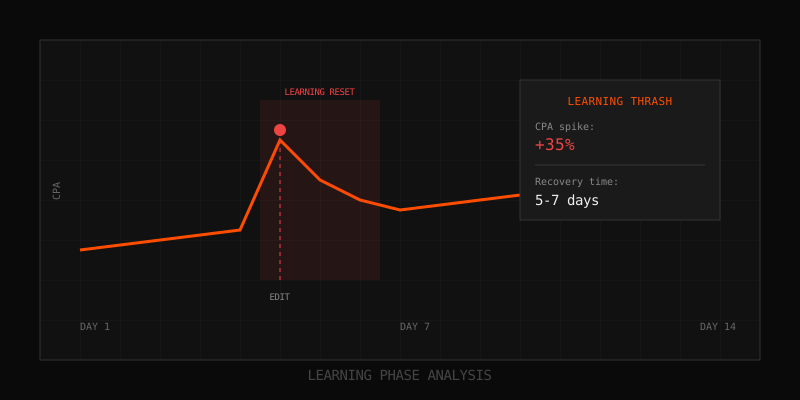
This is why new ad sets struggle initially—Meta has limited data to estimate action rates accurately. During learning phase, EAR predictions are volatile, leading to inconsistent delivery and higher costs.
Component 3: Ad Quality
Meta evaluates ad quality based on multiple signals:
- Engagement signals: Expected clicks, shares, comments, saves
- Relevance to audience: How well the ad matches user interests
- Post-click experience: Landing page quality, load speed, mobile-friendliness
- Negative feedback: Hide ad, report ad, low dwell time
- Policy compliance: Text-to-image ratio, prohibited content flags
Ads with high negative feedback get penalized severely. Even with high bids and good EAR, an ad that users consistently hide will lose auctions to more relevant competitors.
Why This System Exists
Meta's auction design serves Meta's business interests—but understanding those interests helps you work with the system rather than against it.
User Experience Protection
If highest bid always won, advertisers would spam users with irrelevant ads. User experience would degrade, engagement would drop, and Meta would lose its advertising platform value. By rewarding relevance, Meta ensures users see ads they're more likely to find valuable.
Advertiser Ecosystem Health
Pure bid auctions favor large advertisers who can outspend everyone. The Total Value system lets smaller advertisers compete by creating more relevant ads. This keeps the platform attractive to businesses of all sizes.
Long-Term Revenue Optimization
A relevant ad that drives a purchase creates a satisfied user and a repeat advertiser. An irrelevant ad that costs $50 per impression but annoys the user damages both relationships. Meta optimizes for long-term ecosystem value, not short-term auction revenue.
Practical Implications for Advertisers
Relevance Beats Budget
You can't simply outspend competitors. An advertiser with half your budget but twice your relevance will beat you consistently. Focus on creative quality, audience targeting precision, and landing page experience—not just bid increases.
Niche Audiences Have Lower Competition
Broad audiences attract more advertisers, driving up effective costs. Narrow, well-defined audiences have fewer competitors and often higher EAR because you can craft more relevant messaging. A $30 bid to a narrow audience often beats a $50 bid to a broad one.
Creative Fatigue Kills Auction Performance
When users see the same ad repeatedly, engagement drops. Lower engagement signals lower ad quality scores. Your Total Value decreases even with the same bid and audience. This is why creative refresh is essential—it's not just about user perception but auction competitiveness.
Landing Page Experience Matters
Meta tracks post-click behavior. If users bounce immediately or don't convert, that signal feeds back into your ad quality score. A poor landing page doesn't just lose conversions—it damages your auction competitiveness for future impressions.
Bid Strategies and the Auction
Lowest Cost (Automatic Bidding)
Meta sets bids dynamically to maximize results within your budget. The algorithm adjusts in real-time based on auction competition and predicted conversion probability.
Pros: Maximizes volume, requires no bid management, works well for learning phase.
Cons: No cost control—CPA can spike during competitive periods. You might pay $40 for conversions when your profitable threshold is $25.
Cost Cap
You set a target CPA; Meta tries to stay at or below it. The algorithm skips auctions where the expected cost exceeds your cap.
Pros: Controls costs, protects profitability, predictable unit economics.
Cons: May limit scale—if your cap is too low, Meta skips too many auctions. Volume drops but efficiency improves.
Bid Cap
You set the maximum bid in any single auction. Different from cost cap—this limits what you pay per auction, not per conversion.
Pros: Maximum cost control, useful when you have precise unit economics.
Cons: Requires accurate bid estimation. Set too low and you win nothing; set too high and you overpay.
ROAS Target
Meta optimizes for return on ad spend rather than cost. You set a minimum ROAS; the algorithm prioritizes high-value conversions over volume.
Pros: Aligns with revenue goals, focuses on conversion value not just count.
Cons: Requires accurate conversion value tracking. If your value data is wrong, optimization goes wrong too.
How Auction Competition Varies
Time-Based Fluctuations
Auction competition isn't static. It varies by hour, day, and season. Prime time evenings see more advertiser competition than 3 AM. Weekends differ from weekdays. Q4 holiday season can see CPMs increase 50-200% compared to January.
Understanding these patterns helps you plan budgets and expectations. Lower bids might win at 6 AM that would lose at 8 PM.
Industry and Vertical Effects
Competition clusters around industries. If you sell fitness products, you're competing with other fitness advertisers for users interested in fitness. That competitive set has its own dynamics separate from, say, B2B software advertisers.
Niche within your industry to reduce direct competition while maintaining audience relevance.
Audience Saturation
Popular audience segments (like "interested in online shopping") attract massive advertiser competition. Hyper-targeted segments (like "recently searched for specific product category") have fewer advertisers but often higher intent users.
How to Improve Your Auction Performance
Strategy 1: Improve Ad Quality Scores
Test multiple creative variations and kill underperformers quickly. Use engaging hooks, clear value propositions, and strong calls to action. Monitor relevance diagnostics in Ads Manager—ads with below-average quality scores need creative refreshes.
Strategy 2: Refine Audience Targeting
Narrower, more relevant audiences increase EAR. Test lookalike audiences based on your best customers. Exclude converted users to avoid wasting impressions. Use engagement custom audiences to find users already interested in your brand.
Strategy 3: Optimize Landing Pages
Fast-loading, mobile-optimized landing pages improve post-click signals. Match landing page content to ad messaging—consistency improves both conversions and quality scores. Test different layouts and CTAs to maximize conversion rate.
Strategy 4: Choose Appropriate Bid Strategy
New campaigns benefit from lowest cost to gather data quickly. Established campaigns with clear unit economics should use cost cap or bid cap. High-value products with variable AOV benefit from ROAS targeting.
Strategy 5: Monitor and Adapt
Auction dynamics shift constantly. Competitive pressure varies by time of day, day of week, and season. What works in January may fail in December. Regular performance reviews and quick adaptation maintain auction competitiveness.
Common Auction Misconceptions
Misconception: Higher Budget = Better Delivery
Budget determines potential scale, not auction competitiveness. A $10,000/day budget with poor relevance will lose auctions to a $1,000/day budget with excellent relevance. Budget enables spending; relevance enables winning.
Misconception: Bid Cap Should Equal Target CPA
Bid cap is per-auction; CPA is average across conversions. You might need to bid $40 in individual auctions to achieve a $25 average CPA because you also win cheaper auctions. Setting bid cap equal to target CPA often restricts delivery too much.
Misconception: Auction Competition Is Static
Competition fluctuates constantly. Black Friday sees 3-5x normal competition. Q1 is typically lower after holiday fatigue. Your "normal" CPA varies significantly based on external factors beyond your control.
Misconception: Meta's Auction Is Against You
The auction system rewards advertisers who create value for users. It's not adversarial—it's a quality filter. Work with the system by creating relevant, high-quality ads and the auction becomes your advantage.
Auction Optimization Checklist
- Check relevance diagnostics weekly—address any below-average scores
- Refresh creative every 2-4 weeks to prevent fatigue-driven quality drops
- Test narrow audiences against broad to find optimal reach-relevance balance
- Monitor landing page speed and mobile experience monthly
- Review bid strategy quarterly—ensure it matches current campaign goals
- Track competitive periods (holidays, industry events) and adjust expectations
- A/B test ad variations continuously—winners improve Total Value scores
Key Takeaways
- Total Value = Bid x Estimated Action Rate x Ad Quality—highest Total Value wins
- High bids can't compensate for poor relevance; quality multiplies your bid's effectiveness
- Estimated Action Rate depends on historical performance and user-ad fit
- Ad Quality includes engagement signals, landing page experience, and negative feedback
- Choose bid strategies based on campaign maturity and optimization goals
- Niche audiences often outperform broad ones due to higher relevance scores
- Creative refresh prevents fatigue-driven quality score decay
FAQ
How do I see my ad quality score?
In Ads Manager, check the "Relevance Diagnostics" columns (quality ranking, engagement rate ranking, conversion rate ranking). These show how your ad compares to others targeting similar audiences. Aim for average or above average on all three.
Why does CPA spike when I increase budget?
Budget increases force Meta to find additional audiences. These marginal audiences typically have lower EAR, requiring higher bids to win auctions. The algorithm prioritizes spending your full budget over maintaining CPA. Consider cost cap bidding to control this effect.
How long does it take for quality improvements to affect auctions?
Quality signals update continuously but meaningful changes take 3-7 days to stabilize. Don't expect immediate auction improvements from creative changes—give the algorithm time to gather new engagement data.
Does pausing and restarting an ad reset its quality score?
Pausing preserves historical data. When you restart, Meta still has engagement history and quality signals. However, extended pauses (2+ weeks) can cause temporary volatility as the algorithm re-establishes user-specific EAR predictions.
Learn more: How it works · Why bundles beat raw thread history