
Thread Transfer
CPM Trends 2025: Why Costs Are Rising and How to Adapt
Meta CPMs are up 15-30% year over year in most verticals. Here's why costs are rising and how smart advertisers are adapting.
Thread Transfer
Founder, Meta Ads Audit
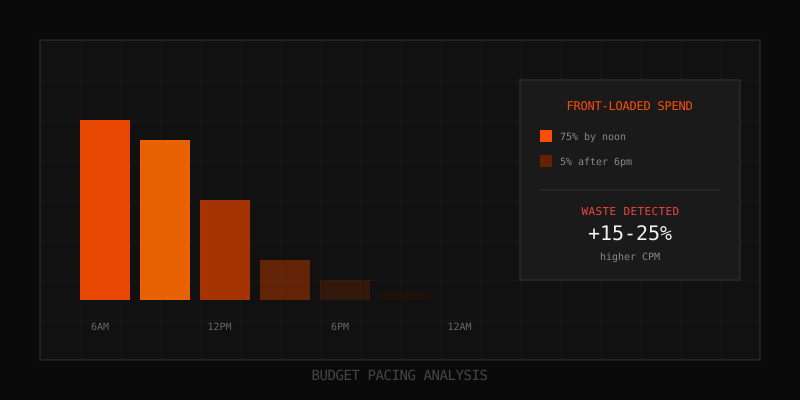
Your CPM was $12 last year. This year it's $16. Same audience, same creative, same everything—except the cost to reach 1,000 people jumped 33%. You're not imagining it. Meta Ads CPMs are rising across nearly every vertical, and the trend shows no signs of reversing in 2025.
This guide breaks down why CPMs are climbing, what the current benchmarks look like by industry, and—most importantly—what you can do to maintain efficiency despite rising costs. Spoiler: complaining about platform costs won't help, but strategic adaptation will.
What Is CPM and Why Does It Matter?
CPM (Cost Per Mille) is the cost to show your ad 1,000 times. It's the foundation of your ad economics—before anyone clicks, converts, or buys, you pay for impressions. Rising CPM means you need better click-through rates and conversion rates just to maintain the same ROAS.
CPM directly impacts every downstream metric:
- CPC: Higher CPM with same CTR = higher cost per click
- CPA: Higher CPC with same conversion rate = higher cost per acquisition
- ROAS: Higher CPA with same AOV = lower return on ad spend
A 25% CPM increase doesn't just cost you 25% more—it cascades through your entire funnel. Understanding and managing CPM is essential for maintaining profitability.
2025 CPM Benchmarks by Industry
These benchmarks represent median CPMs for accounts spending $10,000+ monthly, as of Q1-Q2 2025. Your actual CPM will vary based on targeting, creative quality, and campaign setup.
| Industry | Low CPM | Median CPM | High CPM | YoY Change |
|---|---|---|---|---|
| Fashion/Apparel | $8 | $14 | $22 | +18% |
| Health/Wellness | $10 | $18 | $28 | +22% |
| Home/Furniture | $12 | $20 | $32 | +15% |
| Beauty/Cosmetics | $9 | $16 | $26 | +20% |
| Technology/Electronics | $14 | $24 | $38 | +25% |
| Finance/Insurance | $18 | $32 | $50 | +28% |
| B2B/SaaS | $15 | $28 | $45 | +24% |
| Local Services | $6 | $12 | $20 | +12% |
| E-commerce (General) | $10 | $17 | $28 | +19% |
Why CPMs Are Rising in 2025
CPM increases aren't random—they're driven by specific market dynamics. Understanding these forces helps you develop strategies to counteract them.
1. More Advertisers, Same Inventory
Meta's user base growth has slowed while advertiser demand keeps increasing. Basic economics: more buyers competing for the same ad slots drives prices up. E-commerce brands that moved to Meta during COVID-19 are still spending, and new entrants continue to join.
2. Advantage+ Adoption
Advantage+ Shopping and Advantage+ Audiences have improved campaign efficiency for many advertisers. The irony: when everyone gets more efficient, competition intensifies and CPMs rise. What was an arbitrage opportunity becomes the new baseline.
3. Privacy Changes Reduce Targeting Precision
iOS 14.5 made audience targeting less precise. Less precision means more waste, which advertisers compensate for by bidding higher to reach their actual target audience. Broader targeting spreads budget thinner, but reaching qualified users costs more.
4. Platform Revenue Pressure
Meta faces investor pressure to grow advertising revenue. With user growth plateauing, revenue growth comes from extracting more value from existing inventory. The platform has every incentive to let CPMs rise.
5. Reels Monetization Maturity
Reels initially offered low CPMs as Meta prioritized adoption. As Reels inventory matures, CPMs are normalizing upward. The "cheap Reels inventory" advantage is diminishing.
6. Seasonal Compression
Q4 CPMs now spike earlier and higher than ever. Black Friday/Cyber Monday competition starts in October. Brands front-load spending to get ahead of peak competition, which just moves the peak earlier.
CPM by Placement: Where You Can Still Find Value
Not all placements have equal CPM increases. Understanding placement economics reveals opportunities.
| Placement | Relative CPM | Typical Performance | Notes |
|---|---|---|---|
| Facebook Feed | High | Strong CTR, good conversion | Premium inventory, highest competition |
| Instagram Feed | High | Strong engagement, good conversion | Premium inventory, visual-focused |
| Facebook Reels | Medium-Low | Growing engagement, variable conversion | Still relatively underpriced |
| Instagram Reels | Medium | High engagement, improving conversion | Strong for awareness, testing for conversion |
| Stories | Medium-Low | Good engagement, lower conversion | Best for retargeting |
| Audience Network | Very Low | Low quality, poor conversion | Usually exclude; cheap for a reason |
| Messenger | Low | Niche use cases only | Good for service businesses |
The Reels Opportunity
Reels (both Facebook and Instagram) remain relatively underpriced compared to Feed placements. Advertisers who create native Reels content often see 20-40% lower CPMs with comparable performance. The catch: you need video content that feels native to the format—repurposed Feed ads perform poorly.
Strategies to Maintain Efficiency Despite Rising CPMs
Strategy 1: Improve Creative Quality
The best defense against rising CPM is higher CTR. Meta's auction rewards engaging ads with lower costs—high relevance scores can offset CPM increases. If industry CPM rose 20% but your CTR improved 25%, your CPC actually decreases.
Focus on:
- Strong hooks in the first 3 seconds of video
- Clear value propositions in static images
- Native-feeling content for each placement
- Regular creative refresh to maintain engagement
Strategy 2: Shift Budget to Lower-CPM Placements
Don't let Advantage+ blindly allocate your budget. Analyze placement breakdown and test dedicated campaigns for lower-CPM placements like Reels. You may sacrifice some conversion rate but gain it back through volume.
Be careful: Audience Network has low CPMs but often delivers poor quality traffic. Exclude it unless you've validated performance for your specific account.
Strategy 3: Tighten Targeting to Reduce Waste
Broad targeting can mean low CPMs but high waste. Tightening targeting may increase CPM but improve conversion rate. Run the math: a $20 CPM with 3% CTR beats a $12 CPM with 1.5% CTR on cost-per-click basis.
Use audience exclusions aggressively:
- Exclude recent purchasers from prospecting campaigns
- Exclude website visitors from cold traffic campaigns
- Exclude low-value customer segments identified in your CRM
Strategy 4: Optimize for Value, Not Volume
If you're paying premium CPMs, make sure you're acquiring premium customers. Use Value Optimization campaigns to target high-AOV purchasers. A $30 CPM that acquires $200 AOV customers beats a $15 CPM acquiring $50 AOV customers.
Strategy 5: Time Your Spend Strategically
CPMs fluctuate throughout the day and week. Analyze your hourly data to find low-competition windows. Some accounts see 20-30% lower CPMs during off-peak hours while maintaining conversion rates.
Consider dayparting for specific campaigns, especially if your audience converts well outside of peak hours.
Strategy 6: Build First-Party Audiences
Custom audiences based on first-party data (email lists, purchaser data, high-intent website visitors) often have lower effective CPMs because they convert at much higher rates. A $25 CPM retargeting campaign that converts at 5% beats a $12 CPM prospecting campaign that converts at 1%.
Invest in:
- Email capture and list growth
- Strong CAPI implementation for better audience matching
- Website engagement tracking for warm audience building
Strategy 7: Negotiate at Scale
If you spend $50,000+ monthly, talk to your Meta rep about managed service or reserved inventory options. Large spenders can sometimes negotiate rate cards or priority access to new placements with lower CPMs.
What High CPM Usually Signals
Unusually high CPM (significantly above industry benchmarks) often indicates specific issues:
Poor Ad Quality
Meta's auction penalizes low-quality ads with higher CPMs. Check your relevance diagnostics—if Quality Ranking or Engagement Rate Ranking are "below average," you're paying a premium for poor creative.
Saturated Audience
High frequency combined with high CPM suggests audience exhaustion. The same people are seeing your ads repeatedly, and Meta is charging you more for declining attention. Expand or refresh your audience.
Competitive Targeting
Targeting audiences that every competitor also targets (like "interested in running shoes" for athletic brands) creates auction competition that inflates CPM. More specific or interest-adjacent targeting can reduce competition.
Restricted Categories
Finance, health, political, and other restricted categories face higher CPMs due to limited targeting options and additional compliance requirements. This is structural—you can't optimize it away, only work around it with better creative and conversion rates.
CPM Forecasting for 2025
Based on current trends, here's what to expect for the remainder of 2025:
- Q3: Moderate CPM increase (5-10%) as back-to-school and early Q4 prep begins
- Q4: Significant spike (25-40%) October through December, peaking Black Friday week
- Q1 2026: Sharp decline post-holidays, potential opportunity for January spending
Plan your budgets accordingly. Q4 requires higher ROAS targets to maintain profitability. Some brands deliberately reduce Q4 spend and reinvest in Q1 when CPMs crater.
When to Accept Higher CPMs
Higher CPM isn't always bad. Accept premium CPMs when:
- Conversion rates are proportionally higher (high-CPM audiences that convert justify the cost)
- You're acquiring high-LTV customers (subscription, repeat purchase)
- You're in a growth phase prioritizing market share over efficiency
- Competitive timing demands presence (product launches, seasonal windows)
The goal isn't lowest CPM—it's highest profit. Sometimes that means paying more to reach the right people.
Key Takeaways
- Meta CPMs are up 15-30% year over year across most industries in 2025
- Rising CPMs are driven by competition, Advantage+ efficiency gains, and platform revenue pressure
- Reels placements still offer relatively lower CPMs but require native content
- Counter rising CPMs with better creative (higher CTR), smarter targeting, and first-party audiences
- Focus on profitability (CPA, ROAS), not CPM in isolation
- Plan for Q4 CPM spikes—budget 25-40% higher than current rates
FAQ
Why is my CPM suddenly much higher than last month?
Sudden CPM spikes usually have identifiable causes: audience saturation (check frequency), creative fatigue (check CTR trends), increased competition (seasonal or market entry), or ad quality decline (check relevance diagnostics). Start with frequency and CTR—they're the most common culprits.
Should I use Advantage+ Placements or manual placement selection?
Test both. Advantage+ Placements can find efficient inventory you'd miss manually, but it can also dump budget into low-quality placements like Audience Network. Run a controlled test and compare blended CPM and CPA. Many advertisers find a hybrid approach works best—Advantage+ with specific exclusions.
How do I lower CPM without hurting performance?
The safest path is improving creative quality—higher engagement rates earn lower CPMs through Meta's auction mechanics. You can also test broader audiences (which often have lower CPMs) while closely monitoring conversion rates. If conversion rates hold, the lower CPM is a win.
Is there a CPM where I should stop spending?
There's no universal "too high" CPM—it depends on your downstream metrics. Calculate your maximum allowable CPM: (Target CPA) x (CTR) x (Conversion Rate) x 1000. If actual CPM exceeds this, you're not profitable. That's your ceiling, regardless of industry benchmarks.
Learn more: How it works · Why bundles beat raw thread history