
Thread Transfer
CPA Optimization: Strategies to Lower Cost Per Acquisition
High CPA kills profitability. Here are proven strategies to systematically lower your cost per acquisition while maintaining scale.
Thread Transfer
Founder, Meta Ads Audit
Your CPA is $45. Your target is $30. That gap isn't just a number—it's the difference between a profitable campaign and one that's burning cash. High cost per acquisition is the most common complaint among Meta advertisers, and for good reason: CPA directly determines whether your ads make money or lose it.
This guide provides systematic strategies to lower CPA without sacrificing volume. We'll cover the full optimization stack—from bid strategies and targeting to creative and landing pages. The goal isn't just lower CPA; it's sustainable efficiency at scale.
Understanding CPA
Cost Per Acquisition (CPA) measures how much you pay for each conversion. The formula:
CPA = Total Ad Spend / Number of Conversions
But CPA isn't a single metric—it's the output of your entire advertising funnel. To lower CPA, you need to improve one or more of these components:
- CPM (Cost Per Thousand Impressions): What you pay to reach people
- CTR (Click-Through Rate): What percentage of people click
- CVR (Conversion Rate): What percentage of clicks convert
The relationship: CPA = CPM / (CTR x CVR x 1000)
This means you can lower CPA by reducing CPM, increasing CTR, or increasing conversion rate. Most successful optimization addresses multiple levers simultaneously.
The CPA Optimization Framework
Before diving into tactics, establish your framework:
Step 1: Know Your Target CPA
Your target CPA should be based on unit economics, not industry benchmarks. Calculate:
Target CPA = (Average Order Value x Gross Margin) - Profit Requirement
If your AOV is $100, gross margin is 50%, and you need $20 profit per order, your maximum CPA is $30. Everything above that loses money. Everything below is profitable growth fuel.
Step 2: Diagnose the Problem
High CPA usually traces to specific funnel failures:
- High CPM + Normal CTR + Normal CVR: Audience or timing problem
- Normal CPM + Low CTR + Normal CVR: Creative problem
- Normal CPM + Normal CTR + Low CVR: Landing page or offer problem
- High CPM + Low CTR + Low CVR: Multiple problems; start with creative
Pull your data, compare to benchmarks, and identify which metric is most off. That's where you focus first.
Bid Strategy Optimization
Your bid strategy is the most direct lever for CPA control. Meta offers several options:
Lowest Cost (Default)
Meta spends your budget to get the most conversions possible, regardless of individual CPA. This maximizes volume but can lead to wildly variable CPAs. Best for: accounts prioritizing scale over efficiency.
Problem: Some conversions may cost $15, others $60. The average might be acceptable, but you're paying premium prices for some acquisitions that could have been cheaper.
Cost Cap
You set a target CPA, and Meta tries to get conversions at or below that cost. The algorithm won't bid on expensive placements/audiences, preserving efficiency.
How to use it: Set your cost cap at your target CPA. If delivery is too low, raise the cap 10-20%. If delivery is strong but CPA is at the cap, you have room to tighten.
Warning: Setting cost cap too low causes under-delivery. Start with your current CPA and lower gradually (5-10% at a time) to find the optimal point.
Bid Cap
You set the maximum bid (not CPA) in the auction. This gives precise control but requires more expertise. Best for: experienced advertisers who understand auction dynamics.
Calculate your bid cap: Target CPA x Expected Conversion Rate = Maximum Bid. If target CPA is $30 and CVR is 5%, bid cap is $1.50.
Minimum ROAS
For e-commerce, you can set a minimum ROAS target. Meta only bids on users likely to generate sufficient revenue. This protects efficiency for variable-AOV businesses.
Audience Optimization
Refine Targeting for Intent
Broad audiences have lower CPMs but often lower conversion rates. Narrower, intent-based audiences cost more per impression but convert better. Run the math—often higher-CPM audiences deliver lower CPA.
Test these audience types against broad:
- Website visitors (30/60/90 day windows)
- Engaged email subscribers
- High-value customer lookalikes (based on LTV, not just purchasers)
- Add-to-cart abandoners
- Video viewers (50%+ completion)
Exclusion Audiences
Stop paying to reach people who won't convert:
- Recent purchasers (7-30 days depending on product)
- Existing customers (if prospecting-focused)
- Unqualified leads (for lead gen)
- Bounced website visitors (under 10 seconds)
- App users who already converted
Exclusions reduce wasted impressions and lower effective CPA by focusing spend on people who can actually convert.
Advantage+ Audience Testing
Meta's Advantage+ Audience can find efficient pockets you'd miss manually. But it can also drift into low-quality segments. Test Advantage+ against manual targeting and monitor CPA closely—if Advantage+ delivers lower CPA at acceptable volume, lean into it.
Creative Optimization
Creative is often the biggest CPA lever because it impacts both CTR and conversion rate. Strong creative earns lower CPMs (Meta rewards engagement) and drives more clicks per impression.
Test Hooks Aggressively
The first 1-3 seconds of video (or headline on static) determines whether people engage. Test multiple hooks with the same body content. One strong hook can cut CPA 30-50%.
Hook templates that often work:
- Problem statement: "Tired of [pain point]?"
- Social proof: "Join 10,000+ customers who..."
- Curiosity gap: "The secret to [desired outcome]..."
- Direct benefit: "Get [specific result] in [time frame]"
- Counter-intuitive: "Why [conventional wisdom] is wrong"
Match Creative to Funnel Stage
Cold audiences need education and trust-building. Retargeting audiences need urgency and objection handling. Using the same creative for both wastes money.
- Cold: Focus on problem/solution, social proof, brand story
- Warm (engaged but not converted): Product details, comparisons, testimonials
- Hot (cart/site abandoners): Urgency, discounts, objection handling
Diversify Formats
Don't put all budget into one format. Test across:
- Single image with strong headline
- Carousel (product showcase or story)
- Video (15-30 seconds performs best)
- UGC-style content
- Collection ads (for e-commerce)
Different users respond to different formats. Diversification finds efficient pockets you'd miss otherwise.
Refresh Before Fatigue
Creative performance declines as frequency increases. Don't wait for CPA to spike—proactively refresh creative every 2-4 weeks for high-spend campaigns. Monitor frequency; above 3-4 usually signals fatigue onset.
Landing Page Optimization
You can have perfect ads and still waste money if your landing page doesn't convert. Every 1% improvement in conversion rate directly lowers CPA.
Speed Matters
Pages that load in 1 second convert 3x better than pages that load in 5 seconds. Test your page speed on mobile. Compress images, minimize scripts, use a CDN. This is often the highest-ROI fix.
Ad-Landing Page Match
If your ad promises "50% off blue widgets," your landing page should prominently feature 50% off blue widgets. Mismatches kill conversion rate and waste your ad spend. Create dedicated landing pages for major campaign themes.
Mobile-First Design
70%+ of Meta traffic is mobile. Design for thumb-scrolling, readable text without zooming, and easy tap targets. Forms should be minimal—every field reduces conversion rate.
Clear CTA Above the Fold
Users should know what to do immediately upon landing. Don't bury your CTA below paragraphs of copy. Lead with the action you want them to take.
Social Proof
Reviews, testimonials, customer counts, and trust badges reduce friction and improve conversion rate. "Join 50,000+ happy customers" builds confidence that the ad can't alone.
Campaign Structure Optimization
Consolidate for Algorithm Learning
Meta's algorithm needs 50+ conversions per week per ad set to exit learning phase efficiently. Too many fragmented ad sets starves each one of data. Consolidate similar audiences into fewer ad sets.
A single ad set with $1,000/day budget and 100 weekly conversions will outperform five ad sets with $200/day and 20 conversions each. The algorithm learns faster with more signal.
Separate Prospecting and Retargeting
Prospecting (cold) and retargeting (warm) have different economics. Mixing them in one campaign muddles your data and makes optimization harder. Create separate campaigns with distinct CPA targets for each.
Typical retargeting CPA should be 30-50% lower than prospecting. If it's not, your retargeting isn't working properly.
Test CBO vs. ABO
Campaign Budget Optimization (CBO) lets Meta allocate budget across ad sets dynamically. Ad Set Budget Optimization (ABO) gives you manual control. Neither is universally better—test for your account.
CBO tends to work better with fewer, larger ad sets. ABO works better when you need to ensure minimum spend on specific audiences.
Advanced CPA Tactics
Value Optimization
Instead of optimizing for any conversion, optimize for high-value conversions. Meta's value optimization targets users likely to spend more. Even if CPA increases slightly, revenue per acquisition increases more.
Requirements: Conversion API with purchase value data, 100+ value-diverse conversions over 7 days.
Advantage+ Shopping Campaigns
For e-commerce, ASC can deliver lower CPA through full automation. Test ASC against manual campaigns with the same budget. Many accounts see 10-20% CPA improvement; others see worse results. Data determines.
Creative Iterations on Winners
When you find a winning creative, don't just scale it—iterate on it. Test variations of winning hooks, different testimonials with the same format, similar styles with different products. Extract maximum value before fatigue hits.
Dayparting
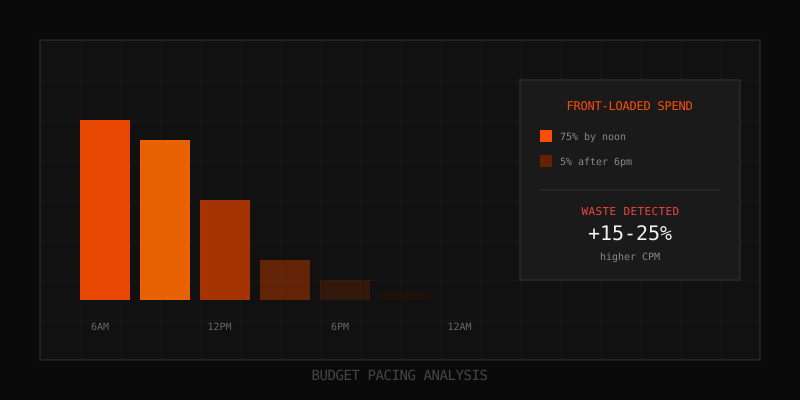
Analyze your hourly conversion data. If certain hours convert poorly, exclude them using ad scheduling. This concentrates budget into high-performing windows and can lower CPA 10-20%.
Placement Optimization
Not all placements deliver equal CPA. Analyze your placement breakdown and either exclude poor performers or create placement-specific campaigns. Audience Network in particular often inflates CPA despite low CPM.
CPA Optimization Checklist
Use this checklist to systematically work through CPA optimization:
- [ ] Calculate your target CPA based on unit economics
- [ ] Diagnose which funnel metric (CPM, CTR, CVR) is underperforming
- [ ] Test Cost Cap or Bid Cap instead of Lowest Cost
- [ ] Build and test high-intent audiences (website visitors, lookalikes)
- [ ] Set up exclusion audiences for recent purchasers and existing customers
- [ ] Test multiple creative hooks with the same body content
- [ ] Create stage-specific creative (cold vs. warm vs. hot)
- [ ] Audit landing page speed and mobile experience
- [ ] Ensure ad-to-landing page message match
- [ ] Consolidate ad sets for better algorithm learning
- [ ] Separate prospecting and retargeting campaigns
- [ ] Analyze placement breakdown and exclude poor performers
- [ ] Test value optimization if you have sufficient conversion volume
- [ ] Set up proactive creative refresh schedule
When CPA Won't Go Lower
Sometimes you've optimized everything and CPA still won't hit target. At that point, consider:
- Product-market fit: Is there sufficient demand for your product at your price?
- Market saturation: Have you exhausted your addressable audience on Meta?
- Competitive pressure: Are competitors driving up auction costs in your niche?
- Target CPA is unrealistic: Some products simply can't be acquired profitably on Meta
- Channel diversification: Maybe Meta isn't your best channel—test Google, TikTok, influencers
Not every business can profitably acquire customers through Meta Ads. If you've exhausted optimization options, it may be time to revisit your acquisition strategy or product economics.
Key Takeaways
- CPA is the output of CPM, CTR, and conversion rate—optimize all three
- Set target CPA based on unit economics, not industry benchmarks
- Cost Cap bidding directly controls CPA but may limit volume
- Creative is often the biggest lever—test hooks relentlessly
- Landing page speed and message match directly impact conversion rate
- Consolidate ad sets for better algorithm learning (50+ weekly conversions each)
- Separate prospecting and retargeting for cleaner optimization
FAQ
How long should I wait before deciding an ad set's CPA is too high?
Wait for statistical significance—typically 100+ clicks and 10+ conversions at minimum. For low-volume accounts, this might take 2 weeks. Making decisions too early leads to false negatives (killing ads that would have worked).
Should I pause ad sets with high CPA immediately?
Not necessarily. Check if CPA is trending down (learning phase). Check if the audience is valuable for later retargeting. If CPA is stable and significantly above target after sufficient data, pause and reallocate budget.
Why did my CPA suddenly spike?
Common causes: creative fatigue (check frequency), audience saturation, learning phase reset (recent edits), seasonal competition, tracking issues. Diagnose by checking which component changed—CPM, CTR, or CVR.
Is it better to have lower CPA or higher volume?
It depends on your business goals. Growth-focused businesses may accept higher CPA for scale. Profitability- focused businesses prioritize efficiency. The ideal is maximum volume at your target CPA—keep scaling until CPA rises to your ceiling, then optimize again.
Learn more: How it works · Why bundles beat raw thread history