
Thread Transfer
The Frequency Sweet Spot: When Repetition Becomes Waste
Your ad hit frequency 7.2 and now CPM is up 15% while CTR dropped 23%. You crossed from repetition to waste. Here's how to find the sweet spot.
Thread Transfer
Founder, Meta Ads Audit
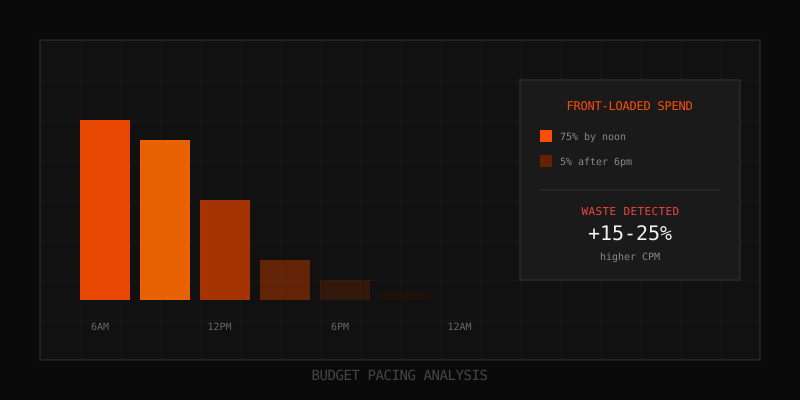
Your best-performing ad creative hit a 7.2 frequency last week. Now CPM is up 15%, click-through rate has dropped 23%, and your audience is ignoring—or worse, hiding—your ads. You crossed the line from effective repetition to expensive waste.
Frequency is one of the most misunderstood metrics in Meta advertising. Too low and you never build recognition. Too high and you burn through goodwill and budget simultaneously. Finding the sweet spot—where repetition reinforces rather than repels—is the difference between scaling profitably and watching your campaigns decay.
What Frequency Actually Measures
Frequency is the average number of times each person in your audience has seen your ad over a given period. A frequency of 3.0 means the average person has seen your ad three times.
But averages lie. If your frequency is 3.0, some people saw your ad once while others saw it ten times. The distribution matters enormously. Meta doesn't show you the distribution by default—you see the average, which hides the extremes where waste accumulates.
Why Frequency Exists
Repetition drives memory. Marketing research consistently shows that people need multiple exposures before they remember a brand or take action. The "Rule of 7"—the idea that prospects need seven touchpoints before converting—has roots in 1930s advertising wisdom.
But Meta isn't traditional advertising. Your audience sees hundreds of ads daily. The attention threshold is higher, and the tolerance for repetition is lower. Seven exposures to a Facebook ad doesn't work like seven exposures to a billboard.
The Frequency Lifecycle
Frequency follows a predictable pattern:
- 1-2 exposures: Initial awareness. Low recognition, high novelty. Click-through rates are often highest here because everything is new.
- 3-4 exposures: Recognition builds. People start to remember your brand. Conversion intent typically peaks in this zone for direct response campaigns.
- 5-6 exposures: Diminishing returns begin. Those who were going to convert already have. Remaining audience becomes increasingly ad-blind.
- 7+ exposures: Waste zone. You're paying to annoy people who won't convert. CPM rises, engagement drops, and ad fatigue accelerates.
The Math Behind Frequency Waste
Let's quantify the waste. Say you spend $10,000 reaching 100,000 people at $100 CPM. At frequency 1.0, that's 100,000 impressions to 100,000 unique people. All fresh.
Now suppose your frequency creeps to 5.0 over the month. Same $10,000 budget, but now you're buying 500,000 impressions to reach just 100,000 unique people. 400,000 of those impressions go to people who've already seen the ad multiple times.
If exposures 4 and 5 convert at 80% lower rates than exposures 1-3, you're spending roughly $6,000 on impressions with minimal conversion potential. That's 60% of your budget in the waste zone.
CPM Inflation at High Frequency
It gets worse. Meta's algorithm often increases CPM as frequency rises because the available inventory within your audience shrinks. You've already reached everyone who's easy to reach. Finding incremental impressions requires outbidding competitors for the same eyeballs.
We commonly see CPM increase 10-20% when frequency exceeds 5.0. Combined with declining engagement, your effective cost per meaningful impression can double.
Finding Your Frequency Sweet Spot
There's no universal optimal frequency. It depends on your objective, creative complexity, and audience relationship. But we can establish guidelines based on campaign type.
Direct Response Campaigns
For campaigns optimizing for purchases, leads, or signups, the sweet spot is typically 2-4 over a 7-day window. People who are going to buy usually do so within the first few exposures. After that, you're paying for impressions that don't move the needle.
Monitor conversion rate by frequency cohort. When conversion rate drops below 50% of the frequency-1 baseline, you've likely exceeded the sweet spot.
Brand Awareness Campaigns
Brand campaigns can tolerate higher frequency—up to 6-8 over 30 days—because the goal is recall, not immediate action. But even brand campaigns hit a ceiling. Ad recall lift flattens after 6 exposures in most studies.
More importantly, brand campaigns at high frequency can create negative associations. People remember your brand, but they remember being annoyed by it.
Retargeting Campaigns
Retargeting is where frequency control matters most. These audiences are small by design, so frequency climbs fast. A 1,000-person retargeting audience with $50/day budget will hit double-digit frequency within two weeks.
Cap retargeting frequency at 3-5 over 7 days. If someone hasn't converted after five exposures to your retargeting creative, more impressions won't change their mind. Move them to a different audience or exclude them entirely.
How to Diagnose Frequency Problems
Method 1: Weekly Frequency Tracking
Export weekly performance data and track frequency per ad set. Plot frequency against CTR and conversion rate over time. You'll see the inflection point where engagement starts declining—that's your empirical sweet spot ceiling.
Method 2: Frequency Breakdown Reports
In Ads Manager, use the breakdown menu to view performance by frequency bucket (1, 2, 3, etc.). This shows how metrics change as people see your ad more times. Look for the frequency where CTR drops by more than 30% from the frequency-1 baseline.
Method 3: CSV Export Analysis
Export your ad set data with frequency and engagement metrics. Flag any ad set where frequency exceeds 5.0 with declining week-over-week CTR. This combination signals you've crossed into the waste zone.
Our Meta Ads Audit tool automatically flags frequency waste by analyzing the relationship between frequency, engagement decay, and CPM inflation. We identify ad sets where repetition has become expensive redundancy.
Strategies to Control Frequency
Strategy 1: Expand Your Audience
The simplest fix for high frequency is a larger audience pool. If you're hitting frequency 8 with a 500,000-person audience, expanding to 2 million people drops frequency proportionally (assuming constant budget).
Test lookalike expansion (1% to 3%), broader interest targeting, or removing demographic restrictions. Yes, this dilutes audience quality somewhat. But paying for impressions that convert beats paying for impressions that annoy.
Strategy 2: Reduce Budget on Saturated Ad Sets
If you can't expand the audience, reduce the budget. High frequency with a small audience means you're overspending relative to the available inventory. Cut budget to bring frequency back into the sweet spot.
Reallocate the freed budget to prospecting campaigns where you can still reach fresh people.
Strategy 3: Refresh Creative Regularly
Fresh creative resets ad fatigue. If someone has seen Ad A five times, showing them Ad B feels like a first exposure even though you're targeting the same person. Creative rotation extends the effective life of your audience.
Aim to refresh hero creative every 2-3 weeks for high-spend campaigns. Keep core messaging consistent but change visuals, hooks, and formats. The goal is novelty within continuity.
Strategy 4: Use Frequency Caps
Meta offers frequency caps for reach and frequency campaigns. You can specify "show this ad no more than X times per person over Y days." This prevents runaway frequency by design.
The limitation: frequency caps aren't available for all campaign objectives. For conversion-optimized campaigns, you must control frequency indirectly through audience size and budget management.
Strategy 5: Sequential Messaging
Instead of showing the same ad repeatedly, build a sequence. First exposure: awareness hook. Second exposure: social proof. Third exposure: offer. Fourth exposure: urgency.
Sequential messaging turns multiple exposures into a journey rather than repetition. Each impression adds new information rather than hammering the same point.
Strategy 6: Audience Exclusions
Exclude people who've engaged but not converted after a threshold. If someone clicked your ad three times without converting, more impressions probably won't help. Exclude them from your ad set and move budget to fresh prospects.
Also exclude recent converters. There's no reason to keep advertising to someone who purchased yesterday. Build exclusion audiences and apply them to all campaigns.
The Hidden Cost: Negative Feedback
High frequency doesn't just waste budget—it actively harms your account. Meta tracks negative feedback signals: "hide ad," "report ad," and low engagement rates. Accounts with high negative feedback pay more CPM and get worse delivery.
When you show the same ad to someone 10 times and they hide it, that signal persists. It affects not just that ad but your account's overall quality score. You're not just wasting money today; you're making tomorrow's advertising more expensive.
Monitoring Negative Feedback
In Ads Manager, add the "Negative Feedback (Ad)" column to your reports. Compare negative feedback rates across frequency levels. High-frequency ad sets almost always have elevated negative feedback—that's the audience telling you they've had enough.
Industry Benchmarks
While optimal frequency varies, here are benchmarks based on aggregate data:
- E-commerce (purchase objective): 2.5-4.0 frequency over 7 days yields best ROAS
- Lead generation: 3.0-5.0 frequency over 7 days for B2C; 4.0-6.0 for B2B (longer consideration cycle)
- App installs: 2.0-3.5 frequency over 7 days; app install decisions are fast
- Brand awareness: 4.0-7.0 frequency over 30 days; recall requires more repetition
- Retargeting: 3.0-5.0 frequency over 7 days maximum; these audiences fatigue fastest
These are starting points. Your specific product, creative quality, and audience composition all affect where your sweet spot actually falls.
When High Frequency Works
Not all high frequency is waste. Some scenarios justify elevated repetition:
- Flash sales or limited-time offers: Urgency justifies aggressive frequency over short windows
- Complex products: High-consideration purchases (B2B software, financial services) may need more exposures
- Sequential campaigns: If each impression delivers new information, frequency 8 doesn't mean eight identical exposures
- Ultra-relevant creative: Truly personalized ads tolerate higher frequency because they feel less like advertising
The test: is engagement holding steady despite rising frequency? If CTR and conversion rate remain stable as frequency climbs, you may have genuinely relevant creative that warrants continued exposure. But that's rare.
Key Takeaways
- Frequency sweet spot is typically 2-4 for direct response, 4-7 for brand campaigns
- Frequency above 5 usually signals waste—engagement and conversion rates decline
- High frequency inflates CPM while reducing effectiveness, a double penalty
- Control frequency through audience expansion, budget reduction, or creative refresh
- Negative feedback from over-frequency harms your account's long-term performance
- Monitor frequency weekly and compare against engagement metrics to find your empirical ceiling
FAQ
What's the difference between frequency and reach?
Reach is how many unique people saw your ad. Frequency is the average number of times each person saw it. Impressions equals reach times frequency. You want to maximize reach at optimal frequency, not maximize frequency at the expense of reach.
Can I set frequency caps on conversion campaigns?
Not directly. Meta only offers explicit frequency caps for reach and brand awareness campaigns. For conversion campaigns, control frequency indirectly by managing audience size, budget levels, and using exclusions.
How quickly does frequency climb?
It depends on audience size and budget. A $1,000/day budget targeting a 100,000-person audience will hit high frequency within a week. The same budget targeting 5 million people might stay at frequency 1-2 for months.
Is frequency 1.0 ideal?
No. Frequency 1.0 means minimal repetition, which limits recognition and recall. Some repetition is valuable—the goal is finding the sweet spot where repetition reinforces without fatiguing.
How do I know when creative fatigue starts?
Watch for CTR declining while frequency rises. If CTR drops 20%+ over two weeks while frequency increases, fatigue has set in. Refresh creative or expand audience to reset.
Learn more: How it works · Why bundles beat raw thread history