
Thread Transfer
Creative Refresh Cadence: How Often to Update Your Ads
Your winning ad won't win forever. CTR drops, frequency rises, and suddenly your CPA is 40% higher. Here's when to refresh and how to plan your creative pipeline.
Thread Transfer
Founder, Meta Ads Audit
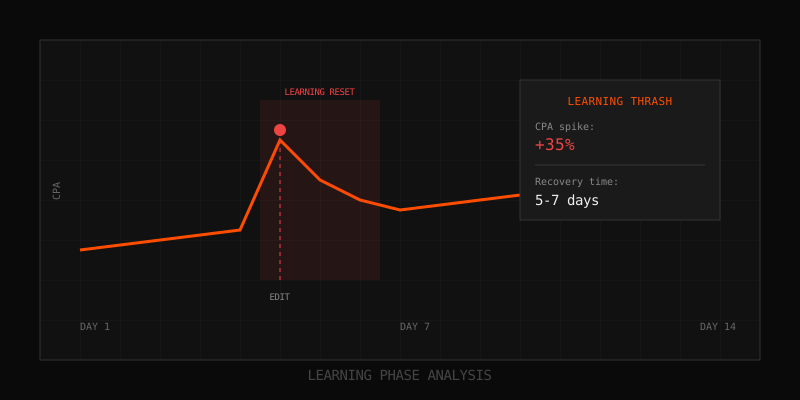
Your best-performing ad has been crushing it for three weeks. CTR is strong, CPA is efficient, and you're tempted to let it ride forever. Then week four hits—CTR drops 15%, frequency climbs past 4, and suddenly your reliable performer is dragging down the whole ad set. This is creative fatigue, and it will happen to every ad eventually.
The question isn't whether to refresh your creatives—it's when. Refresh too early and you waste learnings from winning ads. Refresh too late and you burn budget on declining performance. This guide gives you the data-driven signals to time your refreshes perfectly.
What Is Creative Fatigue?
Creative fatigue occurs when your target audience has seen your ad so many times that they stop responding to it. The visual and copy that once grabbed attention become invisible—users scroll past without registering the message. Performance metrics decline even though nothing about your targeting or offer has changed.
Fatigue isn't a sudden cliff—it's a gradual decay. Understanding the stages helps you catch it early:
Stage 1: Peak Performance (Days 1-14)
Your new creative enters the mix fresh. The algorithm tests it against different audience segments. If it's strong, it quickly earns spend share. CTR and conversion rates are at their highest during this honeymoon period.
Stage 2: Stabilization (Days 15-30)
Performance stabilizes as the algorithm finds the optimal audience segments. Metrics may dip slightly from peak but remain strong. This is sustainable performance—your ad is working.
Stage 3: Early Fatigue (Days 30-60)
The first signs appear: frequency rises above 3-4, CTR begins declining 5-10% per week, and CPA starts creeping up. Most advertisers don't notice because the decline is gradual.
Stage 4: Accelerating Decline (Days 60+)
Decline accelerates. CTR drops 15-20% per week, frequency exceeds 5-6, and the ad becomes actively harmful to campaign efficiency. At this point, you're paying to show people an ad they've learned to ignore.
The Key Fatigue Indicators
Frequency
Frequency measures how many times, on average, each person in your audience has seen your ad. It's the most direct indicator of fatigue risk.
| Frequency Range | Status | Action |
|---|---|---|
| 1.0 - 2.5 | Healthy | Monitor normally |
| 2.5 - 4.0 | Watch closely | Prepare refresh assets |
| 4.0 - 6.0 | Fatigue likely | Begin refreshing |
| 6.0+ | Severe fatigue | Replace immediately |
Important caveat: Retargeting audiences can handle higher frequencies (8-10+) because users already know your brand. Cold prospecting audiences fatigue faster (threshold around 3-4).
CTR Trend
Declining CTR is often the first performance signal of fatigue. When people have seen your ad multiple times, they stop clicking—even if they liked it initially.
Warning signal: CTR declining 5%+ week-over-week for 2+ consecutive weeks while other metrics remain stable.
CPA Trend
As CTR drops, CPA rises. You're paying the same CPM but getting fewer clicks and conversions. This is where fatigue hits your wallet.
Warning signal: CPA increasing 10%+ week-over-week without corresponding changes to targeting, bidding, or market conditions.
CPM Trend
Counterintuitively, CPM often increases as creative fatigues. The algorithm recognizes declining engagement and has to bid higher to serve the ad. You're paying more to show an ad people don't want to see.
Hook Rate and Hold Rate (Video)
For video ads, watch these video-specific metrics:
- Hook rate: Percentage watching past 3 seconds. Declining hook rate means the opening is losing impact.
- Hold rate: Average percentage of video watched. Declining hold rate means the content is becoming stale.
Building a Refresh Cadence
The 3-4-5 Framework
A simple heuristic that works for most accounts:
- 3 weeks: New creative enters rotation
- 4 weeks: Review performance, prepare backup creative
- 5-6 weeks: Rotate out declining performers, introduce fresh creative
This gives each creative time to prove itself while maintaining a steady pipeline of fresh assets.
High-Spend Account Cadence
Accounts spending $50k+/month burn through audience faster. Fatigue cycles compress:
- Introduce new creative every 2 weeks
- Run 3-5 active creatives simultaneously to spread impressions
- Build a 4-6 week creative pipeline to stay ahead of fatigue
Low-Spend Account Cadence
Accounts under $10k/month can extend cycles:
- Creative can run 6-8 weeks before fatigue
- 2-3 active creatives may be sufficient
- Monthly creative refresh is often enough
Audience Size Impact
Audience size dramatically affects fatigue speed:
| Audience Size | Typical Fatigue Timeline |
|---|---|
| Under 100k | 2-3 weeks |
| 100k - 1M | 4-6 weeks |
| 1M - 10M | 6-8 weeks |
| 10M+ | 8-12 weeks |
Small retargeting audiences (website visitors, customer lists) fatigue fastest. Broad prospecting audiences last longer.
Planning Your Creative Pipeline
The Always-On Pipeline
Never wait until creative fatigues to start producing new assets. Maintain a rolling pipeline:
- Live: 3-5 creatives currently running
- Ready: 2-3 creatives approved and staged for rotation
- In production: 2-3 creatives being developed
- In concept: Ideas being tested and refined
Creative Variety Strategy
Don't create 5 variations of the same concept. Spread your bets across:
- Different formats: Static images, carousels, video, UGC
- Different angles: Problem-focused, benefit-focused, social proof, urgency
- Different styles: Polished brand content, raw UGC, educational, entertaining
When one style fatigues, another may still be fresh to your audience.
Iterating on Winners
When a creative outperforms, don't just let it run until it dies. Create variations while it's hot:
- Same visual, different copy angles
- Same concept, different visual execution
- Same hook, different payoff
- Same message, different format (image to video)
These iterations often inherit some of the original's success while resetting the fatigue clock.
Refresh Strategies by Creative Type
Static Images
Static images typically fatigue faster than video because they're consumed instantly. Refresh strategies:
- Change the hero image while keeping winning copy
- Update colors/background while keeping the subject
- Add seasonal elements (holiday overlays, seasonal colors)
- Switch from product shot to lifestyle shot (or vice versa)
Video Ads
Video content takes longer to fatigue but requires more production effort. Smart refresh tactics:
- New hook, same body: The first 3 seconds matter most. Swap the opening to reset engagement.
- Same content, new edit: Re-cut existing footage with different pacing, music, or overlays.
- Extended/shortened versions: A 30-second edit of a 60-second winner feels fresh.
- Format adaptation: Turn landscape into vertical, or vice versa, for different placements.
Carousel Ads
Carousels have multiple fatigue vectors—first card, overall sequence, individual cards:
- Reorder cards (new first card = new first impression)
- Replace the weakest-performing card
- Add/remove cards (change from 4 to 5, or 5 to 3)
- Update headlines while keeping visuals
UGC Content
UGC often lasts longer than polished content because authenticity ages better than polish. Still, refresh by:
- Featuring different creators
- Different testimonials from the same creator
- Compilation edits of multiple UGC clips
- Adding text overlays or captions to existing footage
Detecting Fatigue Before It Hurts
Weekly Performance Review
Set a weekly calendar reminder to check these metrics for each active creative:
- Frequency (target: under 4 for prospecting, under 8 for retargeting)
- CTR trend (flag: 2+ weeks of 5%+ decline)
- CPA trend (flag: 2+ weeks of 10%+ increase)
- Spend share changes (creative losing share = algorithm deprioritizing it)
Automated Alerts
In Ads Manager, create automated rules to flag fatigue:
- Alert when frequency exceeds 4
- Alert when CTR drops below X% (your historical average)
- Alert when CPA exceeds target by 20%+
Our Meta Ads Audit tool automatically monitors creative performance trends and flags fatigue indicators before they significantly impact your results. We track frequency, CTR decay, and CPA increases at the creative level with actionable recommendations.
What to Do When Creative Fatigues
Option 1: Pause and Replace
The cleanest option. Pause the fatigued creative and introduce a fresh one. The fatigued creative goes into your archive—you can potentially revive it later for different audiences or seasons.
Option 2: Reduce Budget Share
If the creative is still profitable (just less so), reduce its budget share rather than killing it entirely. Sometimes a reduced impression volume lets a creative recover slightly.
Option 3: Audience Shift
Move the creative to a different audience that hasn't seen it. A creative that's fatigued with one custom audience might be fresh to another. This extends life without new production.
Option 4: Minor Refresh
Small changes can reset the fatigue clock: new headline with same image, same video with new thumbnail, same carousel with reordered cards. These won't work forever but can buy 1-2 more weeks.
Seasonal Refresh Considerations
Holiday Seasons
Major shopping seasons (Black Friday, Christmas, etc.) require accelerated refresh cycles:
- Competition increases, so does fatigue speed
- Audiences see more ads overall—yours blends into noise faster
- Plan 2x your normal creative output for Q4
Summer Slowdown
Lower competition seasons can extend creative life:
- Less ad clutter means less fatigue pressure
- You can stretch refresh cycles slightly
- Good time to test new concepts at lower stakes
Industry-Specific Seasons
Know your industry's peak periods and plan creative pipelines accordingly:
- Fitness: January, pre-summer
- E-commerce: Q4, Prime Day
- B2B: Q1 budget season, pre-conference periods
- Travel: Booking windows for major holidays
Key Takeaways
- Creative fatigue is inevitable—plan for it, don't react to it
- Frequency above 4 (prospecting) or 8 (retargeting) signals fatigue risk
- Watch for 5%+ weekly CTR declines as an early warning sign
- High-spend accounts need 2-week refresh cycles; low-spend can go 6-8 weeks
- Maintain a pipeline: live creative, ready creative, in-production creative
- Iterate on winners while they're hot—don't wait for fatigue
FAQ
Can a fatigued creative ever recover?
Sometimes, with a long rest period (3+ months) and exposure to a different audience, a creative can work again. But it's usually more efficient to create new variations than to wait for recovery.
Should I refresh all creatives at once?
No. Stagger your refreshes so you always have some stable performers while testing new ones. Refreshing everything at once means all your creative enters learning phase simultaneously.
How do I know if poor performance is fatigue vs bad creative?
Check the timeline. If performance was strong for 3-4+ weeks before declining, that's fatigue. If performance was never strong, that's a bad creative that should be replaced regardless of fatigue.
Does running multiple creatives prevent fatigue?
It spreads impressions and slows fatigue, but doesn't prevent it. With 3 creatives splitting impressions evenly, each takes 3x longer to fatigue. But all will eventually need refreshing.
What if I don't have resources for constant creative production?
Focus on evergreen creative that ages well (testimonials, educational content) and use simple refresh tactics (copy changes, color updates) to extend life. One UGC video can spawn multiple edits.
Learn more: How it works · Why bundles beat raw thread history