
Thread Transfer
AI Model Selection: When to Use What in 2025
Model selection determines 60-90% of costs. GPT-4o for complex reasoning, Haiku for high-volume tasks, Llama for self-hosting. Here's the decision matrix.
Thread Transfer
AI Systems for Builders
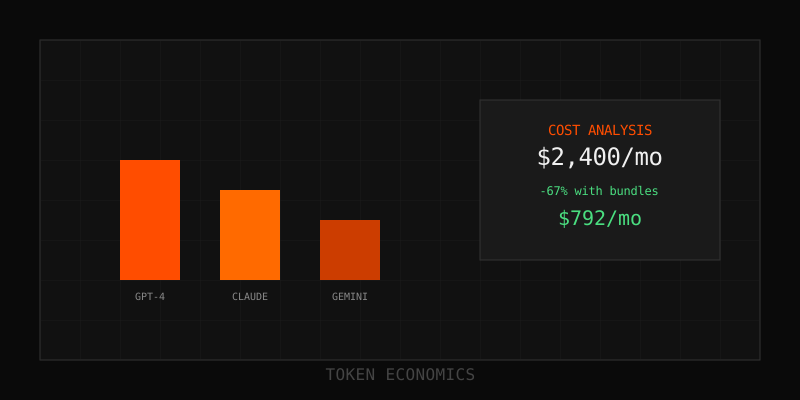
Model selection determines 60-90% of your AI costs and performance outcomes. In 2025, choosing between GPT-4o, Claude Sonnet, Gemini Pro, and Llama isn't about "best"—it's about fit. Use GPT-4o for complex reasoning, Claude Haiku for high-volume tasks, Gemini for speed, Llama for self-hosting. Here's the decision framework.
The 2025 model landscape: no single winner
There is no "best" model in 2025—only the best model for your task. Claude Sonnet 4.5 dominates coding (77.2% on SWE-bench Verified). GPT-5 leads in factual accuracy (80% fewer hallucinations than GPT-4). Gemini 2.5 Flash wins on speed (372 tokens/second). Llama 4 Scout handles massive context (10M tokens).
Optimal architecture uses multiple models: Claude for code reviews, GPT-4o for customer-facing content, Haiku for high-volume classification, Llama for on-premise sensitive data. This guide provides the decision tree for each scenario.
Model comparison: capabilities, costs, and tradeoffs
Claude (Anthropic)
Models: Claude Opus 4.5 (most capable), Claude Sonnet 4.5 (balanced), Claude Haiku 3.5 (fast/cheap).
Strengths: Best-in-class coding (77.2% SWE-bench), natural writing style, thoughtful analytical responses, Artifacts for real-time visualization, strong safety guardrails.
Weaknesses: Higher pricing than Gemini, slower than GPT-4 Turbo, smaller ecosystem than OpenAI.
Pricing (2025): Opus 4.5: $15/$75 per M tokens (input/output). Sonnet 4.5: $3/$15. Haiku 3.5: $0.25/$1.25.
Best for: Software engineering, code reviews, technical documentation, analytical writing, compliance-sensitive applications (financial services, healthcare).
GPT-4/GPT-5 (OpenAI)
Models: GPT-5 (latest flagship), GPT-4o (optimized), GPT-4 Turbo, GPT-3.5 Turbo, o3/o4-mini (reasoning).
Strengths: Versatile general-purpose performance, 80% fewer hallucinations (GPT-5 vs. GPT-4), extensive ecosystem (plugins, GPT marketplace), multimodal (vision, audio), function calling, fine-tuning support.
Weaknesses: Premium pricing, inconsistent quality on specialized tasks (coding lags Claude), occasional verbosity.
Pricing (2025): GPT-5: $12/$60 per M tokens. GPT-4o: $2.50/$10. GPT-3.5 Turbo: $0.50/$1.50.
Best for: General-purpose chatbots, customer support, content generation, brainstorming, multi-step reasoning, image generation (DALL-E integration), projects needing ecosystem depth.
Gemini (Google)
Models: Gemini 3 Pro (most capable), Gemini 2.5 Pro, Gemini 2.5 Flash (fastest).
Strengths: Speed champion (372 tokens/sec for Flash), multimodal excellence (video, audio, images), competitive pricing, deep integration with Google Workspace, Gemini 3 Pro leads in reasoning (1501 Elo).
Weaknesses: Smaller community than OpenAI, less natural prose than Claude, occasional context-handling quirks.
Pricing (2025): Gemini 3 Pro: $8/$40 per M tokens. Gemini 2.5 Pro: $1.25/$5. Flash: $0.075/$0.30.
Best for: High-volume, time-sensitive applications (real-time dashboards, analytics), multimodal tasks (video analysis, image OCR), cost-constrained projects, Google ecosystem users.
Llama (Meta)
Models: Llama 4 Scout (10M context), Llama 4 (general), Llama 3.1 (previous gen).
Strengths: Open-source (free for most uses), ultra-large context (10M tokens for Scout), self-hosting enables data privacy, no per-token costs (infrastructure only), customizable via fine-tuning.
Weaknesses: Requires infrastructure/DevOps, performance trails proprietary models on complex tasks, community support less polished than commercial offerings.
Pricing (2025): Free (open-source). Self-hosting costs: ~$0.50-$2.00 per M tokens depending on infrastructure efficiency. API providers (Together.ai, Replicate): $0.20-$0.60 per M tokens.
Best for: On-premise deployments (sensitive data, compliance), cost-conscious at scale (>500M tokens/month), research/academia, fine-tuning for specialized domains, air-gapped environments.
Cost vs. performance matrix
| Model | Cost (Input/Output) | Speed | Coding | Reasoning | Context Window |
|---|---|---|---|---|---|
| Claude Opus 4.5 | $15/$75 | Medium | Excellent | Excellent | 200k |
| Claude Sonnet 4.5 | $3/$15 | Medium | Excellent | Very Good | 200k |
| Claude Haiku 3.5 | $0.25/$1.25 | Fast | Good | Good | 200k |
| GPT-5 | $12/$60 | Medium | Very Good | Excellent | 128k |
| GPT-4o | $2.50/$10 | Fast | Very Good | Very Good | 128k |
| GPT-3.5 Turbo | $0.50/$1.50 | Very Fast | Fair | Good | 16k |
| Gemini 3 Pro | $8/$40 | Fast | Very Good | Excellent | 2M |
| Gemini 2.5 Flash | $0.075/$0.30 | Very Fast (372 t/s) | Good | Good | 1M |
| Llama 4 Scout | $0.50-$2.00* (self-host) | Medium | Good | Good | 10M |
*Self-hosting costs vary by infrastructure efficiency
Use case decision framework
Complex reasoning and analysis
Scenario: Financial analysis, legal document review, research synthesis, multi-step problem solving.
Recommendation: GPT-5 or Claude Opus 4.5. GPT-5's 80% hallucination reduction makes it ideal for factual accuracy. Claude Opus excels at nuanced interpretation and synthesizing complex information.
Cost profile: High ($12-$15/M input), but error costs justify premium. Misinterpreting a legal clause or financial regulation far exceeds model cost.
Software development and code generation
Scenario: Code reviews, debugging, refactoring, architecture design, documentation generation.
Recommendation: Claude Sonnet 4.5 (77.2% SWE-bench—best in class). For cost-sensitive: Gemini 2.5 or GPT-4o.
Cost profile: Medium ($2.50-$3/M input). Code quality gains (fewer bugs, better architecture) ROI within weeks for most teams.
High-volume, simple tasks
Scenario: Content moderation, ticket classification, sentiment analysis, data extraction, simple Q&A (10k+ requests/day).
Recommendation: Claude Haiku 3.5 or Gemini 2.5 Flash. Haiku for quality, Flash for speed.
Cost profile: Low ($0.075-$0.25/M input). At 1M requests/day (500M tokens/month), Haiku costs $125/month vs. $1,250 for GPT-4o (90% savings).
Real-time, latency-sensitive applications
Scenario: Live chat, real-time translation, interactive dashboards, streaming responses.
Recommendation: Gemini 2.5 Flash (372 tokens/sec—fastest). GPT-3.5 Turbo as alternative.
Cost profile: Low-medium. Flash costs $0.075/M input. Speed advantage improves UX, reducing user abandonment (5-10% conversion lift common for sub-second responses).
Sensitive data and compliance
Scenario: Healthcare (HIPAA), financial services (PCI-DSS), government (FedRAMP), proprietary IP, air-gapped systems.
Recommendation: Llama 4 (self-hosted) or Claude (Anthropic offers strict data retention policies and compliance certifications).
Cost profile: Self-hosting Llama: $0.50-$2.00/M tokens (infrastructure dependent). Claude API with enterprise agreements: $3-$15/M. Compliance risk mitigation justifies premium.
Multimodal applications
Scenario: Image analysis, video transcription, document OCR, mixed-media processing.
Recommendation: Gemini 2.5 Pro (multimodal excellence) or GPT-4o (vision + audio).
Cost profile: Medium. Gemini 2.5 Pro: $1.25/M tokens. GPT-4o: $2.50/M. Multimodal processing often replaces multiple specialized tools (OCR services, video APIs), yielding net savings.
Budget-constrained projects
Scenario: Startups, MVPs, educational projects, experimentation.
Recommendation: Gemini 2.5 Flash ($0.075/M input—cheapest capable model) or GPT-3.5 Turbo ($0.50/M).
Cost profile: Very low. 10M tokens/month costs $0.75-$5. Perfect for validating product-market fit before scaling to premium models.
Multi-model routing: the cost-optimal strategy
Instead of choosing one model, route requests dynamically based on complexity. This "smart routing" approach reduces blended costs by 40-60% while maintaining quality.
Implementation pattern
Classifier model: Use a cheap model (GPT-3.5, Haiku) to analyze incoming requests and tag with complexity score (simple/medium/complex).
Routing logic:
- Simple queries (70% of volume) → Haiku or Flash ($0.075-$0.25/M)
- Medium queries (25%) → Sonnet or GPT-4o ($2.50-$3/M)
- Complex queries (5%) → Opus or GPT-5 ($12-$15/M)
Cost math: Example with 100M tokens/month:
- Single model (GPT-4o): 100M × $2.50 = $250/month
- Routed: (70M × $0.25) + (25M × $2.50) + (5M × $12) = $17.50 + $62.50 + $60 = $140/month
- Savings: 44%
Real-world example: Thread Transfer's routing
Thread Transfer uses multi-model routing for bundle compilation. Simple bundles (meeting notes, short threads) → Haiku. Complex bundles (technical discussions, multi-stakeholder threads) → Sonnet. Critical bundles (legal, compliance) → Opus with human review.
Result: 52% cost reduction vs. single-model approach, no quality degradation (validated via blind A/B testing).
Self-hosting vs. API: the break-even point
Self-hosting Llama becomes cost-effective at ~500M tokens/month. Below that threshold, API overhead (infrastructure, DevOps) exceeds savings. Above it, economies of scale favor self-hosting.
Break-even calculation
API costs (GPT-4o): 500M tokens/month × $2.50/M = $1,250/month.
Self-hosting costs:
- Infrastructure (4x A100 GPUs): $3,000/month
- DevOps (0.5 FTE): $5,000/month (blended)
- Monitoring, backups, etc.: $500/month
- Total: $8,500/month
Effective cost per M tokens: $8,500 / 500M = $17/M (7x more expensive than API at this scale).
At 5B tokens/month: $8,500 / 5,000M = $1.70/M (32% cheaper than GPT-4o API). Self-hosting wins above this volume.
Future-proofing: model evolution trends
Model capabilities double every 12-18 months while prices drop 50-70% annually. Don't over-optimize for current pricing—architect for flexibility.
Key trends for 2025-2026
- Ultra-large context windows: Llama 4 Scout's 10M tokens is the preview. Expect 50M+ by 2026, enabling whole-codebase analysis.
- Specialized models: Domain-specific models (medical, legal, code) will outperform general models on niche tasks at lower cost.
- Hybrid architectures: Combining reasoning models (o3/o4) with fast models (Flash/Haiku) for step-by-step workflows.
- Continued price wars: 50-98% cost reductions in 2025 alone. Expect further compression as competition intensifies.
Selection checklist
- Define success criteria: Accuracy > cost? Speed > quality? Compliance requirements?
- Profile workload: Request volume, complexity distribution, latency SLAs.
- Benchmark candidates: Test top 3 models on representative tasks. Measure quality + cost.
- Consider routing: Can you segment by complexity for cost savings?
- Evaluate ecosystem: Need plugins (OpenAI)? Self-hosting (Llama)? Compliance (Claude)?
- Monitor and iterate: Models evolve monthly. Reassess quarterly.
Closing thoughts
Model selection is the highest-leverage cost optimization decision in AI infrastructure. Choosing Claude Haiku over GPT-4o for high-volume tasks cuts costs 90% with minimal quality loss. Routing intelligently across models delivers 40-60% savings vs. single-model architectures.
Start by profiling your workload—complexity, volume, latency needs. Benchmark top candidates on real tasks. Implement routing for mixed workloads. Combined with prompt caching (50-90% savings) and bundling (Thread Transfer: 40-80% token reduction), teams achieve 70-90% total cost reductions while improving output quality.
Need help architecting multi-model routing or selecting optimal models for your use case? Reach out.
Learn more: How it works · Why bundles beat raw thread history