
Thread Transfer
Self-Hosting vs API: True Cost Comparison for AI
Self-hosting breaks even at ~500M tokens/month. Below that, APIs win. Above, infrastructure costs justify dedicated ops. Full TCO breakdown inside.
Thread Transfer
AI Systems for Builders
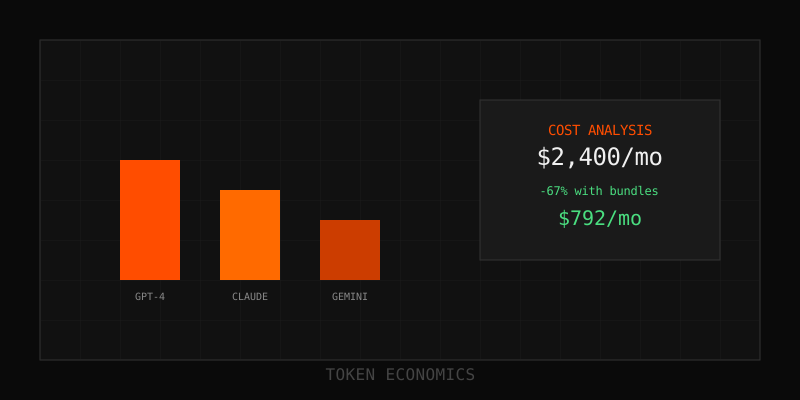
Self-hosting LLMs seems cheaper on paper—$0.50/M tokens vs. $2.50/M for APIs. But hidden costs (infrastructure, DevOps, opportunity cost) flip the equation. Break-even analysis for 2025 shows APIs win below 500M-1B tokens/month. Above that, self-hosting justifies dedicated operations. Here's the full TCO breakdown.
The surface-level cost comparison (misleading)
Simple math suggests self-hosting wins: Run Llama 4 on owned hardware for ~$0.50-$1.00 per million tokens. OpenAI GPT-4o costs $2.50/M. Anthropic Claude Sonnet: $3.00/M. At 1B tokens/month, that's $500-$1,000 self-hosted vs. $2,500-$3,000 API. Savings: 67-80%.
Reality is far more complex. Self-hosting hides infrastructure, engineering, operational, and opportunity costs. When fully loaded, self-hosting effective cost is $3-$8 per million tokens for most teams—higher than APIs until you reach massive scale.
Total Cost of Ownership (TCO): API vs. self-hosting
API costs (fully loaded)
| Cost Category | Description | Example (1B tokens/month) |
|---|---|---|
| Token pricing | Per-token API charges | $2,500/month (GPT-4o at $2.50/M) |
| Request overhead | Network egress, API calls | $50-$100/month |
| Monitoring | Observability tools (Datadog, etc.) | $100-$200/month |
| Integration effort | Initial setup (amortized) | $200/month (5 days eng time / 24 months) |
| Total | $2,850-$3,000/month |
Self-hosting costs (fully loaded)
| Cost Category | Description | Example (1B tokens/month) |
|---|---|---|
| GPU infrastructure | 4x A100 GPUs (cloud or owned) | $3,000-$6,000/month |
| Compute (CPU, RAM) | Supporting infrastructure | $500-$1,000/month |
| Storage | Model weights, logs, backups | $200-$400/month |
| Network/egress | Data transfer costs | $100-$300/month |
| DevOps/ML Ops (0.5 FTE) | Maintenance, monitoring, updates | $5,000-$8,000/month (blended salary) |
| Initial setup | Infrastructure, tuning (amortized) | $500-$1,000/month (30 days / 24 months) |
| Opportunity cost | Engineering focus vs. product | $1,000-$3,000/month (variable) |
| Total | $10,300-$19,700/month |
Break-even analysis: when does self-hosting make sense?
Scenario 1: Low volume (100M tokens/month)
API cost: 100M × $2.50/M = $250/month (GPT-4o)
Self-hosting cost: $10,300-$19,700/month (infrastructure + ops)
Self-hosting effective cost per M tokens: $10,300 / 100M = $103/M (41x more expensive)
Verdict: API wins decisively. Self-hosting infrastructure overhead dominates at low volumes.
Scenario 2: Medium volume (500M tokens/month)
API cost: 500M × $2.50/M = $1,250/month
Self-hosting cost: $10,300-$19,700/month
Self-hosting effective cost per M tokens: $10,300 / 500M = $20.60/M (8x more expensive)
Verdict: API still wins. Infrastructure fixed costs too high relative to usage.
Scenario 3: High volume (5B tokens/month)
API cost: 5,000M × $2.50/M = $12,500/month
Self-hosting cost: $10,300-$19,700/month (same infrastructure handles 5B tokens)
Self-hosting effective cost per M tokens: $10,300 / 5,000M = $2.06/M (18% cheaper than API)
Verdict: Self-hosting begins to make financial sense. Savings: $2,200-$12,800/month (18-63%).
Scenario 4: Very high volume (20B tokens/month)
API cost: 20,000M × $2.50/M = $50,000/month
Self-hosting cost: $18,000/month (scaled infra: 12x A100s, 1.5 FTE ops)
Self-hosting effective cost per M tokens: $18,000 / 20,000M = $0.90/M (64% cheaper)
Verdict: Self-hosting wins decisively. Savings: $32,000/month ($384k/year).
The hidden costs of self-hosting
1. Engineering opportunity cost
Self-hosting requires 0.5-2 FTE for ongoing operations (model updates, infrastructure tuning, monitoring, incident response). That engineering capacity could ship product features instead.
Quantifying: If 1 engineer generates $500k/year in product value, diverting 0.5 FTE costs $250k/year ($20k/month) in foregone revenue/features. This dwarfs infrastructure savings until you reach 10B+ tokens/month.
2. Reliability and uptime
Major API providers (OpenAI, Anthropic, Google) offer 99.9%+ uptime SLAs, geographic redundancy, and instant failover. Self-hosting requires building equivalent reliability—expensive and complex.
Real cost: Downtime during a revenue-critical event (product launch, sales campaign) can cost $10k-$100k+ in a single incident. APIs shift this risk to providers with far deeper pockets for redundancy.
3. Model updates and maintenance
API providers ship new models monthly (GPT-4 → GPT-4o → GPT-5). You automatically benefit. Self-hosting requires manual updates—downloading new weights (100-400 GB), retuning infrastructure, validating quality.
Effort: 2-5 engineering days per major model update. At 4 updates/year: 8-20 days ($10k-$25k labor cost annually).
4. Security and compliance
Self-hosting puts data security entirely on your team. Requirements: encryption at rest/transit, access controls, audit logs, vulnerability patching, SOC 2/ISO compliance for enterprise customers.
Effort: Initial: 10-30 days. Ongoing: 0.25 FTE for security/compliance. APIs offer pre-certified environments (SOC 2, HIPAA, FedRAMP) included in pricing.
5. Model performance tuning
Achieving API-equivalent latency and throughput requires expertise in quantization, batching, KV cache optimization, GPU memory management. Most teams initially see 2-5x worse performance than advertised benchmarks.
Effort: 5-20 days tuning per model. Requires specialized ML engineering skills ($200k+ salaries).
When self-hosting makes sense (despite higher TCO)
1. Data privacy and compliance
Use case: Healthcare (HIPAA), defense (ITAR), financial services with strict data residency requirements, proprietary IP concerns.
Justification: Regulatory fines ($10M+) or competitive leaks far exceed infrastructure costs. Self-hosting keeps data on-premise/in controlled environments.
2. Extreme volume (>10B tokens/month)
Use case: Large enterprises (Google-scale search, Meta-scale content moderation).
Justification: At 50B tokens/month, API costs $125k/month vs. $30k self-hosted (76% savings). Annual savings $1.14M justify dedicated ML Ops team.
3. Fine-tuning and customization
Use case: Domain-specific models (legal, medical, code) requiring extensive fine-tuning on proprietary data.
Justification: Self-hosting enables unlimited fine-tuning iterations. APIs charge $3-$10/M tokens for fine-tuning data, quickly exceeding infrastructure costs for large datasets.
4. Air-gapped environments
Use case: Military, critical infrastructure, offline systems.
Justification: No API access available. Self-hosting is the only option.
5. Multi-year strategic bet
Use case: AI-native companies (Jasper, Copy.ai) where LLMs are core product infrastructure, not a feature.
Justification: Control over roadmap (custom architectures, bleeding-edge research), immunity to API pricing changes, competitive differentiation.
Hybrid approaches: the pragmatic middle ground
Most teams should start with APIs and selectively self-host high-volume, privacy-sensitive, or fine-tuned workloads. This minimizes upfront investment while capturing self-hosting benefits where they matter.
Hybrid architecture pattern
- Customer-facing (low latency, high reliability): API (GPT-4o, Claude). SLA guarantees worth premium.
- Batch processing (high volume, latency-tolerant): Self-hosted Llama. 50-70% cost savings at scale.
- Sensitive data processing: Self-hosted on-prem. Compliance requirement.
- Experimental features: API. Fast iteration, no infrastructure overhead.
Example: E-commerce recommendation engine
Real-time product recommendations (500M tokens/month, user-facing): Claude API ($1,500/month). Latency-critical, high reliability needed.
Nightly catalog enrichment (5B tokens/month, batch): Self-hosted Llama ($2,000/month). Would cost $12,500 via API (84% savings).
Total hybrid cost: $3,500/month. All-API: $14,000/month. All self-hosted: $12,000/month + complexity. Hybrid wins on cost + simplicity.
Decision framework: API vs. self-hosting
Choose API if:
- Volume < 1B tokens/month
- Team < 10 engineers (limited ops capacity)
- Rapid iteration critical (startups, MVPs)
- Reliability > cost (customer-facing applications)
- No specialized compliance requirements
Choose self-hosting if:
- Volume > 5B tokens/month (economies of scale)
- Data privacy/compliance mandates on-premise
- Heavy fine-tuning on proprietary data
- Air-gapped environment (no API access)
- Multi-year commitment to AI as core infrastructure
Choose hybrid if:
- Mixed workloads (latency-critical + batch processing)
- Volume 500M-5B tokens/month (transition zone)
- Some privacy-sensitive data, some not
- Want optionality without full commitment
Cost optimization strategies for each approach
API optimization
- Prompt caching: 50-90% savings on repeated context (Thread Transfer: 40-80% token reduction via bundling).
- Model routing: Use cheaper models (Haiku, GPT-3.5) for simple tasks. 40-60% blended cost reduction.
- Batch processing: Use batch APIs (50% discount) for non-urgent workloads.
- Compression: Minimize tokens via careful prompt engineering, remove verbosity.
Self-hosting optimization
- GPU utilization: Target 80%+ utilization via batching, multi-tenancy. Every 10% utilization = 10% cost reduction.
- Quantization: Use 4-bit/8-bit quantized models. 2-4x throughput, 50-75% memory savings (slightly lower quality).
- Spot instances: Use preemptible VMs for batch workloads. 60-90% cloud GPU savings.
- Model selection: Smaller models (Llama 3.1 8B vs. 70B) for simple tasks. 5-10x cost reduction with minimal quality loss.
Real-world TCO examples
Case 1: Series A startup (200M tokens/month)
API (GPT-4o): $500/month + $100 monitoring = $600/month.
Self-hosting: $11,000/month (infrastructure + 0.5 FTE ops).
Decision: API. Self-hosting 18x more expensive. Engineering focus better spent on product.
Case 2: Series C SaaS (3B tokens/month)
API (Claude Sonnet): 3,000M × $3/M = $9,000/month.
Self-hosting: $12,000/month (infrastructure + ops).
Decision: Borderline. API chosen for reliability + speed to market. Revisit at 5B+ tokens.
Case 3: Large enterprise (25B tokens/month)
API (GPT-4o): 25,000M × $2.50/M = $62,500/month.
Self-hosting: $22,000/month (16x A100s + 2 FTE ops).
Decision: Self-hosting. Saves $40,500/month ($486k/year). Justifies dedicated ML Ops team.
Case 4: Healthcare AI (500M tokens/month, HIPAA)
API (Claude with BAA): 500M × $3/M = $1,500/month + compliance overhead.
Self-hosting (on-prem): $15,000/month (infrastructure + compliance + ops).
Decision: Self-hosting despite higher cost. HIPAA compliance easier on-prem. Regulatory risk > $13,500/month premium.
Closing thoughts
Self-hosting LLMs appears cheaper but hides massive operational costs. True break-even: 5B-10B tokens/month for most teams. Below that, APIs win on TCO, reliability, and engineering velocity. Above it, economies of scale justify dedicated ML Ops infrastructure.
Most teams should default to APIs initially. Evaluate self-hosting only when volume exceeds 1B tokens/month, compliance mandates it, or AI is strategic infrastructure (not a feature). Hybrid approaches capture best of both: APIs for customer-facing, self-hosting for high-volume batch processing.
Combined with prompt caching (50-90% savings), bundling (Thread Transfer: 40-80% token reduction), and smart routing (40-60% savings), API-based architectures routinely achieve 70-90% cost optimization without infrastructure complexity.
Need help modeling TCO for your workload or architecting hybrid API/self-hosted infrastructure? Reach out.
Learn more: How it works · Why bundles beat raw thread history