
Thread Transfer
Enterprise AI Deployment: From POC to Production
Average CPU utilization: 10%. Memory: 23%. 90% of compute wasted while teams struggle to ship. Here's the enterprise AI deployment playbook.
Thread Transfer
AI Systems for Builders
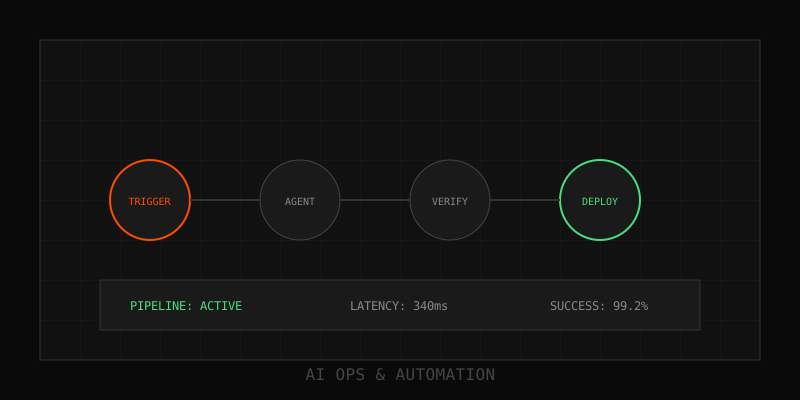
80% of organizations now run Kubernetes in production, but only half are successfully deploying AI workloads at scale. The gap between infrastructure readiness and production AI deployment is wider than most teams expect. Average CPU utilization sits at 10%, memory at 23%—meaning 90% of compute resources are wasted while teams struggle to ship models that actually solve business problems.
The enterprise AI deployment landscape in 2025
Enterprise AI is no longer experimental. 85% of organizations use AI services, with 37% managing over 100 Kubernetes clusters and 12% exceeding 1,000 clusters. Multi-cluster, hybrid cloud deployments are the norm—48% operate across four or more environments. The technology stack is mature. The deployment patterns are not.
The CNCF launched its Certified Kubernetes AI Conformance Program in November 2025, standardizing how AI workloads run reliably across infrastructure. But certification alone won't fix the core deployment failures: insufficient governance, brittle pipelines, security gaps, and context loss between development and production.
Core deployment patterns that scale
GitOps for AI infrastructure
GitOps adoption is now standard for Kubernetes config management, with ArgoCD and Flux dominating tooling choices. For AI deployments, GitOps provides version control on infrastructure changes, automated rollback on failures, and drift detection when production diverges from declared state.
Critical GitOps implementation checklist:
- Declarative infrastructure definitions stored in Git repositories
- Automated sync between Git state and Kubernetes clusters
- Pull-based deployment agents (ArgoCD/Flux) for security isolation
- Immutable deployment artifacts with versioned model registries
- Automated rollback triggers on health check failures
MLOps integration patterns
MLOps automates model deployment, monitoring, and retraining to maintain production performance. Unlike traditional DevOps, MLOps tracks model drift, data quality degradation, and prediction latency alongside standard infrastructure metrics.
Production MLOps architecture requires:
- CI/CD pipelines with automated model testing and validation gates
- Model registries with versioning, lineage tracking, and approval workflows
- Feature stores for consistent training/serving data pipelines
- Real-time monitoring for accuracy drift, data skew, and latency
- Automated retraining triggers when performance degrades below thresholds
Modular AI system architecture
Breaking AI systems into independent, composable components reduces deployment complexity and improves fault isolation. Microservices architecture packages functionality into small services communicating through defined APIs, allowing teams to deploy, scale, and debug components independently.
Architecture blueprint:
# Model serving service
apiVersion: apps/v1
kind: Deployment
metadata:
  name: model-inference
spec:
  replicas: 3
  template:
    spec:
      containers:
      - name: triton-server
        image: nvcr.io/nvidia/tritonserver:24.12-py3
        resources:
          limits:
            nvidia.com/gpu: 1
      nodeSelector:
        gpu-type: nvidia-a100

# Feature preprocessing service
apiVersion: apps/v1
kind: Deployment
metadata:
  name: feature-processor
spec:
  replicas: 5
  template:
    spec:
      containers:
      - name: processor
        image: company/feature-processor:v2.3
        resources:
          requests:
            cpu: "2"
            memory: "4Gi"
GPU resource management
40% of organizations plan to expand orchestration tooling to better manage GPU resources. GPU availability drives AI deployment success—but misconfigured clusters waste budget and create bottlenecks.
GPU infrastructure setup
Prerequisites before deploying GPU workloads:
- Kubernetes cluster with GPU support (EKS, GKE, AKS, or on-premises)
- NVIDIA GPU Operator installed for automatic driver/runtime management
- Container registry with GPU-enabled base images
- Node pools configured with appropriate GPU instance types
- Resource quotas to prevent runaway workload costs
Cost optimization strategies
Region and availability zone selection can reduce GPU costs by 2-7x compared to average spot prices. Organizations using mixed On-Demand and Spot instances realize 59% average savings, while Spot-only clusters achieve 77% savings. Azure users save up to 65% with Arm CPUs for non-GPU workloads.
GPU cost control checklist:
- Profile workloads to right-size GPU type (T4 vs A100 vs H100)
- Implement GPU sharing for inference workloads with low utilization
- Use node autoscaling to release idle GPU nodes within minutes
- Schedule batch training jobs during off-peak hours on spot instances
- Monitor GPU memory utilization—most inference workloads use under 40%
Security and compliance architecture
The enterprise AI governance market reached $9.5B in 2025, growing at 15.8% CAGR. Governance platforms hold 48% market share as organizations demand integrated solutions for compliance, security, and risk management. By 2026, half the world's governments will enforce AI laws requiring enterprises to demonstrate responsible AI use.
Access control and zero trust
SANS guidelines require six control categories for secure AI deployment. Access controls must implement:
- Least privilege access—users, APIs, and systems receive only necessary permissions
- Zero trust architecture—continuously verify all interactions with AI models
- Multi-factor authentication for model deployment and configuration changes
- Service mesh with mutual TLS between all AI system components
- API rate limiting to prevent abuse and data exfiltration
Data protection measures
Protecting data throughout the AI lifecycle prevents bias, corruption, and compliance violations:
- Data integrity validation to prevent poisoning attacks that corrupt model outputs
- Sensitive data segregation—avoid training models on confidential information unless necessary
- Prompt protection—unauthorized prompt access exposes business intelligence
- Encryption at rest and in transit for all training data and model artifacts
- Audit logging for all data access, model queries, and prediction outputs
Model governance framework
40% of technology executives believe their AI governance program is insufficient. Enterprise AI governance requires five characteristics:
- Clear ownership: Designated AI governance group with senior accountable owner and named model owners
- Risk-based controls: Classify AI use cases by risk level with proportional testing, documentation, and monitoring requirements
- Lifecycle governance: Oversight from initial design through deployment, monitoring, and continuous improvement
- Regulatory compliance: Alignment with ISO 27001, ISO 42001, NIST AI RMF, and regional regulations like EU AI Act
- Continuous monitoring: Real-time compliance dashboards, policy enforcement, and predictive risk analytics
Production deployment checklist
Before promoting AI systems to production, verify:
Infrastructure readiness
- Multi-region deployment for disaster recovery and latency optimization
- Auto-scaling policies tested under load with clear min/max thresholds
- GPU node pools isolated from general compute workloads
- Network policies enforcing least-privilege service communication
- Backup and restore procedures validated monthly
Observability and monitoring
- Distributed tracing with trace IDs propagated through all services
- Model performance dashboards tracking accuracy, latency, and throughput
- Data drift detection comparing production inputs to training distributions
- Alert escalation paths with clear SLA thresholds and on-call rotations
- Cost monitoring dashboards showing token usage, GPU hours, and API costs
Security hardening
- Container images scanned for CVEs before deployment
- Network segmentation separating training, inference, and data storage
- Secrets management using external providers (AWS Secrets Manager, Vault)
- Pod security policies restricting privileged containers and host access
- Regular penetration testing on API endpoints and model interfaces
Compliance validation
- Model cards documenting intended use, limitations, and bias testing results
- Data lineage tracking from source to model training to predictions
- Audit logs retained for regulatory minimum periods (typically 7 years)
- GDPR compliance for EU data subjects—right to explanation, right to deletion
- Regular compliance audits with third-party validation
Disaster recovery and business continuity
Modern disaster recovery leverages Infrastructure as Code and GitOps patterns for rapid, consistent recovery. Organizations using unified telemetry and GitOps automation report 50% less engineering time on disruptions.
Disaster recovery requirements:
- All infrastructure and application configs stored in Git repositories
- Automated recovery pipelines that rebuild environments in under 30 minutes
- Cross-region model registry replication for failover
- Regular disaster recovery drills testing full recovery procedures
- RTO and RPO definitions for each AI service with documented failover processes
AI-augmented operations patterns
In 2025, Kubernetes Operators evolved to include AI-augmented reconciliation—using ML models to predict scaling needs and detect anomalies before they cause outages. Advanced implementations use WebAssembly modules for portable, sandboxed reconciliation logic.
Multi-cluster management shifted from edge case to mainstream requirement. Enterprises running workloads across multiple EKS, AKS, or GKE clusters need Operators managing resources consistently across distributed topology.
Context continuity in production AI
The biggest deployment failure pattern isn't technical—it's organizational. Models lose context during handoffs between development, staging, and production. Ops teams lack visibility into model decisions. Support teams can't debug failures without re-running experiments.
Thread-Transfer bundles preserve complete context across deployment stages. When a model escalates an edge case to human review, the full decision chain travels with it—training data references, feature transformations, intermediate predictions, and confidence scores. No lost context. No debugging from scratch.
Production AI requires production-grade context management. Teams shipping reliable AI deployments treat context as infrastructure—versioned, validated, and portable across every environment.
Need help architecting your enterprise AI deployment? info@thread-transfer.com
Learn more: How it works · Why bundles beat raw thread history